


Three-Zone Flex-Neck Anal Plug with Broad Crescent Safety Base
August 14, 2026
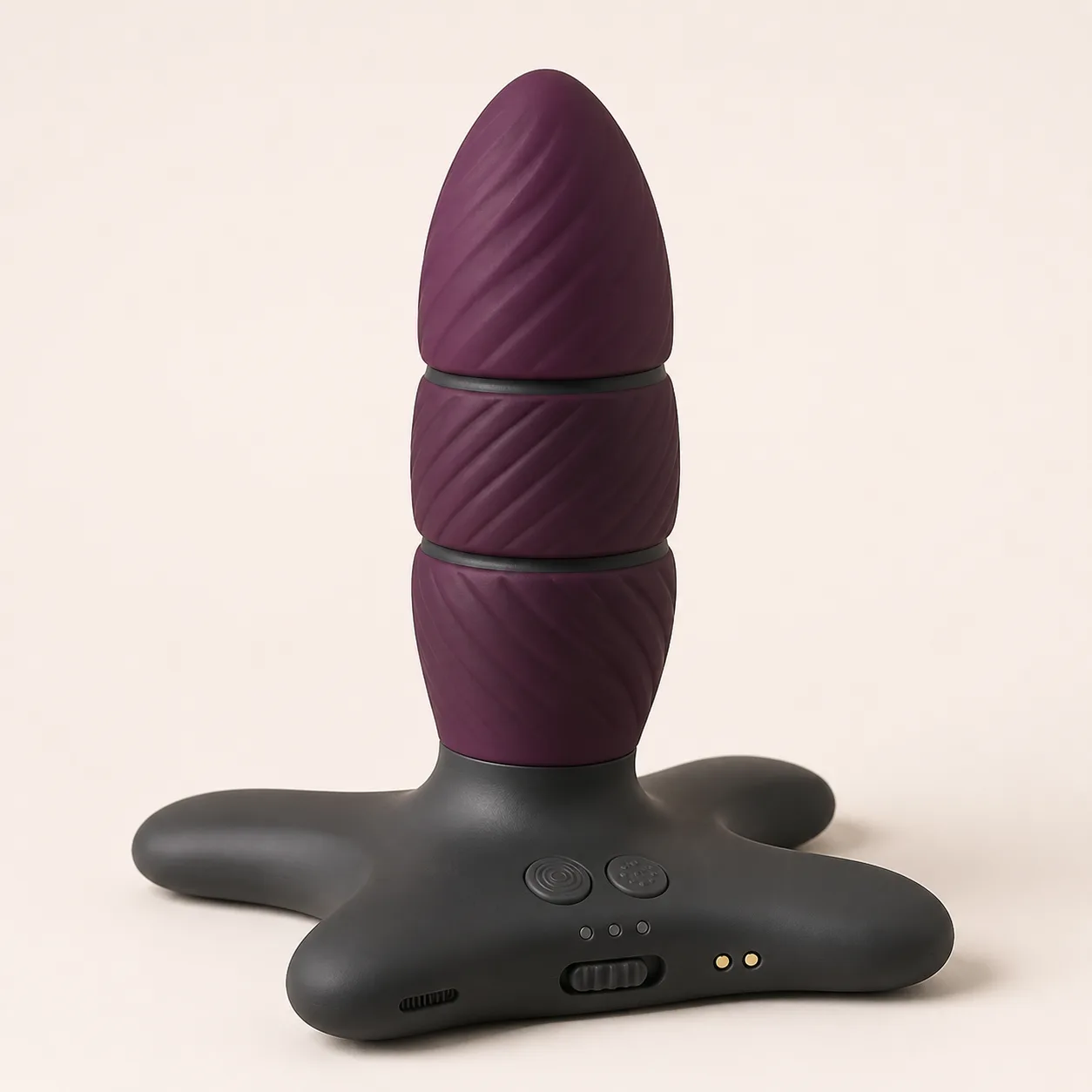
Four-Rib Flex-Cage Anal Plug with Oversized Cross Base
August 14, 2026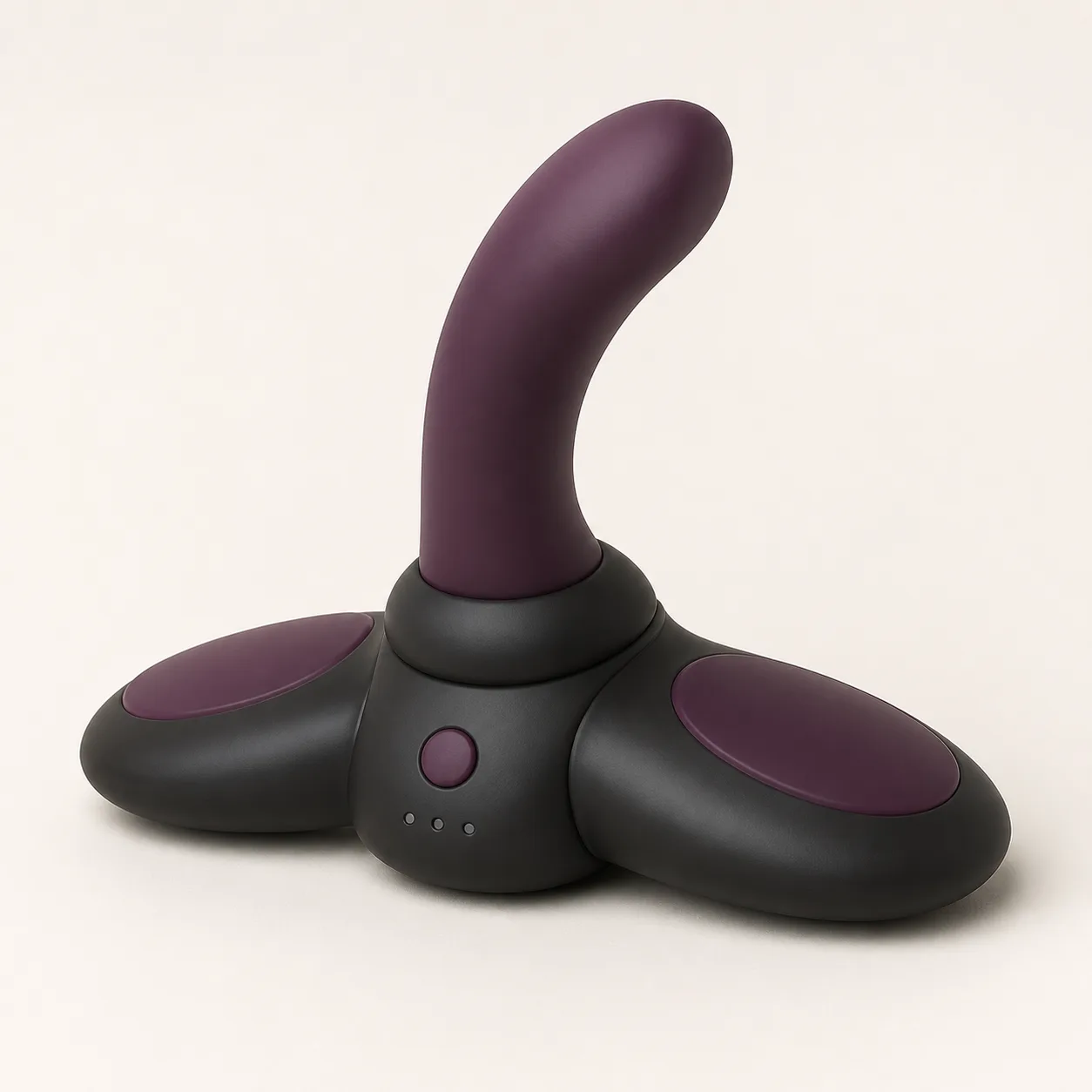
Twin-Rocker Wide-Base Prostate Vibrator with Guarded Flex Stem
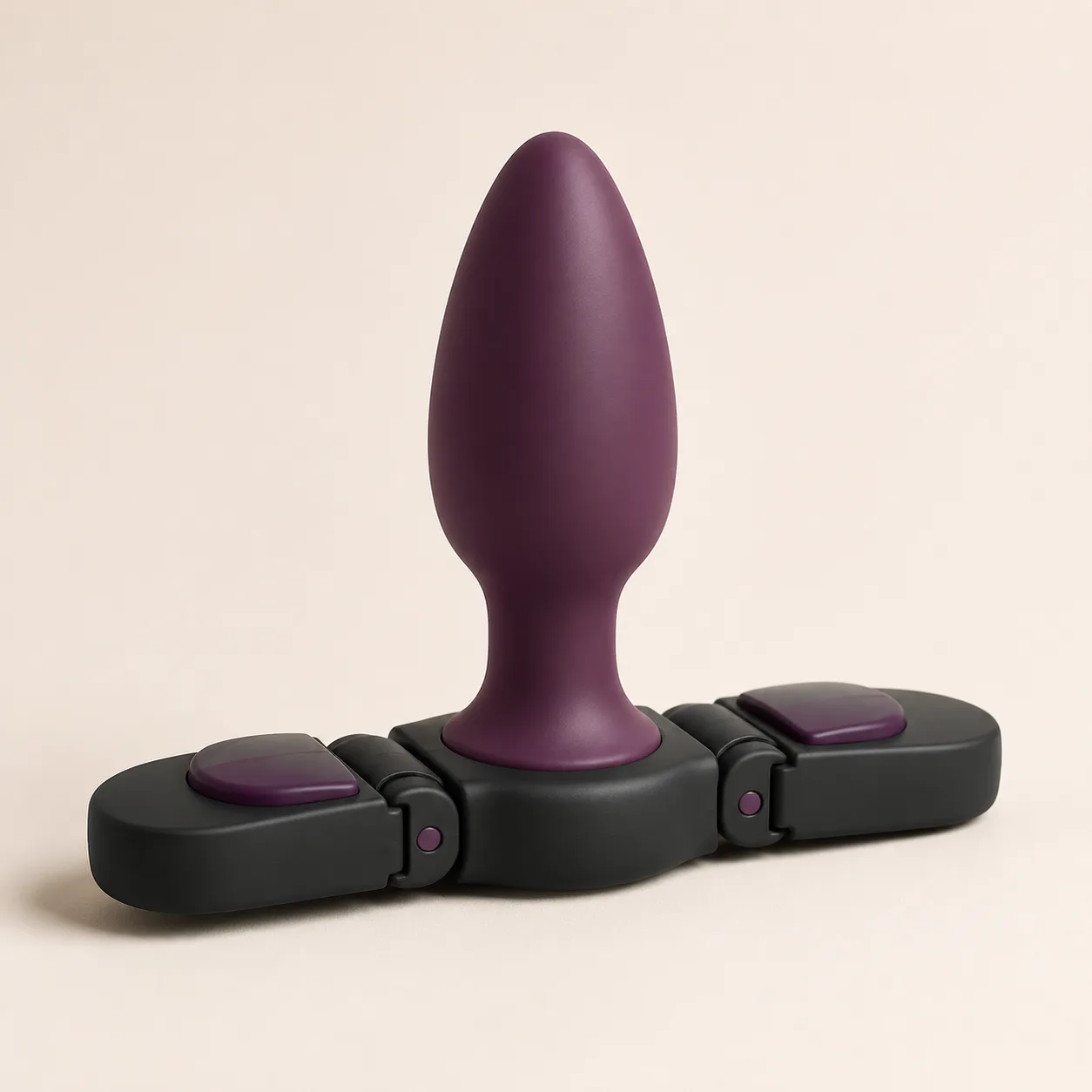
A rechargeable curved-stem vibrator concept with a thick external guard collar and two broad rocker wings for separately testable base stability and transferred output.
37,99 $
200 in stock
Twin rocker wings separate base contact from stem motion
This twin rocker prostate vibrator concept places a short curved stem above a guarded central bridge and two broad external wings. Each wing carries a shallow pad and a slightly different neutral angle, creating a measurable base-motion hypothesis without assuming fit, independent actuation or a specific body position.

The image does not prove insertion dimensions, pivot travel, motor count, wing movement, output, pressure sensing, waterproofing, runtime or safe duration.
Inventory the stem, bridge and two wing joints
Request drawings and a bill of materials for the contact head, stem, internal core if any, guard collar, central bridge, left and right wings, pads, pivots or flexures, stops, actuators, couplings, controller, battery, button, indicators, charging contacts, pigments, seals, lubricants and adhesives.
Confirm whether wing angle is mechanical, flexible or purely visual and identify every conductor that crosses a moving joint.
Measure the insertable profile and external base
Record total and insertable length, tip radius, diameter profile, curve offset, stem-to-collar transition, collar diameter, clear wing span, wing depth and thickness, pad areas, neutral angles, bridge dimensions, mass and control reach.
Compare the largest stem section with the smallest verified external stop span under deformation.
Map the left rocker wing by itself
Support the bridge at defined points and apply small documented loads to the left pad. Measure angular travel, force, rebound, free play, stop contact and displacement transferred into the stem and opposite wing.
Inspect the root for creases, collar lift, seam opening or wire strain.
Map the right rocker wing independently
Repeat the force, angle and recovery measurements on the right side. Compare both wings in two load directions and at several temperatures within supplier limits.
Reject a wing that sticks, bottoms early, twists its pad or fails to recover to the neutral datum.
Verify base stability across asymmetric loads
Place the complete base on a compliant instrumented fixture and apply centered, left-biased and right-biased loads. Record rocking sequence, contact area, slip, bridge lift and whether the guard collar remains clear and accessible.
No stability claim should be published until the broad base stays external under the entire verified envelope.
Characterize stem flex and curve recovery
Use guarded lateral and torsional fixtures to measure stem displacement, local curvature, force and recovery without exceeding confirmed limits. Observe whether base-wing angle changes when the stem bends.
If a core exists, inspect for hard endpoints, migration, surface whitening or permanent lean.
Prove the guard collar limits depth and shields joints
Measure collar reach, thickness, edge radius, deformation and clearance above both wing roots. Probe its perimeter for gaps that could admit hair, film, loose material or residue.
The entire base and collar must remain external, visible and accessible; neither is a suspension, retrieval-cord or depth-adjustment mechanism.
Map vibration along the curved stem
Measure amplitude, frequency, startup, decay, sound and temperature at the tip, outer curve, inner curve, lower stem and collar for every confirmed program and charge level.
Document shell and base transfer so stem output is not confused with structural resonance.
Measure output transferred to both external pads
Place synchronized sensors on the two wing pads while the stem runs in free air and under a low compliant fixture load. Record amplitude, phase, sound and changes at different verified wing angles.
External pads should not be described as independently powered unless separate actuators and control paths are confirmed.
Compare loaded geometry, pressure and slip
Use separate compliant fixtures for the stem and base, within exact-model limits, to log contact pressure, wing rotation, base slip, curve displacement, vibration loss, current and temperature.
Stop testing for hard contact, sudden angle change, collar collapse, wing lift, unusual resistance or loss of control.
Audit the local control and charging system
Document button functions, press duration, lockout, program order, intensity steps, memory, indicator meanings, low-battery response, charging-contact location and polarity, cable specification, charger input, charge time, runtime and operation during charging.
Keep the device off and dry while charging unless exact-model instructions explicitly permit otherwise.
Test current, heat and obstruction response
Run the highest verified program under approved stem and base loads while logging battery current and temperature at the tip, stem root, collar, both wings, bridge, controller, battery and charging contacts.
On a guarded fixture below supplier limits, verify shutdown and restart behavior if a wing or the stem is gently obstructed.
Cycle joints and validate complete cleaning
Run repeated stem flex, left and right wing rocking, compliant-load vibration, power and charging cycles. At planned checkpoints inspect tip, stem, core outline, collar, wing roots, pads, bridge, seams, button and contacts; track motion, stiffness, output, current, heat, cracks and residue.
Obtain exact material, restricted-substance, skin-contact, electrical and battery evidence. Clean every surface, collar edge, wing root and pad seam only by the verified method, then dry fully. Immersion, boiling, alcohol, bleach, abrasives and oils require explicit compatibility evidence.
Price the twin-rocker base after stability tests
An Alibaba vibrating anal plug listing currently shows USD 2.00-2.42 with an MOQ of one piece. It is a category benchmark only and does not confirm this curved stem, twin-rocker base or an approved supplier.
The procurement reference supports an EUR 37.99 planning price after allowing for China-origin freight, exact-part inventory, per-wing force maps, asymmetric base stability, stem flex and recovery, collar retention and pinch review, stem and pad output maps, loaded geometry, current and thermal testing, obstruction response, cycle life, materials and battery documentation, cleaning validation, protective packing and discreet fulfillment. Exact quotation, packed dimensions, weight, freight, duty, tax, insurance, payment fees and delivery terms remain pending.
Frequently asked questions
Do the two base wings move independently?
Independent motion is unconfirmed; each wing, its joint and cross-coupling require measurement.
Are the external pads separately powered?
No. Separate actuators and controls must be proven before any independent-output claim is used.
Is the guard collar wide enough?
That requires exact dimensions, deformation tests and comparison with the stem profile on production samples.
Can the device be worn for a long period?
No duration should be assumed; follow confirmed instructions and stop immediately for pain, numbness, pressure, bleeding, unusual heat or difficulty removing it.
Can it operate while charging?
Only if exact instructions explicitly permit it; otherwise keep it off and dry during charging.
Which faults require retirement?
A cracked stem, exposed core, collapsed collar, loose wing, split root, lifted pad, failed control, unusual heat, battery swelling, corrosion or residue beyond cleaning access.
Reviews
There are no reviews yet.