



Four-Rib Flex-Cage Anal Plug with Oversized Cross Base
August 14, 2026
Three-Band Counter-Rotating Ripple Anal Trainer with Wide Cross Base
August 14, 2026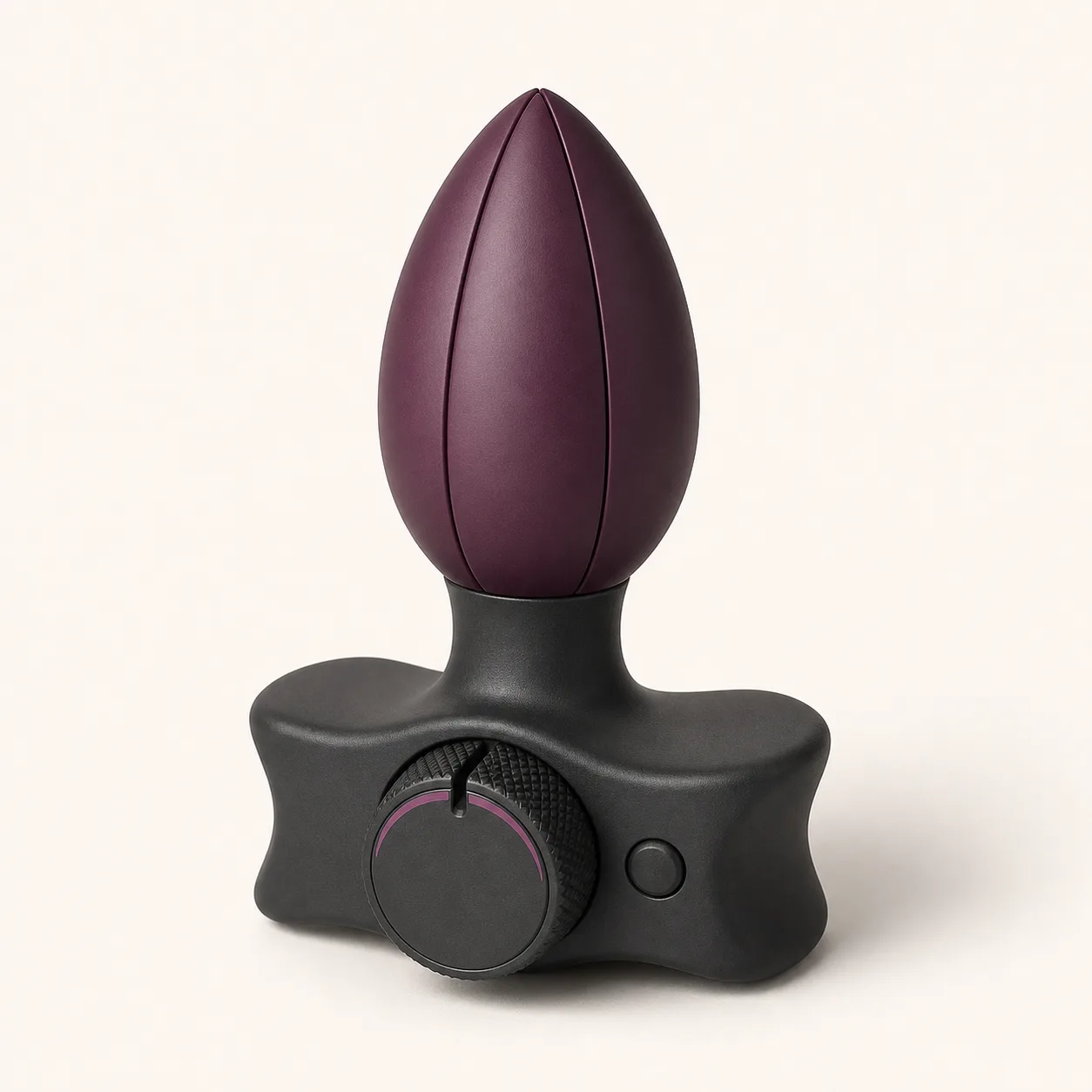
Four-Petal Torque-Limit Expanding Anal Plug with Wide Cross Base
A mechanically adjustable anal plug concept with four closed shell petals, a torque-limit dial, independent release control and oversized cross base.
44,99 $
200 in stock
Start with a fully closed four-petal profile
This torque limit expanding anal plug concept uses four lengthwise shell petals that meet as one tapered head at the minimum setting. A broad external cross base carries a knurled adjustment dial, a visible stop notch and a separate recessed release control.

The image is a design reference, not proof of expansion range, applied force, internal mechanism, pressure relief, materials, ingress resistance, dimensions or production availability.
Build the bill of materials before evaluation
Request an exploded drawing covering the four petals, hinge or flex zones, central spreader, drive screw, nut, torque limiter, dial, stop, release control, spring elements, core, neck, base, fasteners, bushings, seals, pigments, lubricants and adhesives. Every hidden interface needs a part number and replacement rule.
Confirm whether the petals move from one shared spreader or from linked guides, because a single skewed component can change all four contact paths.
Measure the minimum geometry first
At the verified minimum setting, record total length, insertable length, maximum head width, neck width, cross-base span, base thickness, dial projection, mass, taper angles and tip radius. Measure at several temperatures after conditioning.
Use go/no-go gauges and profile scans to detect a petal that sits proud, a seam that widens or a core that remains partially deployed.
Inspect every seam and edge
Number the four seams relative to the dial. Measure closed-gap width, depth, edge radius, alignment, surface step and contamination access from tip to neck under magnification.
Reject sharp transitions, exposed hardware, pinching closure, debris traps or any configuration that produces a hard ledge while the dial is moving.
Map the dial against actual movement
Mark the physical minimum, intermediate points and mechanical maximum without treating decorative graphics as calibrated settings. Record dial angle, torque, backlash, audible or tactile detents and petal displacement at each point.
Repeat clockwise and counter-clockwise so hysteresis, missed engagement and uneven motion are visible rather than averaged away.
Measure expansion in two axes
Capture major and minor diameter, perimeter, tip position, neck transition and inter-petal gap at each verified dial point. Compare unloaded readings with a compliant cylindrical fixture.
Stop if one petal advances early, twists, rocks, binds or leaves an exposed internal edge. A nominal diameter alone cannot describe an asymmetric profile.
Characterize the torque limiter
Measure breakaway, steady and release torque using calibrated tooling at multiple settings, temperatures and cycle counts. Establish whether the limiter slips, clicks, disengages or merely reaches a hard stop.
A comfortable-feeling dial is not evidence of a safe force ceiling; correlate torque with actual radial load and local pressure.
Map radial pressure across all petals
Use a compliant instrumented sleeve to record contact pressure under each petal, beside every seam and near the widest zone while advancing in small verified increments. Hold each setting long enough to observe creep.
Compare centered and slightly offset fixtures, then define conservative operating limits from the highest local pressure rather than the four-petal average.
Verify external-base retention
Measure cross-base width, corner radius, bending stiffness, neck junction strength and resistance to folding through representative fixtures. Confirm the base stays visibly and mechanically external in every approved orientation.
Expansion must never substitute for a dependable external stop; halt testing if the base curls, cracks, rotates onto an edge or narrows under load.
Prove the stop and release sequence
Document the exact steps for halting adjustment, activating the recessed release and confirming the head has reached the minimum profile before removal. Test the sequence with gloved hands and without visual access.
Evaluate a jammed dial, partial release, lost grip and interrupted motion using compliant fixtures only. The device needs a clear manual recovery method that does not require increased expansion.
Cycle the mechanism under realistic contamination
Run repeated close, insert-fixture, staged expansion, hold, release, minimum-confirmation, extraction, cleaning, drying and storage cycles. At checkpoints measure geometry, torque, pressure, seam steps, dial backlash, base stiffness and release time.
Retire a sample after petal mismatch, seam damage, growing backlash, limiter drift, incomplete closure, release delay, core exposure, base damage or abnormal residue retention.
Verify materials and chemical compatibility
Obtain exact composition and restricted-substance evidence for every accessible surface, internal lubricant, pigment, seal and adhesive. Do not infer composition from color, feel or an uncited supplier label.
Test only documented compatible lubricants and cleaners, then inspect swelling, tack, whitening, cracking, seam distortion, torque change and bond loss after conditioning.
Clean and dry the closed and open states
Follow an approved cleaning method while inspecting tip seams, petal edges, neck junction, dial perimeter, release recess and base corners. If limited opening is required for access, use a fixture and keep fingers away from closing gaps.
Measure drying by mass and examine hidden channels for retained liquid before closure or storage. Immersion remains unapproved until exact ingress evidence exists.
Define packaging and landed logistics
Specify a transit restraint that keeps the dial at verified minimum without loading the petals or release control. Packaging must prevent abrasion, contamination, dial movement and base deformation while remaining discreet.
Record packed dimensions and weight before estimating China-origin freight. Duty, tax, insurance, payment charges, inspection, labeling, documentation and delivery terms remain pending.
Price only after the expansion system is proven
An Alibaba anal-plug wholesale page currently shows broad category examples from USD 3.26 to 13.04 with MOQ ten. This is a market benchmark only and does not confirm the illustrated four-petal mechanism, torque limiter, release control, approved materials or legal supplier.
The procurement reference supports an EUR 44.99 planning price after allowing for exact-model sourcing, teardown, profile metrology, seam inspection, two-axis expansion maps, dial and limiter characterization, pressure mapping, base-retention tests, failure recovery, cycle testing, material evidence, cleaning validation, protective packing and discreet fulfillment. Final quotation and every unverified cost remain pending.
Frequently asked questions
How many usable settings does the dial provide?
No setting count is claimed until dial angle, detents, movement and repeatability are measured on exact samples.
Does the torque limiter guarantee a pressure ceiling?
No. Limiter torque must be correlated with radial force and local pressure across temperatures and cycle life.
Can the petals be adjusted while loaded?
Only an approved instruction and instrumented risk review can establish a safe adjustment sequence.
What must happen before removal?
The head must be independently confirmed at its verified minimum profile and the mechanism must not be jammed or partly released.
Is the device waterproof?
No ingress claim is made; use only the documented cleaning method supplied for the exact production sample.
Which faults require retirement?
A sharp seam, uneven petal, incomplete closure, exposed core, drifting limiter, jammed dial, delayed release, damaged base or incompatible surface change.
Reviews
There are no reviews yet.