



Three-Band Counter-Rotating Ripple Anal Trainer with Wide Cross Base
August 14, 2026
Twin-Spine Four-Bead Stiffness-Indexed Anal Trainer
August 14, 2026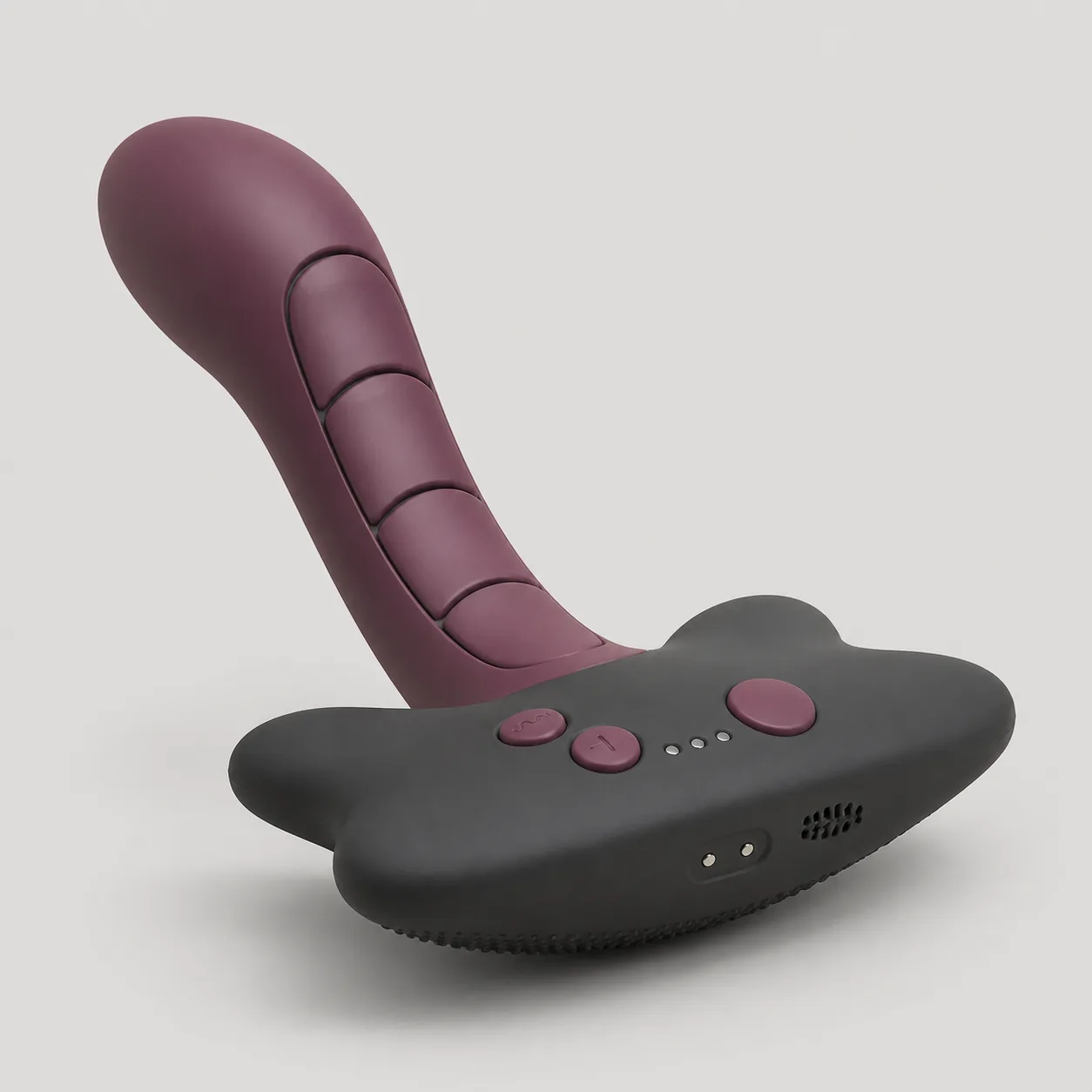
Four-Zone Segmented-Arc Prostate Vibrator with Wide Halo Base
A curved rechargeable prostate-vibrator concept with four flush contact panels, guarded seams and an exceptionally wide four-lobe halo retrieval base.
57,99 $
200 in stock
Arrange four flush zones along one smooth arc
This four-zone segmented-arc prostate vibrator concept places exactly four low rounded contact panels along the inside of a gently curved plum body. Narrow guarded seams preserve a smooth profile, while an exceptionally wide charcoal halo base provides a clearly external retrieval stop.

The image does not prove insertable dimensions, intended contact location, independent panel motion, motor count, output, pressure, materials, base retention, sealing or production availability.
Inventory the segmented body and base assembly
Request an exploded inventory for the continuous outer skin, panels Z1 through Z4, carriers, internal supports, actuator housings, motors, moving masses, isolators, frame, neck core, halo base, controls, controller, indicators, vent, cell, contacts, conductors, seals, pigments, lubricants and adhesives.
Trace shared drives, grounds and supports so four visible panels are not presented as four independent channels without evidence.
Measure insertable profile neck and halo base
Record total and insertable length, tip axes and radii, arc radius, local diameters, panel span, seam width, neck dimensions, base length, width, thickness, lobe projection, mass and center of gravity. Use cross-sections at every panel and transition.
Confirm that the external base remains substantially wider than the narrowest adjacent neck in every orientation and load state.
Characterize panels Z1 through Z4
For each zone, measure length, width, crown, edge blend, flushness, hardness, compression, recovery, friction, skin thickness and bond uniformity. Preserve exact zone identity in inspection and output reports.
Check for thin edges, voids, hard inclusions, proud corners, pigment transfer, swelling, tack and permanent set after specified cleaning and storage.
Inspect seam continuity and edge transitions
Map seam width, depth, end geometry and opening movement while the body is neutral, flexed and gently compressed. Use magnification, soft film and articulated probes to identify sharp lips, capture paths and residue traps.
A visual line is not proof of a sealed interface; ingress and cleaning access require exact-model testing.
Resolve motor allocation and zone output
Determine whether the body contains one actuator, multiple actuators or passive transfer panels. Synchronize three-axis accelerometers on Z1-Z4, the tip, neck and base to measure amplitude, frequency, harmonics, startup, decay and cross-zone transmission.
Repeat free and under a compliant standardized load, noting any panel that bottoms against a hard carrier or loses output when a neighboring zone is restrained.
Map timing phase and loaded transfer
For every confirmed program, record relative phase, beat frequency, drift, direction cues, transition latency and stop order across all four zones. Compare fresh charge, low charge and stabilized temperature.
Measure body flex and pressure at the same time so apparent timing differences are not artifacts of shifting fixture contact.
Verify controls immediate stop and lockout
Document startup, intensity, program change, pause, immediate stop, memory, restart and transport lockout from the external base. Check wet and dry access without covering the retrieval lobes.
Challenge long presses, simultaneous inputs, low voltage, controller reset and charging connection; a local full stop must remain clear and predictable.
Measure flex stiffness and base-junction strain
Apply bounded axial, lateral, bending and torsional fixture loads while measuring tip displacement, arc change, neck strain, panel-edge movement, base rotation and residual set. Stop before damage.
Inspect the body-to-base junction for stress concentration, whitening, delamination, cracks or progressive softening through cycle life.
Map pressure along the complete arc
Use graded compliant fixtures to record contact footprint, peak pressure, load sharing, edge engagement and local shear at each zone under multiple orientations and conservative preloads. State fixture geometry and stiffness.
Do not translate fixture maps into guaranteed fit, stimulation location or therapeutic benefit.
Verify halo retrieval geometry and handling
Measure all four external lobes, under-base grip texture, flex, twist, pull direction, control reach and base-to-neck junction under dry and damp conditions. Confirm that no control recess materially reduces the stop geometry.
Use only within a verified fit envelope; stop for sharp pain, numbness, persistent bleeding, unusual swelling or loss of external control.
Verify battery charging and ingress boundaries
Confirm cell chemistry and capacity, specified input, contact polarity, alignment, retention, protection circuits, charge time, runtime, low-voltage shutdown, charging interlock and transport requirements. Inspect wiring through the curved body and base junction.
Map boundaries at the panels, seams, neck, buttons, stop, indicators, vent, contacts and base. No water-resistance claim is accepted without exact-model evidence.
Log current sound and temperature
Measure current, A-weighted sound and temperatures at every panel, tip, neck, base junction, controls, controller, cell, contacts and vent for each confirmed program under free and compliant load.
Investigate zone imbalance, clicking seams, frame resonance, rising current, abnormal base heating or thermal throttling that changes output.
Challenge faults then cycle clean and inspect materials
In protected fixtures, restrain one panel, bias the arc, obstruct the vent, simulate a loose panel carrier and interrupt power. Stop before damage and quarantine units with delayed shutdown, hard-part exposure, junction cracks, abnormal heat or cell change.
Cycle output, immediate stop, bounded flex, charging, specified cleaning, measured drying and storage. Recheck geometry, panel flushness, seams, output, phase, pressure, base junction, current, sound, heat and odor. Exact composition, restricted-substance and certification evidence remains pending.
Build landed price after four-zone proof
An Alibaba silicone-prostate-massager page currently shows a rechargeable category example at USD 5.50-5.90 with MOQ four. It is a benchmark only and does not confirm this four-panel arc, halo base or an approved supplier.
The procurement reference supports an EUR 57.99 planning price after allowing for China-origin freight, exact-sample sourcing, insertable and four-zone metrology, drive and phase mapping, seam, flex, pressure and base-retention review, controls, charging, current, sound, heat, protected faults, cycle work, protective packing and discreet fulfillment. Exact quotation, MOQ, materials, battery, packed size, weight, freight, duty, tax, insurance, payment fees, certifications and delivery terms remain pending.
Frequently asked questions
Does each panel have a separate motor?
That is unconfirmed; teardown and synchronized measurements must establish motor count and mechanical transfer.
Are the seams open gaps?
The concept shows narrow guarded divisions, but seam depth, movement, sealing and cleaning access require sample inspection.
What is the insertable size?
All dimensions and the acceptable fit envelope remain pending exact-model measurement.
Why is the halo base so wide?
It is intended as an external retrieval stop, but lobe dimensions, stiffness and retention must still be verified.
Is the product waterproof?
No ingress claim is confirmed; panels, seams, controls, vent, contacts and the body-to-base junction need evidence.
Which defects require retirement?
Raised or loose panels, opened seams, neck or base cracks, failed stop or lockout, exposed hard parts, abnormal sound or heat, damaged contacts, cell swelling or persistent residue.

Reviews
There are no reviews yet.