



Four-Zone Segmented-Arc Prostate Vibrator with Wide Halo Base
August 14, 2026
Five-Fin Tapered Anal Plug with Narrow Neck and Wide T Safety Base
August 14, 2026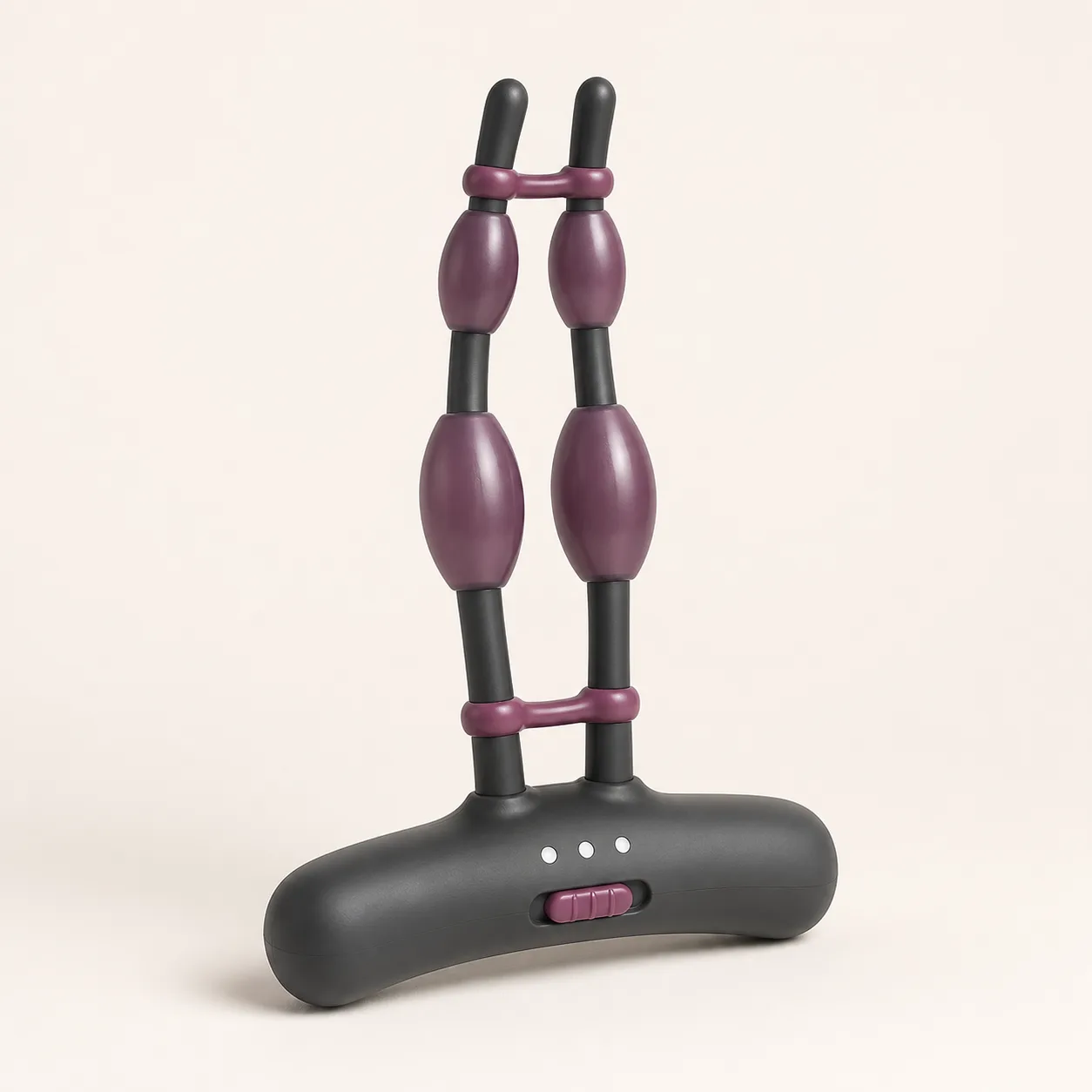
Twin-Spine Four-Bead Stiffness-Indexed Anal Trainer
A twin-spine anal trainer concept with four graduated oval beads, two stabilizing cross-links, a wide T base and three proposed stiffness settings.
46,99 $
200 in stock
Tune two flexible spines beneath four beads
This twin-spine four-bead stiffness-indexed anal trainer concept rises from one wide charcoal T base through exactly two separate flexible stems. Four smoky-plum oval beads form two graduated pairs, while two plum cross-links and a three-dot base slider propose controlled changes to the combined flex profile.

The image establishes a measurable concept and does not confirm dimensions, materials, stiffness states, safety performance or production status.
Name every load-bearing and adjustment element
Label stems S1-S2; rounded tips T1-T2; beads B1-B4; upper and lower cross-links C1-C2; base A0; slider L0; index marks I1-I3; internal tensioner, anchors, shells, pigments and bonds.
Require exact-sample drawings showing continuous load paths from each tip to the non-migrating base.
Measure the wide T base first
Record base length, width, thickness, edge radius, mass, underside shape, bending stiffness and the distance from both stem anchors to every outer edge. Apply centered and offset pull fixtures while logging deflection.
Reject sharp seams, unstable rocking, anchor movement, slider exposure or base dimensions below the approved migration-resistant target.
Characterize spine S1 and spine S2 separately
Measure diameter, free length, straightness, hardness, bending stiffness, torsional stiffness, buckling force and recovery for each stem. Compare bare-stem samples where supplier construction permits.
Reject unequal set, surface cracking, whitening, delamination or anchor rotation.
Verify all four graduated bead profiles
Record B1-B4 maximum diameter, axial length, taper, spacing, edge radius, surface finish and concentricity to its supporting spine. Map the exact order from tip to base.
Four visible beads are not a verified progression until measured geometry and batch tolerances are documented.
Inspect both cross-link collars under flex
Measure C1-C2 span, thickness, attachment, stretch, rotation and clearance to adjacent beads. Bend the two stems together, apart, forward, backward and in torsion while watching collar stress.
Reject tearing, bead contact, collar migration, accessible pinch gaps or hard ridges.
Calibrate the three proposed stiffness states
Map L0 travel and I1-I3 to internal tension, paired-stem bending force, lateral separation and recovery. Approach each state from both slider directions under no load and controlled preload.
Three dots are only visual references until force-displacement curves demonstrate repeatable states.
Build full flex and separation envelopes
Track both tips and all bead centers with optical markers during axial, lateral and torsional fixture loading. Record curvature, stem separation, cross-link strain, base tilt and residual set.
Define hard limits that keep both stems inside the validated material and anchor range.
Test base migration resistance
Use standardized fixtures to apply axial and angled pull through the twin stems while the base rests against bounded compliant apertures. Log base rotation, edge pressure, stem anchor load and slider movement.
No universal retention claim is made; only fixture-specific results with exact base dimensions are acceptable.
Map pressure around paired bead geometry
Use instrumented compliant channels to record contact pressure, bead engagement, stem separation and base reaction in every confirmed stiffness state. Compare centered and modestly offset alignment.
Do not infer comfort or fit from visual symmetry alone.
Confirm materials bonds and surface finish
Request declarations for stems, beads, cross-links, base, slider, internal tensioner, pigments and adhesives. Test odor, color transfer, tack, abrasion, flex cracking, swelling and bond strength on production samples.
No silicone, body-safe, hypoallergenic or certification claim is made while traceable evidence remains pending.
Challenge seams and cleaning access
Apply visible test soil around all bead-to-stem transitions, both collars, twin anchors, base seam and slider recess. Record cleaning access, residue, drying time, swelling, discoloration and odor after repeated wiping.
No immersion or sterilization method is claimed without exact material and construction evidence.
Cycle stiffness flex cleaning and storage
Cycle I1-I3 changes, axial and lateral bending, stem separation, base loading, cleaning, drying and protected storage. Remeasure flex curves, slider retention, collar position, bead bonds, anchor movement and surface condition.
Retire samples for tears, permanent set, loose beads, cross-link damage, slider drift, anchor movement, tack or exposed hard parts.
Specify protective packing and traceability
Prevent both spines from being held bent in transit, isolate the slider and base edges, and define carton dimensions, packed mass, batch code and inspection record. Test vibration, compression and handling.
Final packing, discreet-shipping details and packed weight remain pending supplier and route confirmation.
Build landed price from paired-spine evidence
An Alibaba butt-plug category page showed one plug-set example at USD 1.90 to 2.80 with a one-piece minimum. It is a broad benchmark only and does not identify this twin-spine adjustable trainer or an approved supplier.
The public procurement benchmark supports an EUR 46.99 planning price after provisional allowance for China-origin freight, exact samples, base and bead metrology, twin-spine flex curves, cross-link strain, three-state calibration, pressure and migration fixtures, cleaning, fatigue work, protective packing and discreet fulfilment. Exact supplier, quote, MOQ, dimensions, materials, packed weight, freight, duty, tax, certification, payment terms and lead time remain pending.
Frequently asked questions
How many beads are included?
The concept shows exactly four oval beads arranged as two graduated pairs.
Do the two spines bend independently?
Independent and coupled motion require force-displacement testing with both cross-links installed.
What do the three dots mean?
They propose three stiffness positions whose actual force curves remain pending sample measurement.
Is the base wide enough?
Exact dimensions and migration-resistance results must be confirmed against the approved fixture protocol.
What material is used?
Stem, bead, collar and base composition remain pending traceable supplier declarations.
Which defects require retirement?
Tears, permanent set, loose beads, damaged links, slider drift, anchor movement or exposed hard parts.
Reviews
There are no reviews yet.