



Progressive Weighted Kegel Ball Set
August 14, 2026
Remote Swinging Faux-Fur Fox Tail Anal Plug
August 14, 2026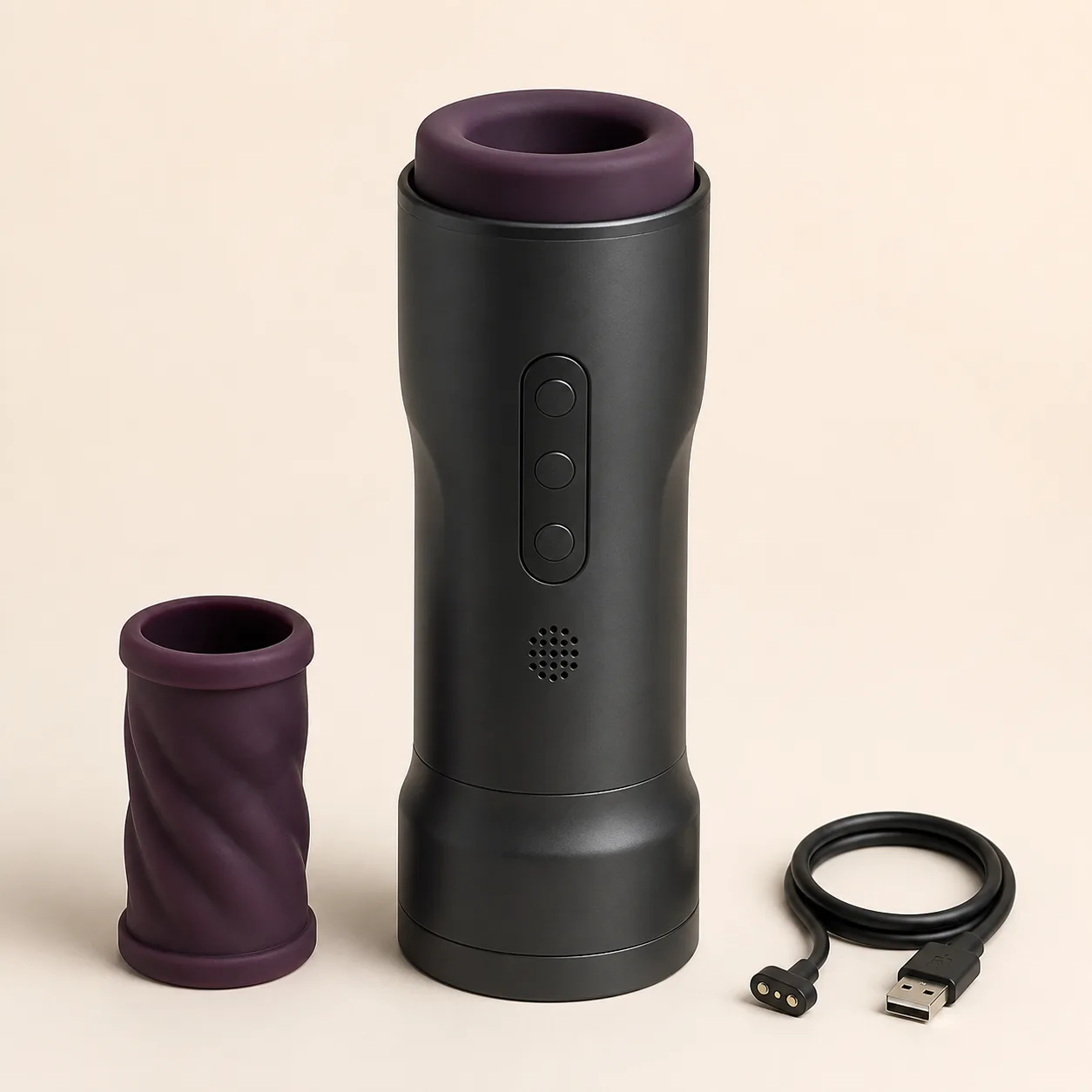
Sound-Responsive Telescopic Male Stroker
A motorized stroker concept with locally overridden sound response, separately mapped telescopic motion and a removable sleeve for complete inspection.
84,99 $
200 in stock
Sound response should be understandable before it is exciting
This enclosed motorized stroker concept combines telescopic motion, adjustable vibration and a sound-reactive input. The audio feature needs a clear explanation: which sounds trigger motion, whether intensity follows volume or rhythm, and how quickly the device settles when sound stops.
The supplier identifies three telescopic states and seven adjustable frequencies. Those counts, the interaction between them and the sound algorithm remain unconfirmed until the exact sample is mapped.

Privacy review starts at the microphone grille
A sound-responsive device does not automatically need to record, save or transmit audio. Test it offline and request a data-flow statement covering the microphone, processor, memory, wireless radios and any companion software.
If the production unit stores clips, connects to a network or exposes identifiable data, that behavior must be disclosed before sale. An unexplained microphone path fails review.
Map the silent state first
In a quiet room, confirm whether the device stays idle, continues the last program or uses a default motion. Measure the delay between silence and motor slowdown, then repeat after power cycling.
A safe stop cannot depend on shouting or producing a particular sound. Local controls must pause all movement immediately.
Build a repeatable audio test set
Use calibrated tones, speech, music and brief transients at controlled sound levels. Record the activation threshold, response lag, stroke change and any unexpected reactions to doors, alarms or nearby conversation.
Testing should cover ordinary background noise as well as intended input. Publishing a sound feature without false-trigger data invites unpredictable motion.
Separate telescoping, rotation and vibration claims
The listing emphasizes telescopic movement and seven adjustable frequencies, while related wording may imply sucking or vibration. Each motor action needs its own button map, measured range and startup behavior.
Do not merge speed levels, patterns and motion axes into a larger marketing number. The customer should know exactly what one press changes.
The sleeve must be checked outside the housing
Remove the soft insert according to the confirmed instructions. Inspect the opening, full channel, closed or open end, seam, wall thickness and locking rim under bright light.
Measure relaxed and gently stretched dimensions without claiming a universal fit. Tears, thin patches, tack, residue or a rim that can detach during operation reject the sleeve.
Fit is established before the motors start
Charge the clean dry device, apply a validated water-based lubricant to the sleeve and enter slowly with all motion off. Stop for pinching, sharp drag, excessive vacuum, numbness or restricted circulation.
Never use telescoping action to overcome resistance. The user must be able to withdraw promptly while holding the housing securely.
Lowest motion reveals alignment problems
Begin with the weakest independently verified setting and a short cycle. Check that the sleeve stays seated, the housing remains stable and the moving assembly does not strike its end stops.
Increase only one control at a time. Pause for pain, reduced sensation, swelling, discoloration, heat, rattling, sudden acceleration or a sleeve that migrates.
Sound mode needs a physical override
Confirm that one reachable local action suspends sound response and motor movement together. Test that command during loud input, low battery, a stalled mechanism and immediately after reconnecting power.
An audio-reactive product should never restart solely because ambient sound resumes after a fault.
Heat and current change under mechanical load
Run defined loaded cycles at each telescopic state and selected vibration levels. Measure the grip, motor zone, sleeve boundary, battery area and charging contacts while logging current and sound.
Stop testing for excess temperature, burnt odor, unstable travel, clicking, sleeve abrasion or battery swelling. Continuous-use limits must come from measured production samples.
Cleaning follows the removable parts
Detach the sleeve without pulling on an internal linkage. Clean both sleeve surfaces using the validated method, rinse only where permitted and leave the channel fully open until dry.
Wipe the housing, rim and control area without flooding the motor cavity, microphone or contacts. Reassembly while damp can trap moisture and distort sound pickup.
Open-ended and sealed sleeves behave differently
An open channel allows easier rinse-through and pressure release; a closed end can retain moisture and create stronger suction. The final product page must match the supplied insert rather than treating both as equivalent.
Any sleeve redesign triggers new fit, seal, cleaning, airflow and durability tests.
Charge without a sleeve installed
After cleaning and drying, place the empty housing on a nonflammable surface and connect the confirmed magnetic lead. Keep the contacts free of lubricant and watch the first charge for heat, odor or unstable indicators.
Do not operate, wash or wear the unit while charging. Cable polarity, input limits, runtime and battery capacity remain pending.
Storage protects the mechanism and microphone
Keep the dry sleeve uncompressed in a separate lint-free pouch. Store the housing upright or flat without loading the telescopic carriage, blocking the sound grille or leaving the cable attached.
Before the next use, confirm free travel, clean sound pickup, immediate local stop and a secure sleeve lock.
Questions about a sound-responsive stroker
Does it record voices?
That is not established. The microphone, storage, radio and data path require documented review.
Can sound be the only stop control?
No. A reachable local control must stop every motor state.
Are three telescopic modes verified?
Not yet. Range, speed and control logic need sample measurement.
What lubricant should be used?
Use only a water-based option validated for the final sleeve composition.
Can the housing be rinsed under a tap?
Not unless the exact assembly has verified ingress instructions covering the microphone and charging contacts.
What ends a session?
Pain, numbness, swelling, discoloration, heat, noise changes, control delay or sleeve movement.
Supplier reference and planned price
Alibaba product 60771615329 identifies SZ Magic Love Tech Limited and model LT95657. Observed listing fields state USB charging, 271 × 98.5 × 85 mm, a 4 cm telescopic distance, three telescopic modes, seven adjustable frequencies, TPE plus ABS, a 14 × 13 × 35 cm single package and 1.600 kg gross weight. Displayed tiers were USD 31.90 for 1–9 pieces, USD 31.40 for 10–49 and USD 29.90 from 50 pieces; stated lead time was seven days for up to 100 pieces.
The planned EUR 84.99 display price provisionally considers a China-origin sample, the listed package mass, freight planning, sleeve inspection, audio privacy and trigger testing, motion mapping, heat/load checks, cleaning validation, discreet packaging, handling and delivery. Exchange rate, freight, duty, tax, final materials, certificates, battery, ingress protection and commercial terms remain pending.
Production approval binds software, motion and sleeve
The approved sample freezes the housing, sleeve geometry and material, motor assembly, travel, vibration map, sound threshold, processing behavior, local stop, battery, contacts, cable, dimensions, mass and package.
A substitute sleeve, microphone, firmware, gearbox or motor starts a fresh evaluation because it can alter fit, noise response, cleaning and shutdown behavior.
Reviews
There are no reviews yet.