



Detent-Hinge Articulating Mini Wand with Spherical Head
August 14, 2026
Curved Rolling-Bead Thrust Rabbit Vibrator
August 14, 2026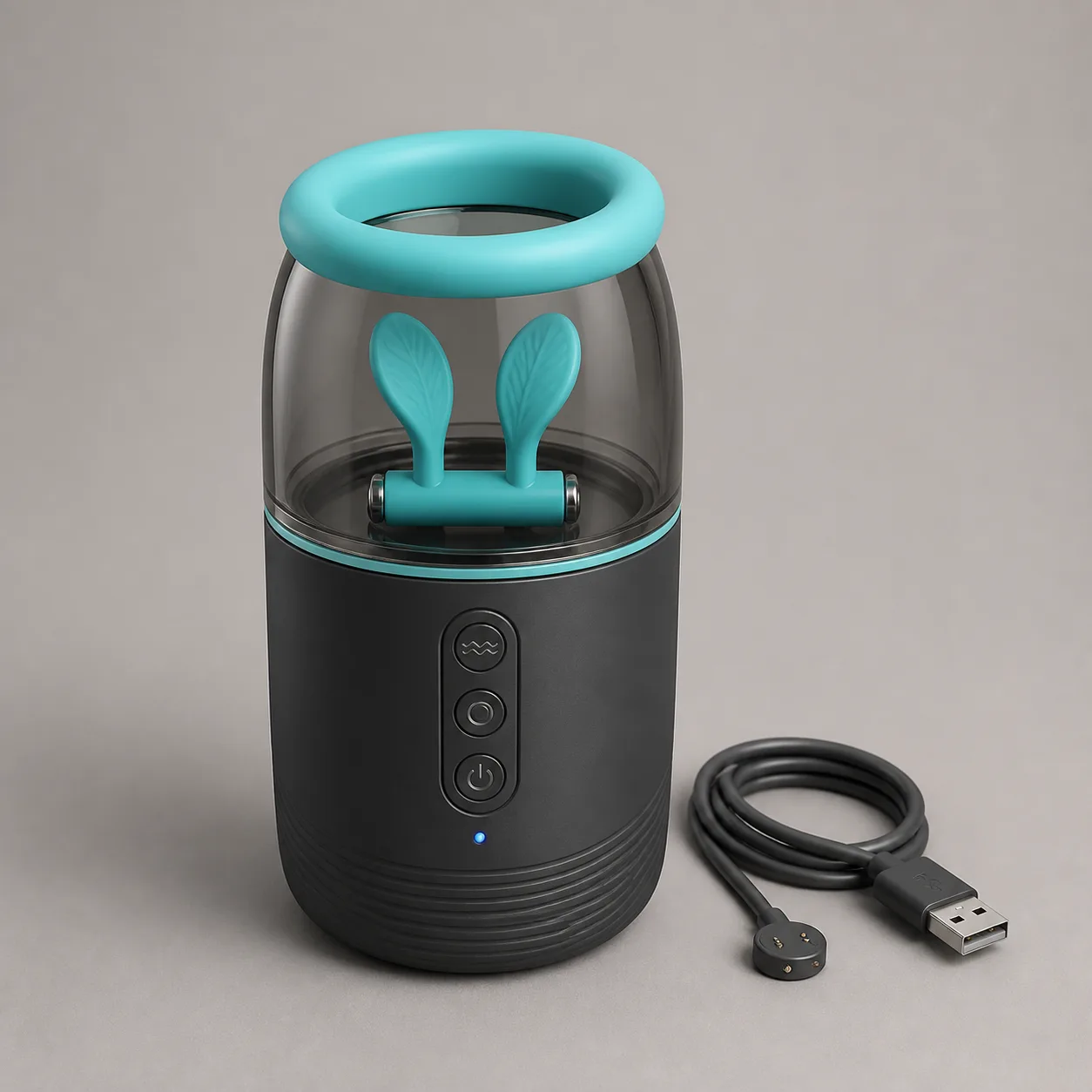
Transparent Dual-Paddle Glans Stimulation Cup
A shallow transparent glans stimulation cup concept with two visible flexible paddles and evidence-led checks for clearance, motion and cleaning access.
59,99 $
200 in stock
A shallow transparent cup keeps the moving parts observable
This dual paddle glans stimulation cup concept uses a wide turquoise rim and two short flexible paddles inside a smoky chamber. The format is intended for localized external contact rather than the full-length enclosure of an automatic stroker.

No endurance, delay, training or therapeutic outcome is claimed.
The rim must be softer than the chamber edge beneath it
Measure inside opening, outer diameter, wall thickness, compression and bond overlap. Flex the turquoise rim in every direction to confirm that a harder transparent lip cannot emerge or form a pinch line.
Stop for pain, numbness, persistent discoloration, irritation or broken skin.
Cup depth defines whether the concept stays localized
Record the distance from the rim plane to each paddle, the carriage and the chamber floor. The usable depth should match the approved drawing and leave enough clearance that the moving mechanism cannot bottom out against the body.
Do not force a deeper fit than the measured chamber allows.
Two leaf paddles need synchronized motion data
Measure sweep angle, travel, frequency and phase for both paddles at every mode. They may move together, alternate or follow different paths, and that distinction should be stated rather than described with a generic tongue label.
Test contact first at the lowest verified setting.
Paddle edges need a dynamic softness check
Record tip radius, thickness, root width and compound hardness before running the mechanism against a compliant pad. Increased speed can make a soft resting paddle strike more sharply or fold against the window.
Reject tears, hard cores, mold flash or permanent curling.
Carriage clearance must prevent trapping at both sides
Map gaps around the paddle axle, chamber wall and moving base through a full cycle. Hair, loose fabric and skin must stay outside the mechanism, and an obstruction should stop motion without overheating or automatic restart.
Power off before repositioning or removing debris.
The transparent shell should expose residue, not trap it
Inspect the smoky window for bonded double walls, unreachable pockets and seams that can hold liquid behind the visible surface. Cleaning validation should prove that the entire approved contact chamber can be flushed and dried.
Fogging or residue behind a sealed panel is a rejection condition.
Three controls need separate function names
Map each short press and long press for power, paddle motion, vibration and any pulse function. The blue indicator should distinguish active operation, charging and low battery without forcing the user to infer state from the paddle alone.
One accessible action must stop all movement immediately.
Ten frequencies do not necessarily mean ten useful modes
The source uses ten-frequency language without a verified sequence. Measure dominant frequency, acceleration, pattern length and paddle travel at each state, then group truly distinct outputs rather than padding the count with near duplicates.
Confirm the startup mode after every power cycle.
Material records must cover the turquoise assembly
Marketplace text does not identify the rim, paddle compound, turquoise pigment, smoky chamber polymer, graphite housing, carriage, seals or adhesives. Request lot-linked documents for all skin-contact and fluid-path components.
Check odor, tack, oil bleed, dye transfer, swelling, clouding and stress cracks after conditioning.
Cleaning should start with the paddles fully stopped
Power off and separate any supplier-approved removable liner or rim before washing. Rotate no hidden part by hand; use mild compatible cleanser within the documented boundary, rinse the chamber only if permitted and dry beneath both paddles.
Do not boil, bleach, machine-wash or use abrasive tools on the window.
Ingress testing must include the open chamber
No water-resistance claim is approved without model-specific evidence for the cup floor, paddle axle, window seam, buttons, housing joint and magnetic contacts. A rinseable rim does not prove that the motorized chamber is submersible.
Charge only when the cup, paddles and contacts are fully dry.
Battery tests need a mechanically loaded cycle
Confirm cell chemistry, capacity, charging input, full charge time, runtime and low-power behavior. Monitor the chamber floor, grip and contacts while both paddles operate against a repeatable compliant load.
Stop using a unit with abnormal heat, odor, swelling, erratic motion or damaged contacts.
The proposed price includes moving-chamber inspection
The Alibaba lead displays USD 26.80 for 1 to 199 pieces, USD 26.50 for 200 to 499 and USD 25.90 from 500. Its generated description mixes unverified training, material, ingress and performance claims.
The procurement reference is a sourcing lead only. The EUR 59.99 plan allows for China-origin freight, a sample, rim and depth measurement, paddle motion, clearance, stall, thermal and material tests; freight, duty, tax, insurance, packaging, payment fees and destination terms remain pending.
Choose a shallow chamber for targeted moving contact
This concept is for adults who prefer a visible pair of flexible contact paddles in a compact cup. A full sleeve, open external vibrator or manual texture may suit shoppers who want broader contact, easier access or no motorized carriage.
Final mode guidance will be based on synchronized motion data from the approved sample.
Frequently asked questions
Is this a full-length stroker?
No. It is a shallow localized cup concept whose depth must be confirmed before sale.
Do the two paddles move together?
Their phase and travel remain pending measurement on the production unit.
Does it provide endurance or delay benefits?
No endurance, delay, training or therapeutic outcome is claimed.
Can the paddles pinch?
Clearance and stall protection must be verified; keep hair and fabric away and stop before repositioning.
Can the chamber be submerged?
No immersion guidance is approved without ingress evidence for the open cup, paddle axle, window, seams and contacts.
What should be checked before use?
Inspect the rim, chamber, both paddles, carriage gaps, controls and charging contacts, then test low motion and immediate stop away from the body.
Reviews
There are no reviews yet.