


Expandable Care-Supply Cabinet Shelf Riser with Slotted Top
August 14, 2026
Four-Fin Memory-Control Finger Sleeve Vibrator
August 14, 2026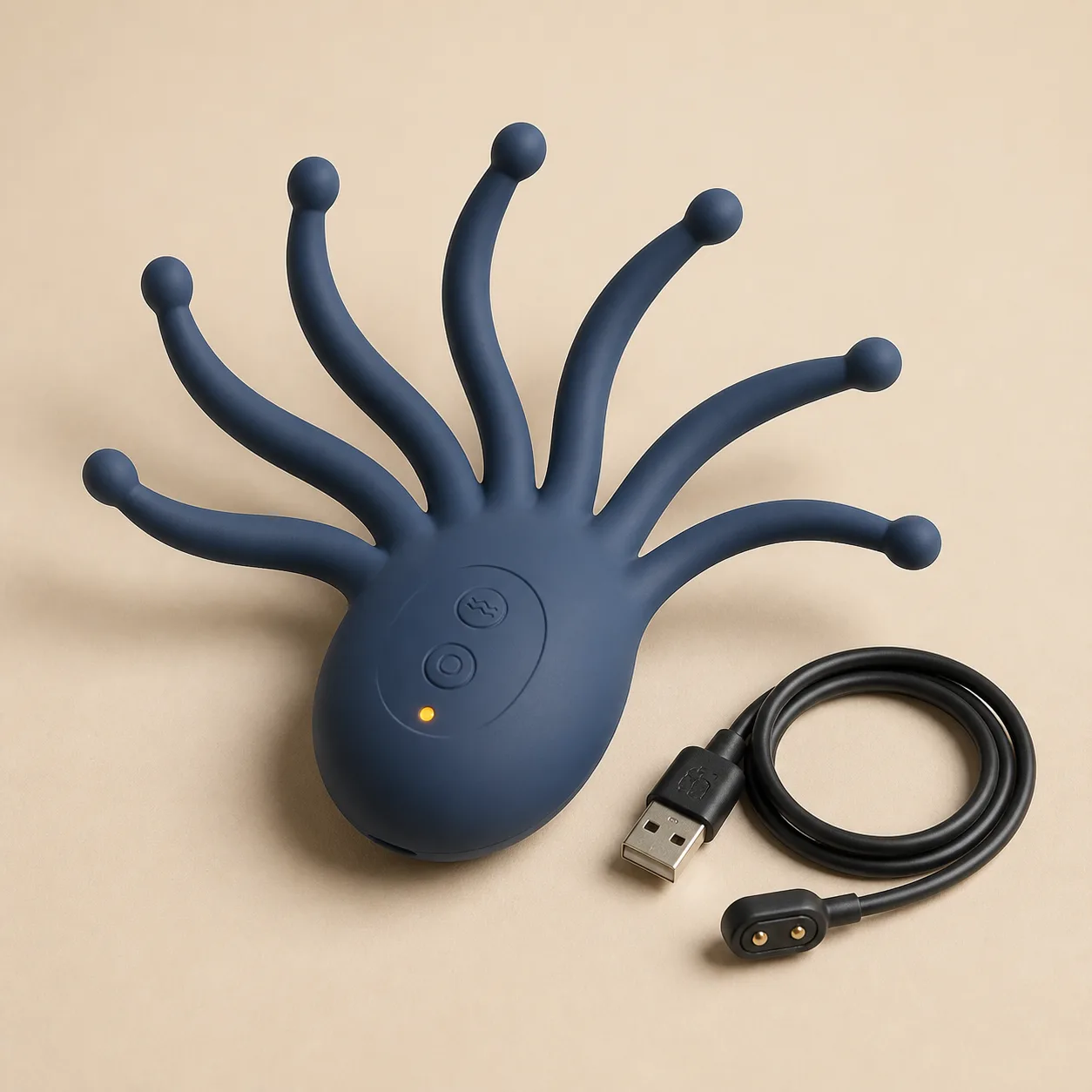
Octopus-Arm Wrap External Male Vibrator
An open-fan external male vibrator concept with eight flexible rounded arms and evidence-led checks for geometry, flex fatigue and vibration transfer.
29,99 $
200 in stock
Eight flexible arms create contact without a closed sleeve
This octopus wrap male vibrator concept fans eight rounded arms from a central motor pod. The open geometry is intended for adjustable external contact and quick visual inspection, not for squeezing into a fixed-size tunnel.

No sensitivity, circulation, endurance, training or therapeutic outcome is claimed.
Arm count should stay consistent across the production lot
Count all arms and measure their center spacing, length, base width and free angle. A missing or misaligned arm changes both contact coverage and vibration transfer, even when the central housing passes inspection.
Reject asymmetry outside the approved drawing.
Rounded tips need more than a visual softness check
Record tip diameter, edge radius, compression and compound hardness at room and body temperature. The small end bulbs should not conceal a rigid core, mold flash, pinhole or trapped air pocket.
Stop for pain, numbness, irritation or persistent discoloration.
The arms should flex without becoming constricting loops
Map the force required to bend each arm inward and the recovery time after release. Use the fan for light external contact only; do not knot arms together, secure them with another ring or create a closed constricting band.
Reposition rather than increasing pressure when comfort changes.
Eight roots are eight potential fatigue points
Cycle every arm through bending and twisting, focusing on the narrow transition into the center pod. Inspect for whitening, surface cracks, permanent set and internal separation before repeating vibration tests.
Any torn or thinned root ends the unit’s service life.
Motor position will make some arms feel stronger
Measure acceleration at every tip, mid-arm and root to show how energy travels through the fan. Arms closest to the motor may deliver a different frequency or amplitude than the outer pair.
Publish the spread rather than describing all eight as identical.
Ten modes need a reproducible order
The sourcing page advertises ten frequencies without identifying steady levels, pulses or ramps. Build a complete sequence with measured frequency, acceleration and restart state for each mode.
The lowest output and power-off should remain easy to reach with one hand.
The center pod should stay outside and visible
Confirm the housing dimensions, grip surface and button reach when the arms are curved around an external contact area. The pod is a control and battery enclosure, not an insertable component.
Keep its seams and charging recess clear of lubricant and moisture.
Material evidence must include the tiny tip bulbs
The marketplace’s broad silicone and ABS language does not identify the arms, tip bulbs, slate pigment, pod shell, button insert, internal carrier or adhesives. Request lot-linked documents for the exact supplied color.
Check odor, tack, oil bleed, dye transfer, swelling and surface tearing after conditioning.
Cleaning an open fan requires patience at each valley
Power off and wipe or wash only confirmed washable surfaces, separating every arm to reach the narrow valleys without sharply folding a root. Dry the underside of the fan, buttons and magnetic recess before storage.
Do not boil, bleach, machine-wash or use an abrasive brush.
Water resistance should cover the entire molded fan
The generated page mentions splash resistance, but no exact report or tested boundary is accepted. Evidence must cover arm roots, pod seam, buttons, indicator and charging contacts after repeated flex cycles.
Avoid immersion and running water on the powered unit until the exact model is approved.
Battery and heat checks belong at the center
Confirm cell chemistry, capacity, charging input, full charge time, runtime and low-power behavior. Log temperature on both sides of the pod while all arms are held against a repeatable compliant fixture.
Stop using a unit with swelling, odor, damaged contacts, erratic modes or abnormal heat.
Sound testing should include contact with all eight arms
Measure noise at a fixed distance with the fan free and under a light defined load. Buzz transferred through multiple arms can differ from the airborne sound of the center motor, so record both conditions.
Investigate clicking or rising rattle after fatigue cycles.
The planned price includes arm-by-arm inspection
The Alibaba lead displays USD 5.50 for 50 to 499 pieces, USD 5.00 for 500 to 999, USD 4.20 for 1,000 to 2,999 and USD 3.85 from 3,000. Its generated text mixes unverified ingress, sound, material and wellness statements.
The procurement reference is a sourcing lead only. The EUR 29.99 plan allows for China-origin freight, a sample, arm geometry and fatigue testing, vibration mapping, thermal and material review; freight, duty, tax, insurance, packaging, payment fees and destination terms remain pending.
Choose open contact when inspectability matters
This design is for adults who want a flexible external fan with multiple rounded points and an unobstructed cleaning path. A closed sleeve, simple bullet or single contact pad may suit shoppers who prefer fewer moving surfaces and a more concentrated sensation.
Use the lightest arm pressure and lowest mode that remain comfortable.
Frequently asked questions
Are there exactly eight arms?
The concept shows eight; production count, spacing and geometry must match the approved drawing.
Can the arms be tied into a tight ring?
No. Keep the fan open and externally adjustable rather than forming a constricting loop.
Do all tips vibrate equally?
Not necessarily. Output depends on motor location and arm geometry, so every tip requires mapping.
Does the product provide training or health benefits?
No sensitivity, circulation, endurance, training or therapeutic outcome is claimed.
Can it be submerged?
No immersion guidance is approved without ingress evidence covering the flexed arm roots, pod seam, buttons and contacts.
What should be checked before use?
Inspect all tips, eight arms, every root, the center pod, controls and charging contacts, then test the lowest mode and power-off away from the body.
Reviews
There are no reviews yet.