


Rolled-Edge Finger Cot Kit with Frosted Storage Case
August 14, 2026
Sealed Rotation and Air-Pulse Automatic Stroker
August 14, 2026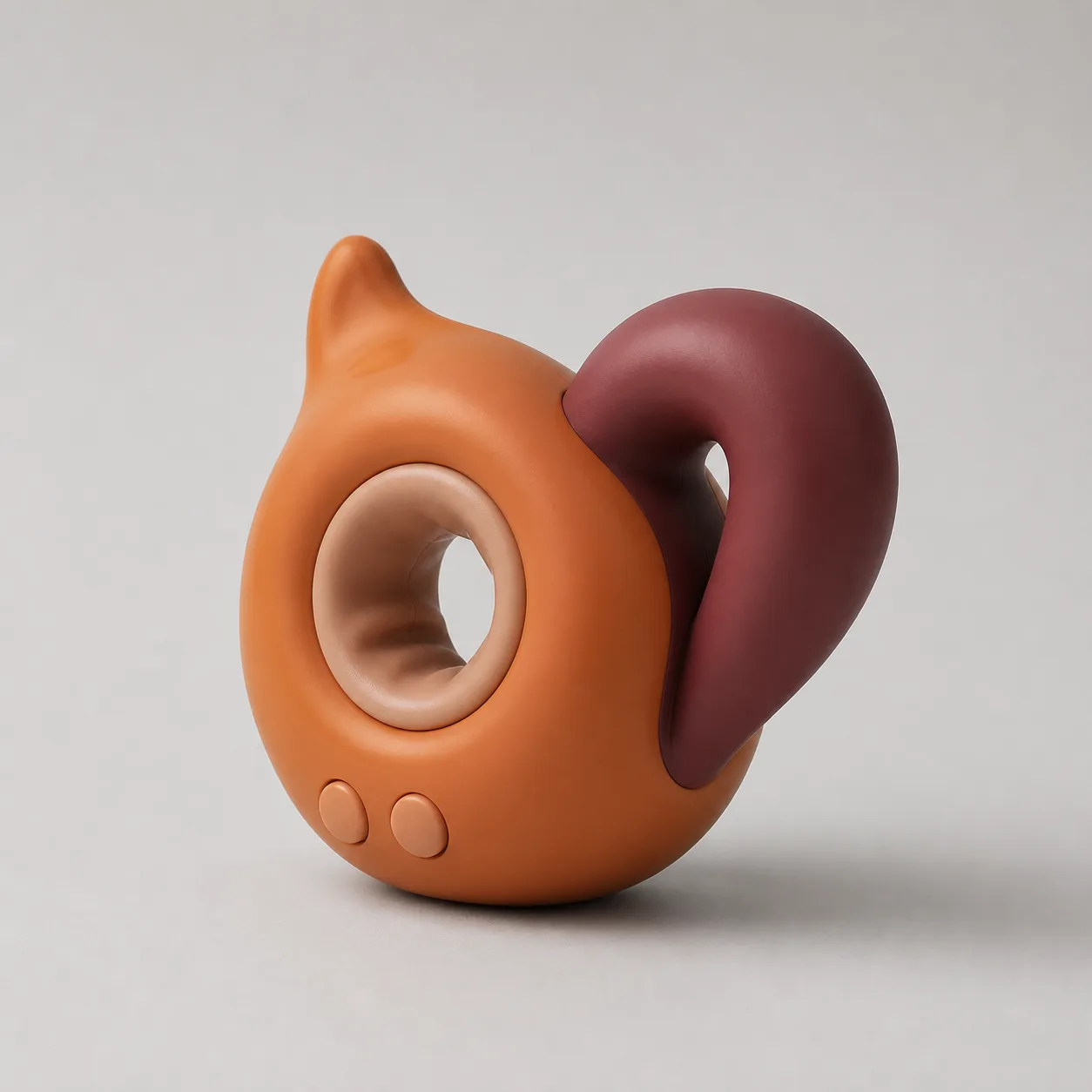
Squirrel-Tail Air-Pulse Palm Vibrator
A squirrel-inspired palm vibrator concept with a circular air chamber, curled tail grip and evidence-led checks for pressure and controls.
29,99 $
200 in stock
The curled tail turns a character shell into a palm grip
This squirrel air pulse vibrator concept uses a cinnamon shell, circular recessed chamber, two direct controls and a broad plum tail that wraps around one side. The character idea is secondary to grip security, chamber alignment and fast access to the stop control.

No therapeutic, circulation, sensitivity or other medical outcome is claimed.
The chamber opening needs exact scale
Measure inner opening, outer rim diameter, recess depth and the distance to the buttons and tail. Record these values with tolerances because a circular opening can look much larger in a close product photograph than it is in hand.
Comfort depends on fit and gentle placement, not on forcing a seal.
Rim flexibility controls both seal and pressure distribution
Measure lip hardness, wall thickness and compression force at several points around the circle. The rim should flex evenly without folding inward, creating a sharp crease or concentrating load along one section.
Stop immediately for pain, numbness, bruising or persistent discoloration.
Air pulses require a pressure-and-frequency map
Use a calibrated fixture to record waveform, peak pressure, pulse rate and level-to-level change at the production chamber. Each setting should start predictably and remain stable as battery voltage falls.
No strength percentage or mode count is approved without direct sample results.
The exhaust path must stay open in the palm
Locate intake and exhaust ports, then test the device in left- and right-hand grips to confirm that the curled tail or fingers do not block airflow. Log any pressure change, motor strain or sound change when the shell is held naturally.
Never tape over a port or use the device if an opening is obstructed.
Vibration needs independent identification
The sourcing title uses both suction and vibrator language, but it does not define whether vibration is in the rim, body or air motor. Measure vibration frequency and acceleration at the relevant contact surfaces and separate those results from pneumatic pulses.
Combined modes should be listed only if direct controls and output are verified.
Two buttons should provide an unambiguous stop
Document short press, long press, pattern advance and shutdown behavior from every mode. Button shapes and spacing should prevent accidental increases while the tail grip is squeezed, and full power-off should not require cycling through stronger settings.
Test shutdown after a low-battery warning and after an interrupted command.
The tail joint needs repeated flex and pull testing
Determine whether the plum grip is moulded with the shell, bonded, mechanically locked or purely decorative. Cycle it through realistic hand compression and torsion, then inspect the root for whitening, gaps, loose edges and internal movement.
Do not use the tail as a hanging loop unless the final instructions and load test approve that purpose.
Heat should be mapped around the air motor
Operate the lowest, middle and highest verified settings through a complete battery cycle while measuring the chamber rim, shell center, tail joint and charge area. Repeat under a representative palm grip that may reduce cooling.
Switch off a unit that becomes unexpectedly hot, changes sound or loses pulse consistency.
Sound claims need a room and distance
Record A-weighted sound at a stated distance in a room with a known ambient level, first in free air and then against a compliant test surface. Note tonal whine, clicking and changes caused by blocked or partial seals.
Words such as quiet or discreet are withheld until the method and result are published.
Charging and runtime remain open specifications
Request cell manufacturer, chemistry, nominal capacity, protection circuit, connector type, charge input, cable specification, charge time and runtime for each verified mode. Inspect for temperature rise and controlled shutdown at low voltage.
Charge only when the clean dry device is away from use and resting on a non-flammable surface.
Water resistance must cover buttons and air passages
An air-pulse product creates special ingress questions at its chamber, ports, controls and charging interface. Test the complete conditioned assembly to the claimed method and inspect internally for moisture after flex and drop cycles.
Until exact-model evidence is approved, do not submerge the device and keep the charge area dry.
Materials include more than the soft outer surface
Obtain identities for the rim, orange shell, plum tail, buttons, internal air duct, seals, adhesives, colorants and any rigid support. A broad silicone claim cannot establish the composition of the pump enclosure or electronics.
No medical-grade, hypoallergenic or latex-free wording is approved without traceable component evidence.
Cleaning must protect the internal pump
Validate a method for the chamber, rim underside, button edges, tail junction and air ports that removes residue without driving liquid into the airflow path. The drying protocol should include chamber-down drainage and a visual check of every recess.
Do not flush the air path or immerse the product unless the final manufacturer procedure explicitly permits it.
The planned price includes pneumatic testing
The Alibaba page displays USD 4.97 per piece at a one-piece minimum, without a visible quantity-tier table in the accessible record. Supplier identity, rights to the unbranded model, bulk pricing, exact functions, materials and packaging require confirmation.
The procurement reference is a sourcing lead only. The EUR 29.99 plan allows for China-origin freight, a sample, dimensions, pressure, vibration, controls, tail fatigue, sound, heat, battery, ingress, cleaning and packaging checks; freight, duty, tax, insurance, payment fees and destination terms remain pending.
Frequently asked questions
Does it produce air pulses, vibration or both?
The exact output channels and combined-mode logic remain pending direct testing of the offered model.
How wide is the chamber opening?
Inner diameter, outer rim diameter, depth and dimensional tolerances remain pending sample measurement.
Is the curled tail a handle?
It is a planned palm-grip feature, but its construction, flex limit and approved load remain pending fatigue testing.
How many settings are available?
Air levels, vibration patterns and button sequences remain pending a verified control map.
Can the device be immersed?
No immersion claim is approved until the complete conditioned assembly passes a stated ingress test.
What should be checked before use?
Inspect the rim, chamber, air ports, buttons, tail joint and charge area for cracks, blocked openings, residue, moisture or deformation.
Reviews
There are no reviews yet.