



Brush-Form Air-Pulse Dual Stimulator
August 14, 2026
Five-Ring Transparent Lightweight Chastity Kit
August 14, 2026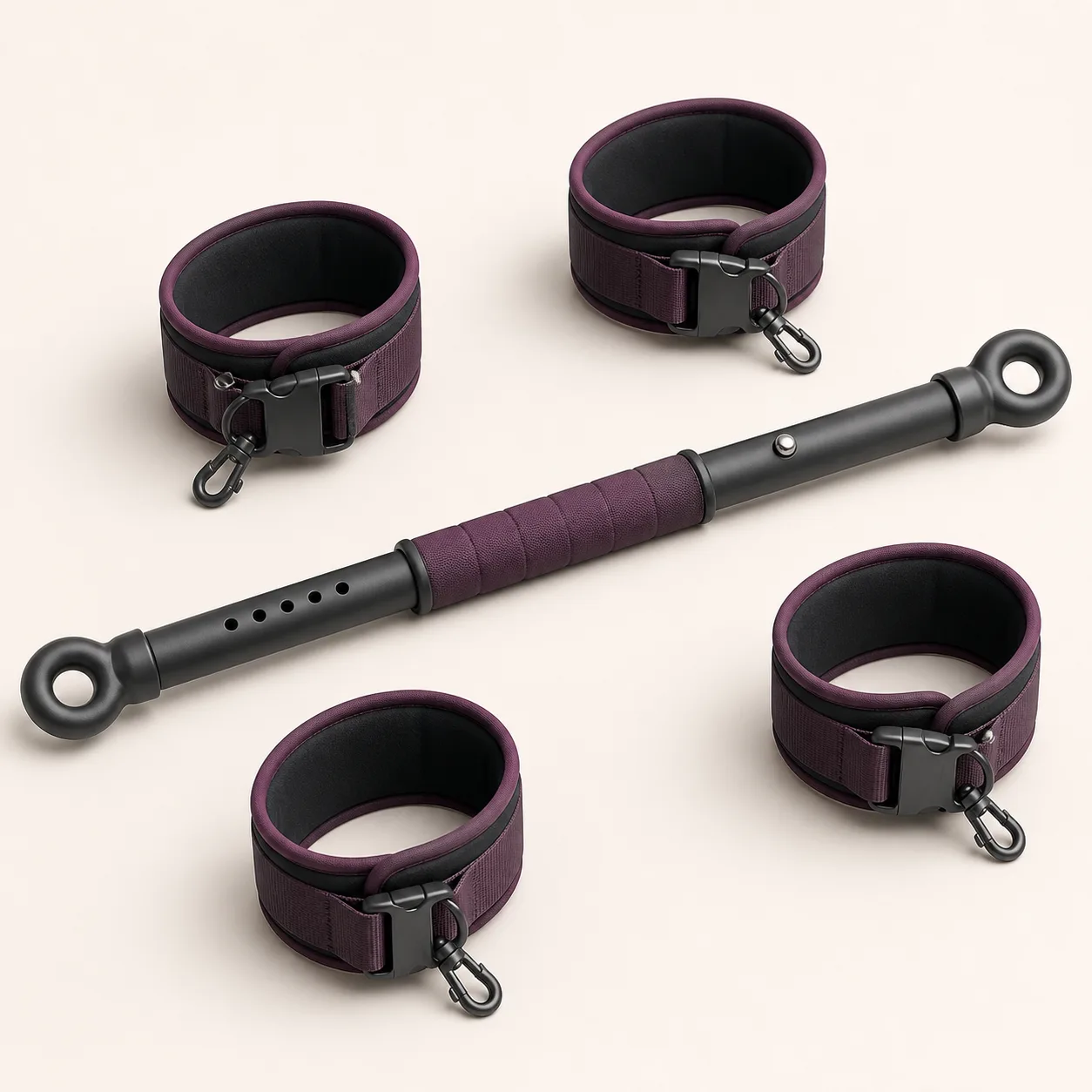
Pin-Indexed Telescoping Spreader Bar with Rotating Eyes and Four Cuffs
An adjustable adult positioning set concept with pin-indexed telescoping bar, rotating end eyes and four independently releasable padded cuffs.
44,99 $
200 in stock
An indexed bar and four independently releasable cuffs
This telescoping spreader bar cuff set concept combines a matte-charcoal adjustable bar, plum center grip, spring-loaded index pin, five visible length holes, rotating end eyes and four broad padded cuffs with local quick-release buckles and swivel clips.

The planned kit is for consensual adult positioning at floor or bed height only. It is not suspension equipment, a lifting device or a substitute for supervision.
Count and identify every component before setup
Confirm one telescoping bar, two rotating end eyes, one functioning index pin, four cuffs, four adjustable tails, four buckles and four swivel clips. Photograph the received parts beside the supplier bill of materials.
Mixed clip, buckle or cuff revisions must not be combined without a new qualification check.
Measure the usable length at every hole
Seat the pin in each visible index hole and record eye-to-eye distance, exposed inner tube, overlap depth and total mass. Create a simple length table using millimeters rather than informal labels.
The shortest and longest displayed positions are approved only if the pin fully crosses the inner member.
Prove that the index pin is fully engaged
Listen and look for complete pin travel, then apply a light axial check in both directions while the bar rests on a padded fixture. Inspect spring force, pin diameter, hole edges and the gap between outer and inner tubes.
A pin that sticks, sits below flush or can be released by brushing the grip area disqualifies the sample.
Guard the telescoping joint against pinching
Move through the full adjustment range with no cuffs attached. Map closing gaps around the grip collars, index holes and tube overlap, and keep hands, hair, clothing and bedding away from the sliding joint.
Adjust length only when the set is unloaded and away from the body.
Test both rotating eyes through a complete turn
Rotate each rounded eye under light fixture tension and record friction, wobble, binding and contact with the tube end. Inspect the eye shoulder and hidden fastener after repeated cycles.
Free rotation may reduce strap twist, but it does not prove a working-load rating.
Map cuff fit before choosing attachment points
Measure padded width, usable circumference range, overlap, edge thickness and strap-tail length on all four cuffs. Check whether the padding remains flat at both ends of the range.
Label cuffs by measured range rather than assuming that every piece fits wrists and ankles equally.
Verify each buckle as a local release
Fasten every cuff on a soft sizing mandrel and open the buckle with one hand from multiple angles. Repeat under a small documented strap load and after dust and lubricant-free handling cycles.
A blocked, cracked or two-hand-only buckle is not suitable for the planned set.
Inspect swivel clips and attachment stitching
Check gate closure, spring response, swivel travel, sharp edges and the connection between each clip, strap and cuff body. Apply the supplier-approved proof load on a fixture without shock loading.
Clips that cross-load, gape, snag fabric or rotate against an open gate must be rejected.
Fit cuffs without compressing circulation or nerves
Apply each cuff flat, leave a conservative clearance and recheck warmth, color, sensation and movement frequently. Padding should spread pressure without hiding an overtightened strap.
Release immediately after numbness, tingling, coldness, discoloration, swelling, sharp pain, panic or loss of communication.
Keep the set low and within a documented force envelope
Use only on stable padded surfaces where the bar cannot fall, lever against a joint or become a step. Never attach to ceilings, doors, furniture frames, vehicles or moving equipment.
No standing, body-weight support, impact loading, suspension or unattended wear is planned for this product.
Agree on consent, signals and a release order. Before attachment, all adults should agree on boundaries, a stop word, a nonverbal signal and who controls the release. Keep appropriate safety shears and a phone within reach without placing tools against skin.
Attach no more components than can be released promptly in the practiced order.
Confirm all materials and surface finishes
Request composition for tubes, pin, spring, eyes, clips, buckles, webbing, padding, edge binding, thread, coatings and pigments. Inspect coating thickness, corrosion, welds, burrs and seams on the exact production revision.
Metal grade, padding chemistry, restricted-substance evidence, skin-contact suitability and load data remain pending.
Clean cuffs separately from the sliding bar
Detach the clips and follow the verified method for each component. Wipe the bar, index holes, pin, eyes and clips without flooding the spring cavity; clean cuff surfaces and stitching according to confirmed textile limits.
Dry hardware, webbing, padding and buckle recesses completely before storage. No machine washing, soaking, bleach, alcohol, heat or aggressive disinfectant is approved without exact-model instructions.
Qualify every lot with a release drill
Sample all five visible length positions, both eyes and all four cuff-release paths from each production lot. Record dimensions, pin engagement, collar gaps, eye rotation, clip closure, buckle opening force, stitching and coating defects.
Finish by timing a no-load release drill on soft fixtures; any inconsistent component triggers lot quarantine.
Price from a four-cuff adjustable-bar reference
An Alibaba showroom lists a bondage wrist-and-ankle cuff kit with adjustable spreader bars at USD 9.66-10.18 with a five-set minimum. The page does not establish this exact pin layout, rotating eyes, four matching cuff sizes or legal contracting supplier.
The procurement reference supports an EUR 44.99 planning price after allowing for China-origin freight, exact-set quotation, component inventory, length and overlap mapping, pin, pinch-gap, eye and clip testing, cuff and buckle fit checks, materials review, cleaning validation, protective packing and discreet fulfillment. Packed size, weight, freight, duty, tax, insurance, payment fees and destination terms require confirmation.
Frequently asked questions
How many bar lengths are available?
The visual shows five index holes, but usable positions and exact eye-to-eye distances require sample measurement.
Can the bar support body weight?
No. The planned use excludes lifting, suspension, standing, impact and body-weight support.
Why do the end eyes rotate?
They are intended to reduce cuff-strap twist, subject to cycle, wobble and fixture-load testing.
Are all four cuffs the same size?
That must be verified by measuring padded width, usable circumference and overlap for every cuff.
Can the length be changed while attached?
No. Remove load and all body contact before moving the telescoping joint or pin.
Which faults require immediate retirement?
A sticky pin, damaged hole, tube play, sharp edge, loose eye, gaping clip, cracked buckle, torn stitching, compressed padding, corrosion or any delayed local release.
Reviews
There are no reviews yet.