


Remote Retractable Expanding Anal Bead Massager
August 14, 2026
Dual-Swing Triple-Channel Rabbit Vibrator
August 14, 2026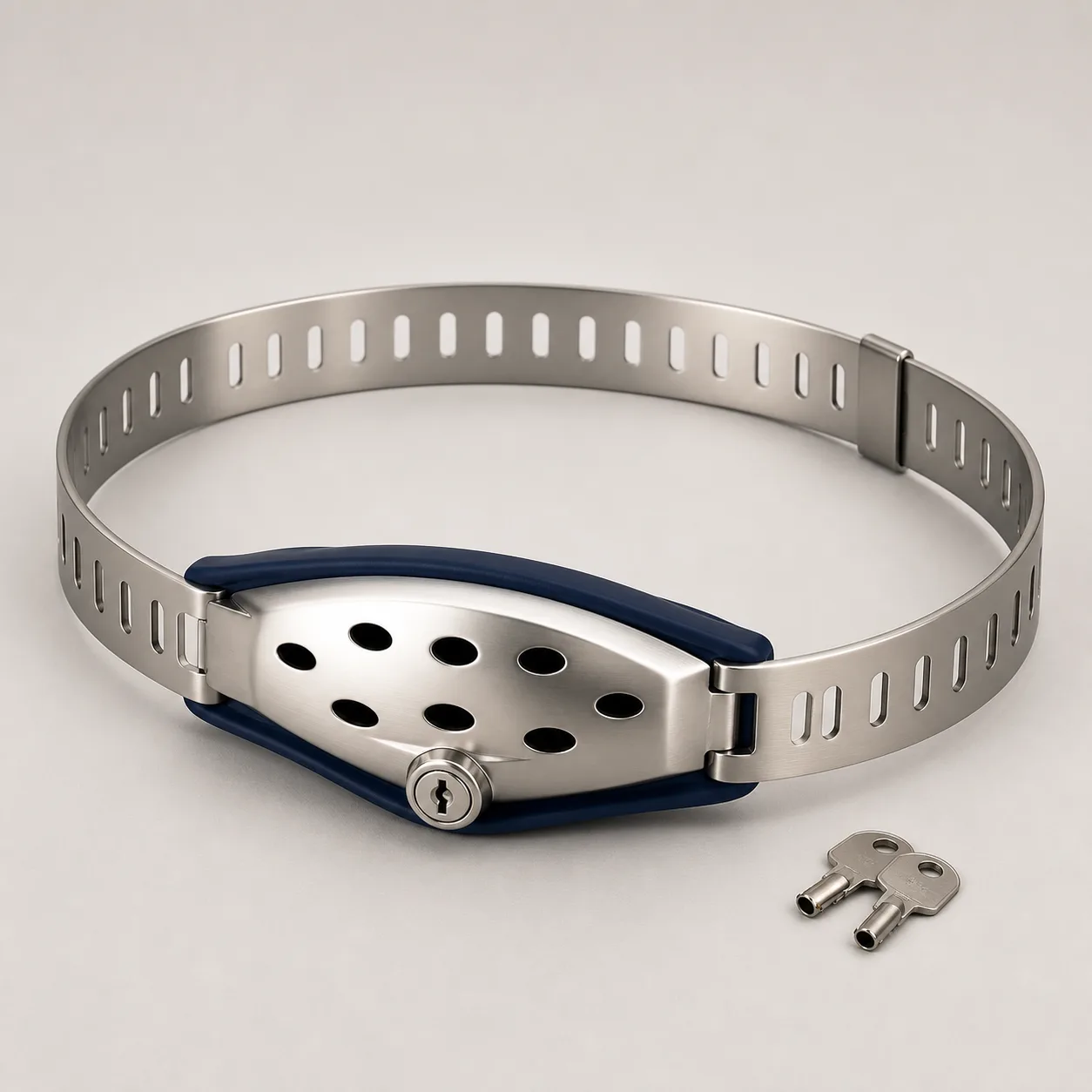
Silicone-Lined Adjustable Steel Chastity Belt
An adjustable metal chastity belt concept with a ventilated lined shield and evidence-led checks for fit, release and emergency access.
99,99 $
200 in stock
A locking belt starts with a verified exit plan
This adjustable steel chastity belt concept combines a slotted metal waist band, ventilated central shield, soft edge liner and keyed lock. Before any fit or security discussion, the final model must have fast voluntary release, a tested emergency method and immediate access to keys.

No medical, behaviour-change or long-duration-wear benefit is claimed.
The waist band needs a truthful adjustment chart
Measure minimum and maximum closed circumference at every usable slot, band width, thickness, overlap and increment size. The marketplace mentions a 25-45 cm range, but that number is not linked to a confirmed variant and is not approved.
Fit must allow normal movement and breathing without edge pressure or forced compression.
The shield requires a full interior drawing
Record internal length, width, depth, taper, ventilation opening size and clearance to every hinge and fastener. Publish a dimensioned section rather than treating the external oval as evidence of usable space.
Any swelling, numbness, coldness, discoloration, trapped tissue or pain requires immediate removal.
The liner must protect every contact edge
Inspect the navy liner around the shield perimeter, band transitions and any exposed slot. Measure thickness, hardness, compression set and retention after cleaning so it cannot roll aside and reveal a metal edge.
A split, displaced, tacky or hardened liner is a rejection condition.
Adjustment slots can create shear and pinch points
Use feeler gauges and soft test media to map clearances at the overlapping bands through the full adjustment range. Bending, walking and sitting should not make a slot edge, buckle or sliding plate capture skin or fabric.
Never resize or reposition the locked belt on the body.
Hinges need motion and entrapment testing
Cycle each hinge through its allowed arc while measuring gaps under straight, twisted and seated configurations. Covers or guards should prevent access to moving pinch zones without hiding corrosion or residue during inspection.
Stop using the belt if a hinge stiffens, loosens or develops a sharp offset.
The keyed lock must open under realistic load
Test insertion, turning force and release time with the belt unloaded and under conservative multidirectional tension. The lock should not jam after sweat conditioning, cleaning, a controlled drop or repeated cycles.
Security claims are secondary to predictable wearer-controlled removal.
Two keys are a minimum logistics question
Confirm key count, key-code uniqueness, duplication route and whether a damaged cylinder can be accessed without specialist tools. One key should remain immediately reachable by the wearer and another should be held nearby by an informed adult.
Never rely on a mailed key, distant holder or battery-powered remote for emergency access.
An emergency method must be timed and rehearsed
Identify the exact hand tool, cutting point or sacrificial fastener approved for the final model, then time removal on a fixture that prevents injury to a person beneath it. The tool should be stored with the product and protected against misuse.
Do not apply improvised cutting, heat or power tools near the body.
Continuous and unattended wear are excluded
The marketplace promotes prolonged use, but no such claim is accepted. The final instructions should define short supervised checks, planned removal intervals and a clear prohibition on sleep, intoxication, driving, exercise, bathing, travel and any situation where rapid access is limited.
A locking device should never be worn alone or where help cannot be reached.
Mass and balance affect pressure during movement
Weigh the complete belt, shield, liner and lock, then locate the center of mass. Measure contact pressure while standing, sitting and bending on an instrumented fixture, noting whether the shield pulls the band downward or twists at the hips.
The page’s 350 g statement remains unverified and variant-dependent.
Alloy and finish require lot-linked evidence
Request chemistry, manufacturing route, joining method, passivation and surface-roughness results for the entire metal assembly, including lock, hinge pins and fasteners. Marketplace references to several steel grades and titanium options do not identify the offered unit.
Reject burrs, pits, rust, peeling finish, weld spatter or a cloth-snagging edge.
The liner and adhesives need separate identities
Confirm polymer chemistry, colorants, plasticisers, adhesive, replacement procedure and compatibility with the metal finish. A generic silicone description is insufficient if pads, tubing or bonded strips use different compounds.
No medical-grade or hypoallergenic wording is approved without traceable exact-model evidence.
Cleaning depends on complete disassembly access
Validate a method that reaches band overlaps, slots, shield vents, liner channels, hinge barrels, lock face and fastener recesses. If the lock or liner cannot be removed, prove that cleaning and rinse water do not remain trapped behind them.
Dry every crevice before reassembly and store the lock open with the keys beside it.
The planned price includes restraint-specific testing
The Alibaba page displays USD 27.99-48.99 per piece at a one-piece minimum without assigning the range to confirmed variants. Supplier identity, rights to the unbranded model, dimensions, materials, lock, keys and packaging remain pending.
The procurement reference is a sourcing lead only. The EUR 99.99 plan allows for China-origin freight, a sample, dimensions, mass, edges, hinges, lock, loaded release, emergency access, alloy, corrosion, liner, cleaning and packaging checks; freight, duty, tax, insurance, payment fees and destination terms remain pending.
Frequently asked questions
What waist range does the belt fit?
Usable circumference, slot increments, overlap and tolerances remain pending measurement of the exact variant.
Can it be worn overnight?
No. Sleep, unattended use and any setting that delays immediate removal are excluded from the approved concept.
Who should keep the keys?
The wearer must have immediate access to a working key, with a second nearby and an informed adult able to help.
How is it removed if the lock jams?
The exact tool, sacrificial point and timed fixture procedure remain pending engineering validation for the final model.
Is the metal stainless steel?
Alloy grade, passivation, joins, fasteners and lock materials remain pending lot-linked evidence.
What should be checked before fitting?
Inspect every edge, liner, slot, hinge, vent, lock and key, then confirm fast voluntary release and emergency-tool access.
Reviews
There are no reviews yet.