


Opaque Drawstring Care-Waste Liners, 20-Pack
August 14, 2026
Remote Lip-Shaped Vibrating Nipple Clamps
August 14, 2026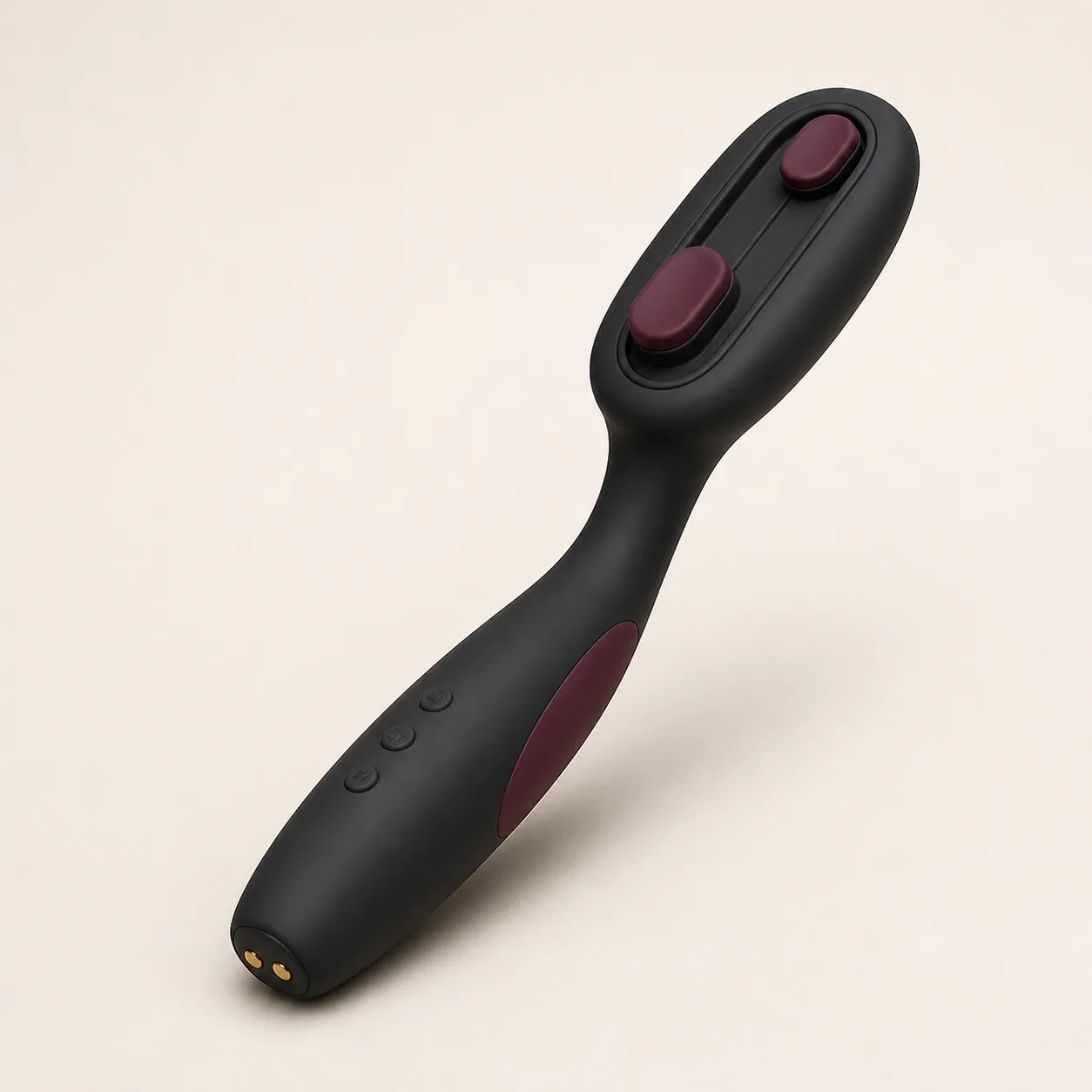
Alternating Twin-Pad Curved Vibrator with Guarded Linear Tracks
A rechargeable curved vibrator concept with two rounded contact pads on guarded parallel tracks, designed for independently testable alternating linear motion.
38,99 $
200 in stock
Alternating pads create a two-point motion concept
This alternating twin pad vibrator concept places two rounded contact pads on separate guarded tracks within a broad curved head. The intended mechanism moves one pad forward as the other moves back, creating a compact shifting contact pattern without an exposed drive train.

The visualization does not establish exact travel, frequency, pressure response, waterproofing, material or charging specifications.
Request a complete drive and enclosure inventory
Ask for exploded drawings and a bill of materials covering both pads, carriers, rails, guides, linkages, eccentric elements, gears, bushings, motor, controller, battery, wiring, seals, neck reinforcement, buttons, charging contacts, pigments, lubricants and adhesives.
Confirm whether the two pad paths share one drive or use independently controlled actuators, because fault behavior and timing tests differ.
Measure the head and both travel corridors
Record overall length, grip circumference, neck arc, head width and depth, each pad length and height, spacing between pads, rail length, guard height, end clearance and the minimum gap around every moving edge.
Measure the product in neutral and both extreme pad positions rather than estimating movement from a promotional image.
Map pad A stroke before comparing pad B
Track the forward pad through each supported setting with a non-contact gauge. Record displacement, rate, pause duration, lateral drift, audible changes and repeatability across battery levels.
Inspect for carrier tilt, edge lift, rubbing, abrupt reversal or contact between the pad and its surrounding guard.
Characterize pad B as a separate mechanism
Repeat the same measurements for the second pad, using identical charge, temperature and fixture conditions. Compare usable travel, acceleration, dwell and position error rather than assuming matched components behave identically.
A visible or measurable mismatch needs a stated manufacturing tolerance and an acceptance limit.
Verify alternating phase across every program
Use synchronized video or position sensing to establish whether the pads truly oppose each other, overlap, pause together or change phase at setting transitions. Record startup, steady operation and shutdown behavior.
Marketing terms such as alternating, wave or reciprocating need measured definitions for the exact production revision.
Keep guarded gaps clear of pinch hazards
Probe the track perimeter through the complete movement cycle with standardized soft film, hair and textile fixtures. Pay particular attention to the reversing ends, pad undersides and the junction where the recessed track meets the head shell.
Reject sharp rims, closing gaps, accessible hard parts or a guard that flexes into the moving carrier.
Challenge pad retention and lift resistance
Apply small capped forces to the center and each edge of both pads while stationary and operating in a fixture. Observe lift, twist, rocking, carrier exposure and permanent displacement after the load is removed.
The pad surface must not peel away or reveal a cleaning trap under expected handling pressure.
Compare free motion with controlled contact load
Run both pads in free air and against a compliant instrumented surface at several low verified loads. Record displacement loss, phase shift, current draw, vibration transfer into the grip, noise and surface temperature.
Do not publish intensity or pressure claims until the supplier defines a safe loading envelope and provides reproducible data.
Confirm stall detection and local shutdown
Using a guarded laboratory fixture only, obstruct one pad below documented limits and check whether the controller stops that pad, both pads or the entire device. Record response time, restart behavior, error indication and whether the other carrier keeps moving.
Repeated cycling after a jam can increase heat or gear damage; the user instructions need a clear fault sequence.
Separate neck flexibility from drive vibration
Measure bending force and recovery at several neck positions while the motor is off, then compare handle vibration during each active program. Inspect the neck root and head junction for whitening, delamination, internal knocking or position-dependent noise.
A flexible profile should not allow the head shell to press against the moving mechanism.
Audit controls, charging and thermal behavior
Document button functions, press duration, lockout, setting memory, low-battery indication, charge contacts, cable specification, charger input, charge time, runtime and behavior during charging. Confirm that operation while charging is either prevented or explicitly supported.
Log temperature at the pads, head, neck, grip, battery and contacts through worst-case verified cycles, including a single-pad obstruction test.
Verify materials and the wet-use boundary
Obtain exact formulations for the contact pads, guards, shell, buttons, internal supports, coatings, pigments, lubricants and adhesives. Request restricted-substance, skin-contact, electrical and battery evidence tied to the ordered model.
Silicone, body-safe, medical-grade, hypoallergenic, waterproof and submersible claims remain pending until exact-model documents and sample tests support them.
Clean both track recesses without forcing movement
Power the device off and follow the confirmed cleaning method. Wipe pad tops, rounded edges, guard rims, track recesses, head seams, controls and charging contacts while rotating the product for visibility; do not push a carrier beyond its powered range.
Immersion, boiling, dishwasher use, alcohol, bleach, abrasive brushes and lubricant inside the tracks require explicit compatibility evidence. Dry recesses and contacts fully before charging or storage.
Build the retail price from verified landed cost
An Alibaba listing for a rechargeable curved personal massager currently shows USD 7.49 at 1-99 units, USD 6.79 at 100-499, USD 6.39 at 500-2,999 and USD 5.79 at 3,000 or more. It is a category benchmark only and does not confirm this alternating twin-pad mechanism or an approved supplier.
The procurement reference supports an EUR 38.99 planning price after allowing for China-origin freight, dual-carrier inspection, phase and loaded-motion testing, pinch-gap checks, stall protection, thermal review, material documentation, charging verification, protective packing and discreet fulfillment. Exact quotation, packed dimensions, weight, freight, duty, tax, insurance, payment fees and delivery terms remain pending.
Frequently asked questions
Do the two pads always move in opposite directions?
That is the intended concept, but the phase relationship must be measured for every setting and production revision.
Can either pad be pressed into its track?
No manual travel is assumed. Pressing or forcing a pad can damage its carrier or create a pinch point.
What should happen if one pad stops?
Switch the device off, remove contact, inspect for visible debris or damage and follow the confirmed fault instructions. Do not repeatedly restart a jammed mechanism.
Are the track recesses waterproof?
No ingress rating is assumed. Wet-use and immersion claims require exact-model evidence and sample validation.
Can the device operate while charging?
Only if the final instructions explicitly permit it; otherwise keep it powered off and dry until charging is complete.
Which faults require retirement?
A lifted pad, enlarged gap, exposed carrier, rough travel, persistent phase error, cracked shell, loose contact, unusual heat, swelling battery, corrosion or residue beyond cleaning access.
Reviews
There are no reviews yet.