


Dual-Density Curved Suction-Cup Wand
August 14, 2026
Cut-to-Fit Non-Adhesive Care-Storage Drawer Liner Roll
August 14, 2026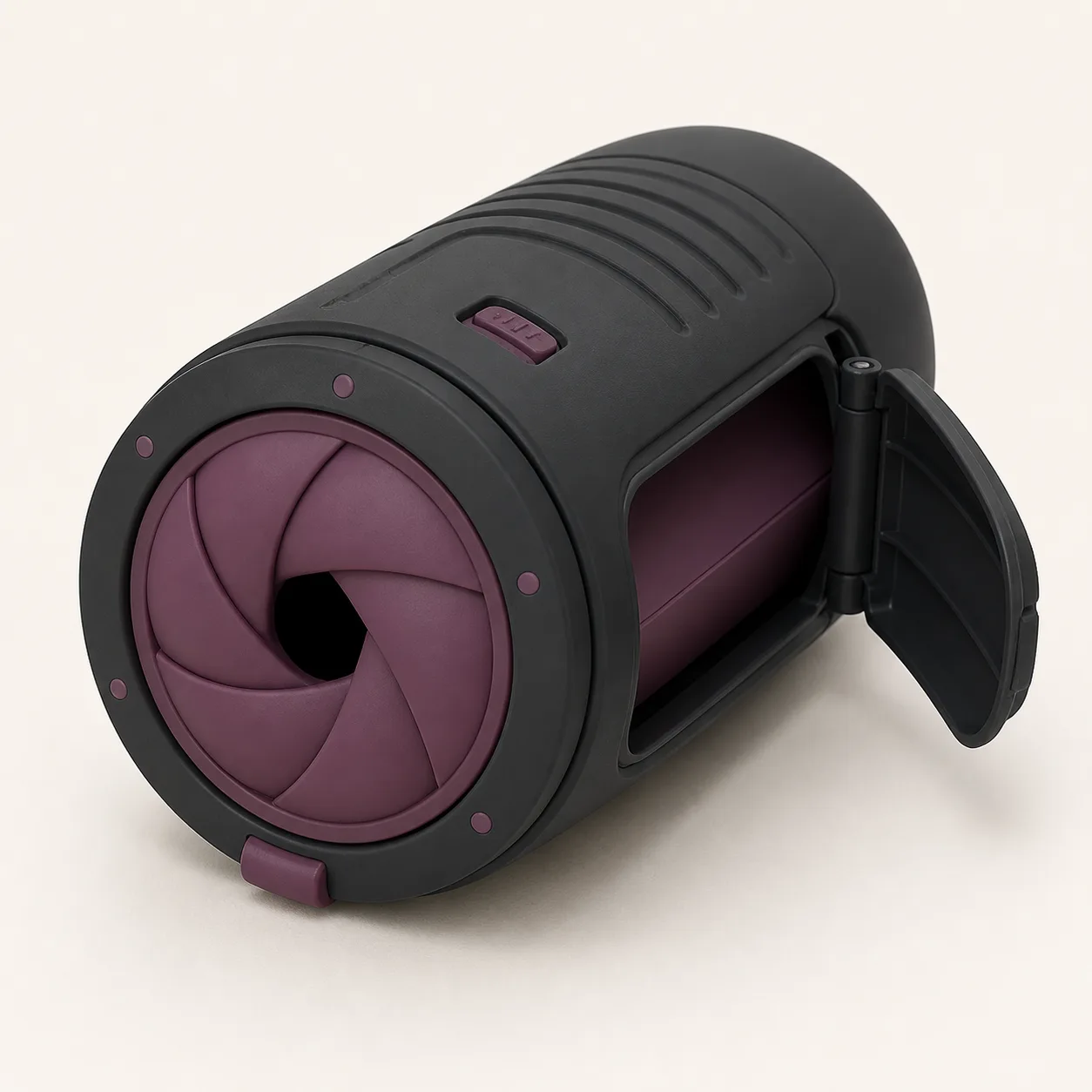
Quarter-Turn Iris-Entry Manual Stroker with Hinged Cleaning Door
A non-powered manual stroker concept with an adjustable overlapping-petal entry, quarter-turn aperture ring, continuous liner and attached inspection door.
33,99 $
200 in stock
Separate aperture behavior from sleeve feel
This iris entry manual stroker concept places an adjustable overlapping-petal aperture ahead of a continuous through-liner. A quarter-turn outer ring is intended to alter the entry opening, while an attached side door exposes the liner and petal backs for inspection.

The visualization does not prove aperture range, pressure, fit, liner texture, material, immersion resistance or supplier approval.
Inventory the full iris and shell assembly
Request an exploded drawing and bill of materials for the entry rim, every overlapping petal, backing carriers, pivots, guides, cam ring, reference markers, grip tab, detents, stops, local release, shell ribs, through-liner, liner collar, support cage, cleaning door, hinge, latch, pigments, lubricants and adhesives.
Confirm whether each visible leaf is an independent molded element, a flexible section of one diaphragm or a cosmetic layer over hidden gates.
Measure the resting geometry before adjustment
Record total length, shell diameter, rim span, free opening, liner bore, internal length, wall thickness, entry transition, ring width, door opening, hinge clearance and mass. Map the smallest edge radius and every step between soft and rigid regions.
Repeat after controlled conditioning because a flexible iris or liner may relax differently outside its transport packing.
Calibrate the quarter-turn aperture ring
Measure ring angle, torque, detent force, free play, stop compression and opening diameter at closely spaced positions in both directions. Mark any hysteresis rather than treating visible dots as verified size levels.
Check whether the opening remains centered and whether the ring can move under axial pull, damp handling or pressure on its grip tab.
Inspect every petal overlap and edge
Number the leaves consistently and measure overlap, exposed edge length, carrier clearance, local thickness and the transition at each tip. Inspect under magnification for flashing, gaps, lifted corners, hard backing or lubricant migration.
Move the ring slowly through its complete verified arc and check that no leaf crosses, buckles, folds under a neighbor or reveals a support edge.
Map the opening with compliant gauges
Use compliant cylindrical gauges across the proposed fit envelope. Record entry force, aperture displacement, petal deflection, liner movement, ring drift and extraction force at every approved setting.
Stop for abrupt force rise, nonuniform opening, petal inversion, liner separation, gate exposure, delayed release or permanent deformation.
Measure circumferential pressure at the entry
Place pressure film or a suitable sensor sleeve around a compliant gauge and compare load beneath each petal, along the overlap lines and past the entry transition. Test centered and deliberately offset loading.
Define a conservative usable range only after the maximum local pressure and recovery time remain within approved limits.
Test the mechanical release path
Verify that the recessed release opens the iris through the full tested load range without requiring the main ring to be turned first. Measure reach, direction, force, travel, response time and resistance to accidental activation.
Repeat with dry and lightly damp gloves, and ensure the connected door, hinge and shell ribs do not obstruct access.
Inspect the through-liner seat
Document liner orientation, collar seating, axial retention, anti-rotation feature, seam position and the clearance from all iris carriers and door hardware. Confirm the liner cannot migrate into the cam path.
Measure pull-off, twist and creep only with approved fixtures and retire a sample after tearing, whitening, permanent stretch or exposed hard structure.
Audit the hinged cleaning door
Measure opening force, hinge play, latch engagement, false-close resistance and the flushness of every door edge. Check that the door cannot close on a displaced liner or leave a ledge inside the shell.
With the door open, inspect access to the liner exterior, petal backs, cam channel, release linkage, hinge recess and drainage paths.
Record manual movement resistance
Move the complete device along a standardized compliant fixture at controlled speed and travel. Log initial and sustained force, stick-slip, iris movement, liner migration, shell grip pressure and sound.
Compare both directions and every approved aperture position without assuming that a smaller opening creates a predictable sensation or safer fit.
Check grip and accidental adjustment
Map hand positions on the longitudinal ribs and note contact with the ring, grip tab, release and cleaning-door latch. Test whether normal squeezing alters the aperture or lifts the door.
Inspect all external ribs and controls for sharp edges, fabric snagging and concentrated finger pressure during repeated dry and damp handling.
Cycle the iris, liner and door together
Run repeated ring selection, compliant loading, controlled movement, extraction, emergency release, door opening, liner inspection, cleaning and reassembly cycles. At planned checkpoints measure ring torque, opening symmetry, petal overlap, release time, liner retention, hinge play and latch depth.
Remove a sample from evaluation after leaf crossing, carrier play, ring creep, release delay, liner damage, loose hinge, unreliable latch, cracked shell or any newly exposed edge.
Validate complete cleaning and drying
Obtain exact cleaner compatibility data before testing. Follow the documented liner-removal path and clean the entry rim, both sides of every petal, overlap lines, cam channel, through-liner, collar seat, shell cavity, door, hinge, latch and release recess.
Measure drying by mass and inspect hidden channels for retained moisture or residue before reassembly and closed storage.
Price only after aperture control is verified
An Alibaba manual stroker listing currently shows USD 3.15-3.94 with an MOQ of one. It is a category benchmark only and does not confirm this iris mechanism, quarter-turn ring, through-liner, cleaning door or an approved supplier.
The procurement reference supports an EUR 33.99 planning price after allowing for China-origin freight, complete teardown, geometry mapping, ring and release calibration, petal inspection, compliant force and pressure tests, liner retention, door and latch review, mechanism cycling, material evidence, cleaning validation, protective packing and discreet fulfillment. Exact quotation, packed dimensions, weight, freight, duty, tax, insurance, payment fees and delivery terms remain pending.
Frequently asked questions
Do the reference dots define verified opening sizes?
No. Each position needs direct aperture, pressure and force measurements on the exact sample.
Can the iris close completely?
The safe travel and minimum approved opening are unconfirmed; stops and local release must be tested before sale.
Does the side door detach?
The concept shows a connected hinge, but hinge construction, opening angle and service instructions need exact-model confirmation.
Is the liner removable?
A through-liner is visible, yet its approved removal path, retention and replacement availability remain pending.
Can the whole shell be rinsed?
Only after the manufacturer supplies a compatible cleaning method for the iris channel, hinge, latch and hidden mechanism.
Which faults require immediate retirement?
A crossed or lifted petal, delayed release, creeping ring, torn liner, exposed carrier, loose hinge, unreliable latch, cracked shell, sharp edge or trapped residue.
Reviews
There are no reviews yet.