


Dual Wired Egg Vibrator with Hand Controller
August 14, 2026
Mini Open-Ended Manual Sensory Sleeve with Rounded Rims
August 14, 2026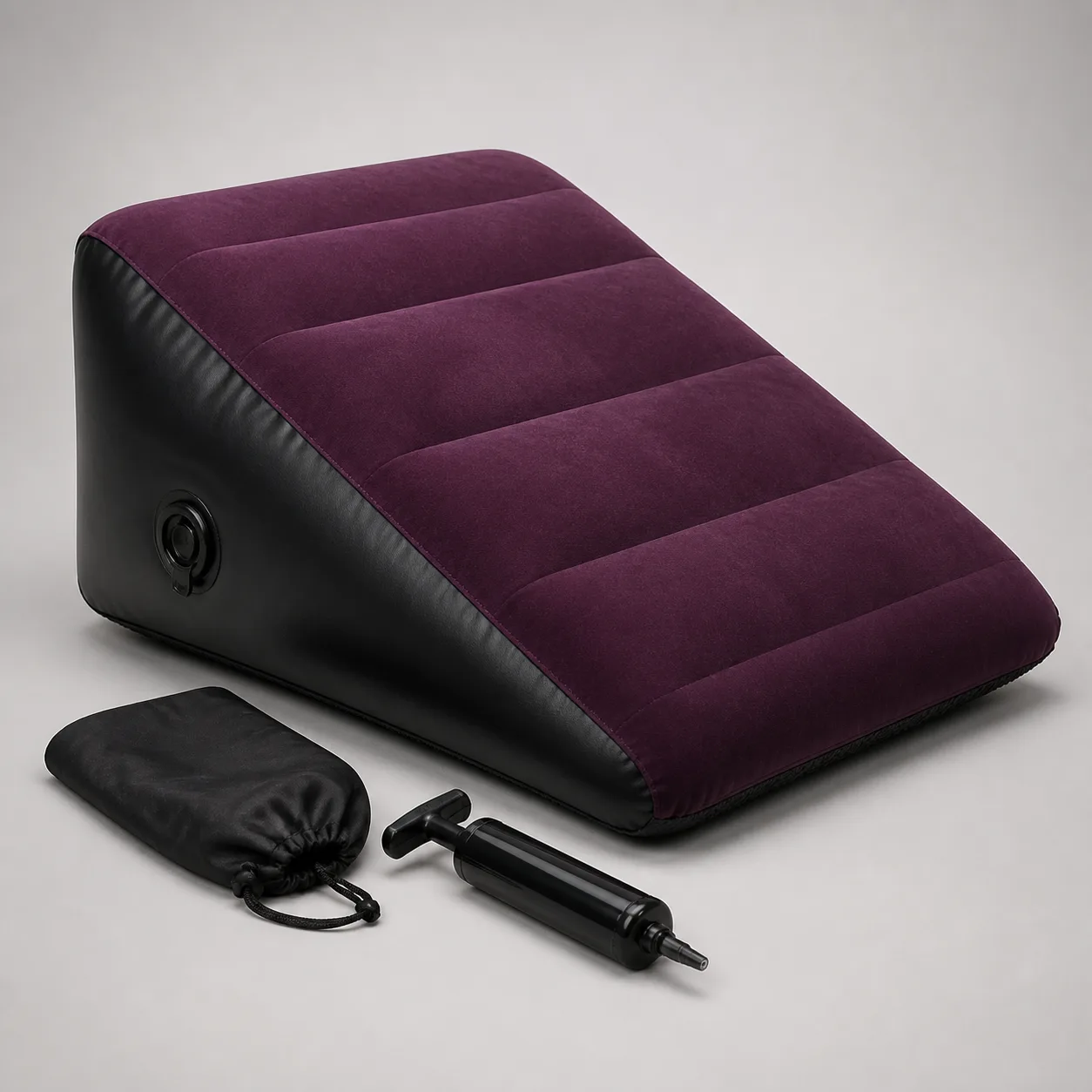
Adjustable Inflatable Intimacy Positioning Wedge
A compact inflatable positioning wedge evaluated through firmness control, seam integrity, valve placement, air retention and stable-angle testing.
39,99 $
200 in stock
Firmness begins with air volume, but shape matters just as much
An inflatable wedge changes support by changing internal pressure. That makes it easier to store than a solid foam ramp, yet it also means the working angle can shift as weight moves across the surface. Inflate the production sample on a clean floor, close the valve fully and let it rest before deciding whether its slope is suitable.
A very hard cushion is not automatically more stable. Overinflation can round the broad faces, reduce the contact patch and place extra stress on seams. A soft cushion can fold or roll toward an edge. The usable range needs to be established with measured pressure or a repeatable pump procedure, not by appearance alone.

Check the wedge on the floor before bringing it onto a bed
First evaluation belongs on a level, dry floor where sliding and deformation are easy to see. Press down on the high end, the low end and both upper corners. The base should stay flat, the valve should remain clear of pressure points and the cushion should recover without creasing sharply.
A mattress adds another moving layer. If the sample later passes floor testing, place it near the center of a firm mattress and apply load gradually. Stop if the wedge rolls, migrates, sinks into a gap or approaches the edge. It should never be used on a table, stool, chair or other elevated surface where a shift could cause a fall.
The valve is a critical component, not a storage detail
Inspect the valve base for puckering, thin material, exposed adhesive and a hard rim that can be felt through the side panel. Open and close it several times with dry hands. The cap or plug should seat positively without tools, and the valve should be positioned where it cannot be compressed under the main load.
Mark the inflated height, leave the wedge unloaded overnight and measure again in the same room. Repeat after controlled loading. Small temperature changes affect air pressure, so record temperature along with height. Persistent softening, hissing or bubbles during a compatible leak test requires rejection.
Support tests must use distributed weight and an explicit safety margin
The supplier page does not establish a verified load rating. Procurement should request one for the exact size and construction, then perform a progressive test with a broad padded fixture. Concentrated weights or a person standing on the cushion create forces unlike ordinary supported positioning and are not acceptable tests.
Observe seam stretch, sidewall bulging, base lift and valve movement at each step. Keep the working limit below the lowest load that produces unstable geometry. Do not stand, jump, bounce or place the entire body on the high edge. The wedge is a positioning aid, not a seat, step, lifting device or mobility support.
Surface feel can change when the fabric is damp
A flocked or textile-like top may feel grippy when dry but become slick after contact with moisture or a cleaner. Test friction with the exact care method intended for the production surface. Check for dye transfer onto a clean white damp cloth and for fibres that shed when rubbed.
Use a clean removable barrier when appropriate, provided it does not bunch or turn the slope into a slide. Stop if the surface causes heat, itching, abrasion or marked redness. Material identity, coating chemistry and compatibility with lubricants remain pending until supplier documents and a sample are reviewed.
Seam layout determines how the cushion behaves near its edges
Run a hand along every welded or stitched line while the wedge is partly inflated and again at its approved working firmness. Look for sharp flash, skipped sections, trapped fibres, uneven overlap and zones that whiten when flexed. The low edge should taper without forming a hard ridge under pressure.
Repeatedly load the center and then move the fixture toward each quadrant while staying inside the approved zone. A seam that creeps, peels, clicks or develops a blister should fail inspection. Production quality control should define permissible seam width and a sampling plan rather than relying on a visual check alone.
Plan the angle around the body instead of forcing the body onto the angle
Start with shallow elevation and a supported, neutral posture. The wedge can be rotated or partly deflated to change height, but it should not be folded while loaded. Hips, knees, shoulders and neck need independent support where necessary; one triangular cushion cannot safely fit every posture or body proportion.
Change position slowly and keep a stable handhold nearby. End use for pain, numbness, tingling, coldness, cramping, dizziness, shortness of breath, unusual swelling, bleeding or loss of balance. This item does not diagnose, treat or improve any medical condition, and it is not intended for rehabilitation or pregnancy support.
Cleaning is limited by an unverified cover and valve assembly
The current listing does not establish whether the surface is removable, washable or fully sealed. Until model-specific instructions are approved, deflate only after wiping the exterior with a soft damp cloth and a mild cleaner confirmed compatible with the sample. Keep liquid away from the open valve and do not immerse the cushion or pump.
Dry all faces with airflow before deflation and storage. Trapped moisture can create odor or damage an internal coating. Boiling, steam, bleach, strong solvents, pressure washing and machine washing are not assumed safe. Inspect the valve and seams again after cleaning because some materials soften when wet.
Deflation and storage should protect the internal coating
Open the valve without twisting its base. Let air escape naturally, then press from the high end toward the valve using broad hands; do not kneel on the folded cushion. Sharp creases in the same place can fatigue a coated textile, so roll or fold only as permitted by the verified care guide.
Store the dry wedge and pump in a clean pouch away from heat, sunlight, oils, sharp hardware and heavy objects. Before the next use, examine folded areas for sticking, cracking or colour change. A patch or adhesive should be used only if the supplier provides a tested repair system and clear limits.
Questions that a useful product page should answer after sampling
How high is the wedge at its approved firmness?
The production height and usable inflation range remain pending. They will be published only after repeatable measurement.
What load can it support?
No verified rating is available. A distributed-load test with a safety margin is required before a working limit is stated.
Is the top cover removable?
The source does not confirm that detail. Cover construction, closure design and care instructions must be checked on the sample.
Can an electric pump be used?
Only a pump and pressure limit approved for the exact valve should be used. High-pressure equipment can damage seams quickly.
Can the wedge be used in a bath or shower?
No ingress evidence has been approved. Keep it out of wet areas and prevent water from entering the valve.
Does it stay inflated overnight?
Air retention is a procurement test, not an assumed feature. Height should be recorded under controlled temperature before and after resting.
Supplier reference and provisional EU display price
The selected Alibaba listing, ID 1600480337744, displayed USD 2.40–2.60 with a one-piece minimum and showed a hand-pump variant. The planned EUR 39.99 display price provisionally allows for China-origin freight and dimensional-weight uncertainty, sample purchase, seam and valve inspection, overnight air-retention measurement, progressive load testing, colourfastness and surface-friction review, cleaning assessment, protective packaging, neutral labeling, payment processing and destination delivery. Supplier identity, freight, duty, tax, insurance, sample fees, quantity tiers, lead time and all purchasing conditions remain pending confirmation.
Procurement checklist for a repeatable production specification
Lock one exact size, colour and pump configuration. Record deflated dimensions, inflated height and slope, item weight, valve type, approved pressure range, static load limit, seam width, wall construction, top textile or coating, underside grip, air retention, dye transfer, cleaning method, repair limits and packaging. Obtain current material declarations and applicable restricted-substance evidence for the destination market. Labels, warnings, reports, freight, duty, tax and contract terms must be approved before any unverified specification is promoted.
Reviews
There are no reviews yet.