



Wireless Remote Vibrating Egg – Rechargeable Couples Control
August 14, 2026
Single-Bottle Massage Oil Warmer – 250ml Countertop Concept
August 14, 2026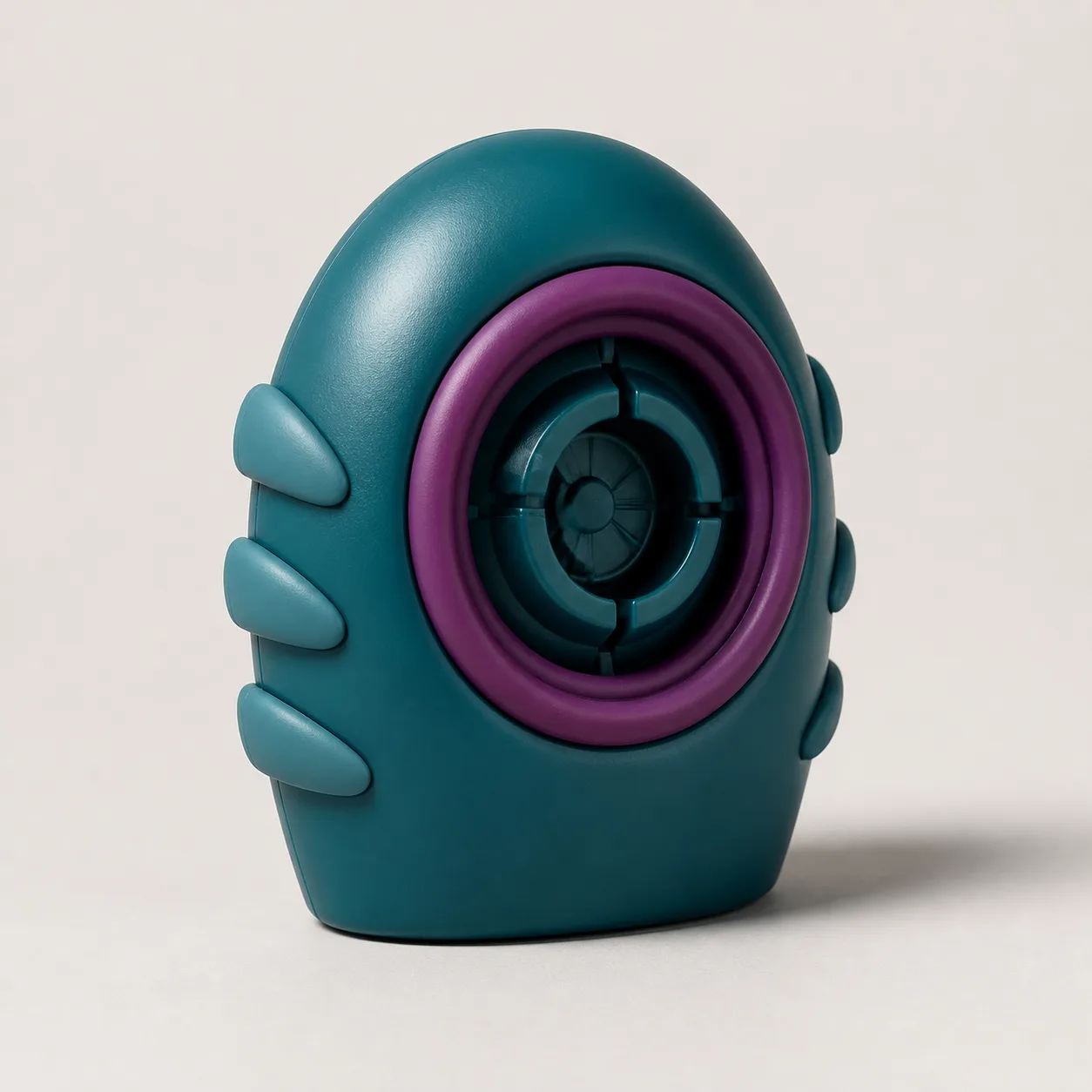
Cyclops-Pod Fantasy Manual Stroker
A compact one-portal fantasy manual stroker concept with side grip fins and evidence-led checks for its channel, liner and cleaning access.
44,99 $
200 in stock
The cyclops shell is a grip system, not decoration alone
This fantasy manual stroker concept uses a rounded teal pod, a single plum entrance ring and six low side fins. The fantasy character gives the hand clear landmarks, but the final design still needs measured grip span, wall flexibility and compression response.

No therapeutic, reproductive or other medical outcome is claimed.
The portal must be documented at rest and under stretch
Measure outer ring diameter, resting opening, ring thickness and the force required to expand it through a conservative test range. Inspect the transition from the plum ring into the recessed channel for folds, sharp steps or hidden seams.
Stop for pain, numbness, tearing or persistent skin change.
An internal map matters more than a fantasy name
Create a section drawing that records channel length, minimum and maximum internal diameters, texture height, texture spacing and the position of every narrowing. A supplier phrase such as monster-shaped does not explain the physical path.
No fit claim is approved until the minimum passage and stretch limit are measured.
Closed-end and open-end behavior are fundamentally different
Confirm whether the channel ends inside the pod, opens through the rear or uses a separate vent. For a closed route, measure trapped-air pressure and specify how it is released; for an open route, verify the rear edge and clean-out access.
Never block a designed vent or add an improvised plug.
The shell and liner need a defined relationship
Request an exploded view showing the rigid or semi-rigid shell, soft liner, portal ring, base and any adhesive. State whether the liner is removable, mechanically locked, bonded or moulded in place, because each construction changes cleaning and fatigue risks.
Reject a sample with liner creep, shell gaps or exposed bonding residue.
Side fins should create controlled compression
Measure force versus displacement at each pair of fins and at the smooth body panels between them. The grip should change pressure gradually without collapsing the channel, pinching the liner or creating a hard ridge against the hand.
Compression guidance must be based on the finished wall stack, not on a bare material swatch.
A stable base should prevent rolling during preparation
Record the flat footprint, standing angle and tip force required to knock the empty product over. Stability is useful for filling, drying and storage setup, but the base should not be promoted as a suction feature unless a tested suction structure exists.
Keep the pod away from edges where its rounded shell could fall.
Every material must be identified separately
The marketplace page uses broad silicone language without linking a report to the exact offered model. Confirm the shell, liner, ring, fins, colorants, adhesives and any internal support with lot-linked supplier documents.
No medical-grade, hypoallergenic, non-porous or latex-free wording is approved without suitable evidence.
Clean-out access decides whether the design is practical
Challenge the approved wash method with residue placed at the entrance transition, first constriction, deepest texture and channel end. If the liner is fixed, prove that water and a soft cleaning tool can reach and rinse every internal surface without inversion damage.
Do not use an unapproved brush, boiling water, solvent or chemical soak.
Drying must be verified at the deepest point
After the rinse protocol, place moisture indicators at the channel end and behind any removable liner flange. Record drainage orientation, airflow method and time to a dry result across multiple samples.
Do not close the product in a case while any internal surface remains damp.
Texture durability needs compression and cleaning cycles
Cycle the liner through stretching, hand compression, washing and drying, then inspect texture peaks, valleys, portal edge and channel end under magnification. Look for whitening, tears, tack, permanent deformation or a new seam line.
Production release needs a defined cycle count and rejection standard.
Odour and surface transfer require investigation
Record odour after unpacking, after the approved wash and after warm storage conditioning. Use suitable laboratory screening to investigate extractables, color transfer and oily surface migration rather than masking persistent odour with fragrance.
A sample with unexplained residue or persistent strong odour should not proceed to sale.
Storage should preserve the portal and side fins
The packaging insert should support the pod without compressing its ring, flattening the fins or forcing the channel closed. If a breathable pouch or drying stand is included, it must appear in the approved bill of materials and pass color-transfer checks.
Store the clean dry product away from heat, direct sun and incompatible surfaces.
The sourcing price is only the beginning
The Alibaba lead displays USD 15.08 for 1 to 49 units, USD 14.58 for 50 to 99 and USD 13.58 from 100. Supplier identity, rights to the unbranded model, construction, materials, channel specification and packaging remain pending.
The procurement reference is a sourcing lead only. The EUR 44.99 plan allows for China-origin freight, a sample, dimensions, channel mapping, compression, materials, vent, seams, cleaning, drying and fatigue checks; freight, duty, tax, insurance, payment fees and destination terms remain pending.
Compare the pod with simpler open-ended sleeves
The enclosed fantasy pod offers a structured grip and distinctive shell, while an open-ended sleeve usually provides easier through-rinsing and direct airflow for drying. Neither format is inherently better without verified dimensions, texture, clean-out access and material evidence.
Choose the construction that can be inspected and maintained consistently.
Frequently asked questions
What are the internal dimensions?
Channel length, minimum diameter, maximum diameter and texture profile remain pending section measurement.
Is the liner removable?
Removal, attachment method, flange geometry and reassembly instructions remain pending a production sample.
Does the pod have an air vent?
Open-end, closed-end and vent construction must be confirmed before airflow guidance is approved.
Are the side fins firm or flexible?
Material hardness and force-versus-displacement measurements remain pending finished-product testing.
How should the inside be dried?
The validated drainage orientation, airflow method and drying time will be published after moisture-indicator testing.
What should be inspected before use?
Check the portal, liner, channel, shell seams, fins and base for tears, tack, residue, deformation, gaps or persistent odour.
Reviews
There are no reviews yet.