



Ten-Piece Padded Bondage Starter Kit
August 14, 2026
Xuanqi 1170 Lace Nightdress or Belted Robe: M-XL
August 14, 2026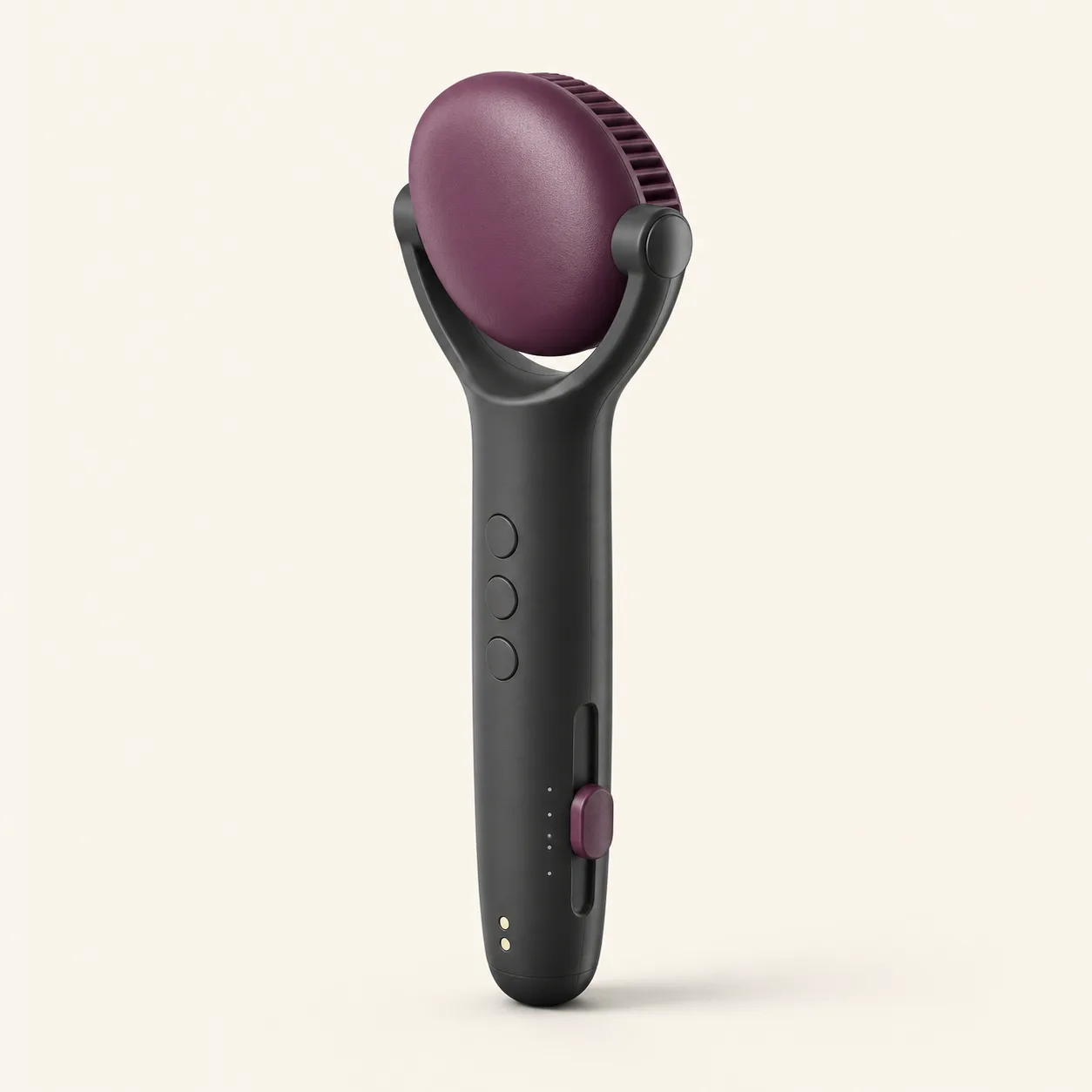
Five-Position Counterbalance Wand with Dual-Surface Pivot Head
A rechargeable external wand concept with a captive five-position balance slider and an oval pivot head offering smooth and shallow-ribbed contact faces.
42,99 $
200 in stock
A movable grip weight changes how this wand balances
This counterbalance wand massager concept places a captive five-position slider beside the lower grip and a broad oval head in a two-sided pivot yoke. Moving the slider changes leverage at the wrist, while rotating the head selects a smooth dome or shallow ribbed contact face.

The rail is a mechanical balance control, not a power or intensity control. Both mechanisms need sample testing before the design can be offered for sale.
Account for every moving and contact component
Confirm the handle shell, three controls, charging contacts, captive slider, rail, index detents, internal weight, yoke arms, pivot hubs, oval head and both face textures. Request disclosure of hidden springs, magnets, bearings, bushings, stops, seals, fasteners and adhesives.
Small revision changes can alter retention, cleanability and balance.
Measure the handle, rail and oval head
Record overall length, handle circumference, grip taper, rail length and depth, slider projection, yoke clearance, head width, thickness, edge radius and contact-face area. Measure the assembled mass and the distance from the grip center to the head axis.
Published dimensions should come from a production sample, not the visualization.
Map all five balance positions
Place the unpowered wand on a low-friction balance fixture and locate its center of gravity at each indexed slider position. Record the position spacing, detent force, grip angle and wrist torque with the head straight and at both pivot stops.
The useful setting is the one that remains controllable for the intended grip, not automatically the furthest setting.
Challenge slider capture before powered testing
With the product over a padded tray, apply controlled push, pull, shake and drop tests within written supplier limits. Check whether the slider skips an index, protrudes beyond the rail, exposes a sharp edge or releases its internal weight.
Any cracked track, loose mass, unexpected travel or detachable slider fails qualification.
Inspect the rail as a pinch and residue zone
Measure the smallest gap around the slider at every setting and while the handle flexes under normal grip force. Use visible test soil to check whether the rail can be cleaned without forcing debris beneath the shell.
Keep skin, hair and fabric away from the moving slot while adjusting the balance.
Verify the dual-surface pivot and its stops
Rotate the head only while the wand is switched off. Document the travel angle, stop positions, actuation torque and whether each face centers positively without relying on motor vibration to hold it.
The smooth dome and ribbed face must remain distinct, stable choices rather than a freely spinning disc.
Cycle the yoke under controlled side load
Use a fixture to repeat the approved pivot motion, then test low axial and lateral loads at both stops. Recheck hub play, yoke symmetry, face alignment, noise and any opening around the pivot.
Wobble, exposed hardware, creeping angles or a widening gap require rejection.
Compare output on both faces and angles
Map amplitude, frequency, sound and surface temperature at each control setting with the slider centered. Repeat on the smooth and ribbed faces at the straight position and both verified head angles.
A different contact texture can change perceived intensity even when the motor setting is unchanged.
Confirm controls, lockout and shutdown behavior
Identify power, increase and decrease functions by test rather than button shape. Measure long-press timing, setting order, memory behavior, accidental activation force, low-battery indication and emergency shutdown response.
The balance slider and head pivot should be adjusted only after power is off.
Use externally with light pressure and full control
This wand is intended for external contact only. Begin at the lowest verified output, support the grip without covering ventilation or the rail, and avoid pressing hard enough to stall the head or force the pivot away from its stop.
Stop for pain, numbness, skin irritation, excessive heat, unusual noise, odor, swelling, loss of control or any movement in the slider or yoke.
Qualify charging and thermal limits
Confirm battery chemistry, rated capacity, charge input, supplied cable specification, charging time, runtime and protection circuitry. Log temperatures at the battery, controls, motor, pivot and contact face during charging and the longest approved operating cycle.
Do not operate while charging unless the exact production instructions expressly permit it.
Verify materials for every face and mechanism
Request composition for both head surfaces, pigments, handle shell, slider, rail liner, yoke, pivot hardware, seals and adhesives. Review hardness, porosity, restricted-substance and skin-contact evidence for the exact color and revision.
Water resistance, cleaner compatibility and any claimed silicone grade remain pending until documented and sample-tested.
Clean the ribbing, yoke and rail separately
Switch off, isolate the charging contacts and follow confirmed mild-cleaning instructions. Use a soft cloth around the smooth dome, across each rib, along the yoke recess and beside the stationary slider without flooding unverified seams.
Dry the head edges, pivot hubs, rail and charging contacts completely before storage or charging. Boiling, soaking, bleach, alcohol and abrasive tools are not approved without exact evidence.
Build the planning price from a category benchmark
An Alibaba showroom lists a rechargeable waterproof wand massager at USD 5.88-6.18 with a one-piece minimum. It is a category reference only and does not establish this five-position counterbalance and dual-surface pivot design, a legal supplier or a production quotation.
The procurement reference supports an EUR 42.99 planning price after allowing for China-origin freight, mechanism-specific quotation, dimensions, center-of-gravity mapping, slider retention, rail safety, pivot cycling, output and thermal testing, material review, cleaning validation, protective packing and discreet fulfillment. Packed size, weight, freight, duty, tax, insurance, payment fees and destination terms require confirmation.
Frequently asked questions
Does the slider change vibration strength?
No. It is proposed to shift the center of gravity; output is controlled by the buttons.
Can the balance weight be removed?
No. The concept uses a captive slider, and any release or exposed internal weight is a fault.
May the head rotate while powered?
No. Switch off first, then move the head only between verified positive stops.
Which head surface is gentler?
The smooth face may feel broader, but actual sensation depends on measured output, angle, pressure and individual sensitivity.
Is the wand intended for insertion?
No. This design is described for external contact only.
When should the product be retired?
Retire it for a loose slider, cracked rail, moving weight, yoke play, failed pivot stop, split surface, water ingress, battery swelling, abnormal heat or trapped residue.
Reviews
There are no reviews yet.