


Smart Heated Cupping Massager – Compact Wellness Design
August 14, 2026
Rechargeable Countdown Release Lock Module
August 14, 2026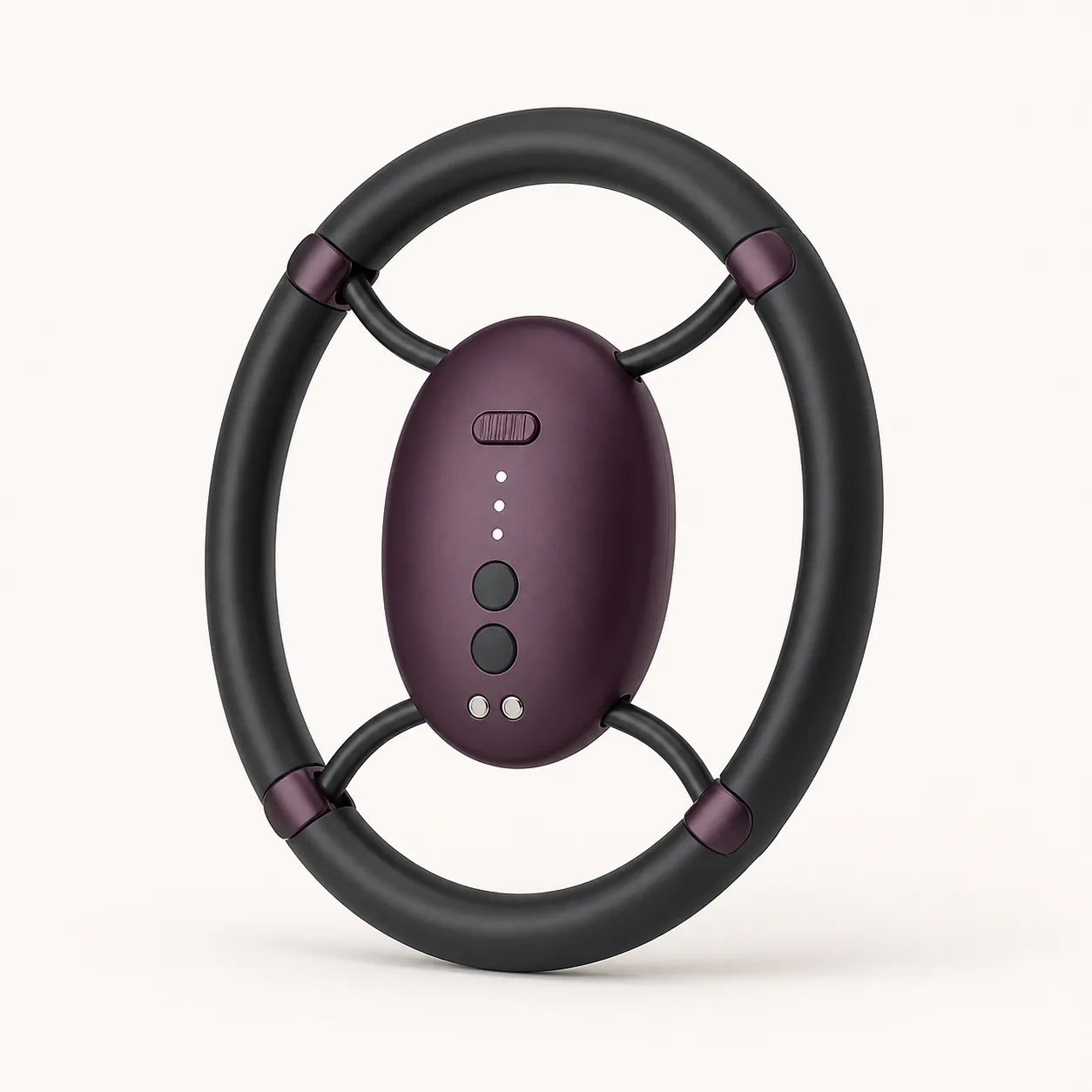
Four-Arch Torsion-Balanced Couples Ring
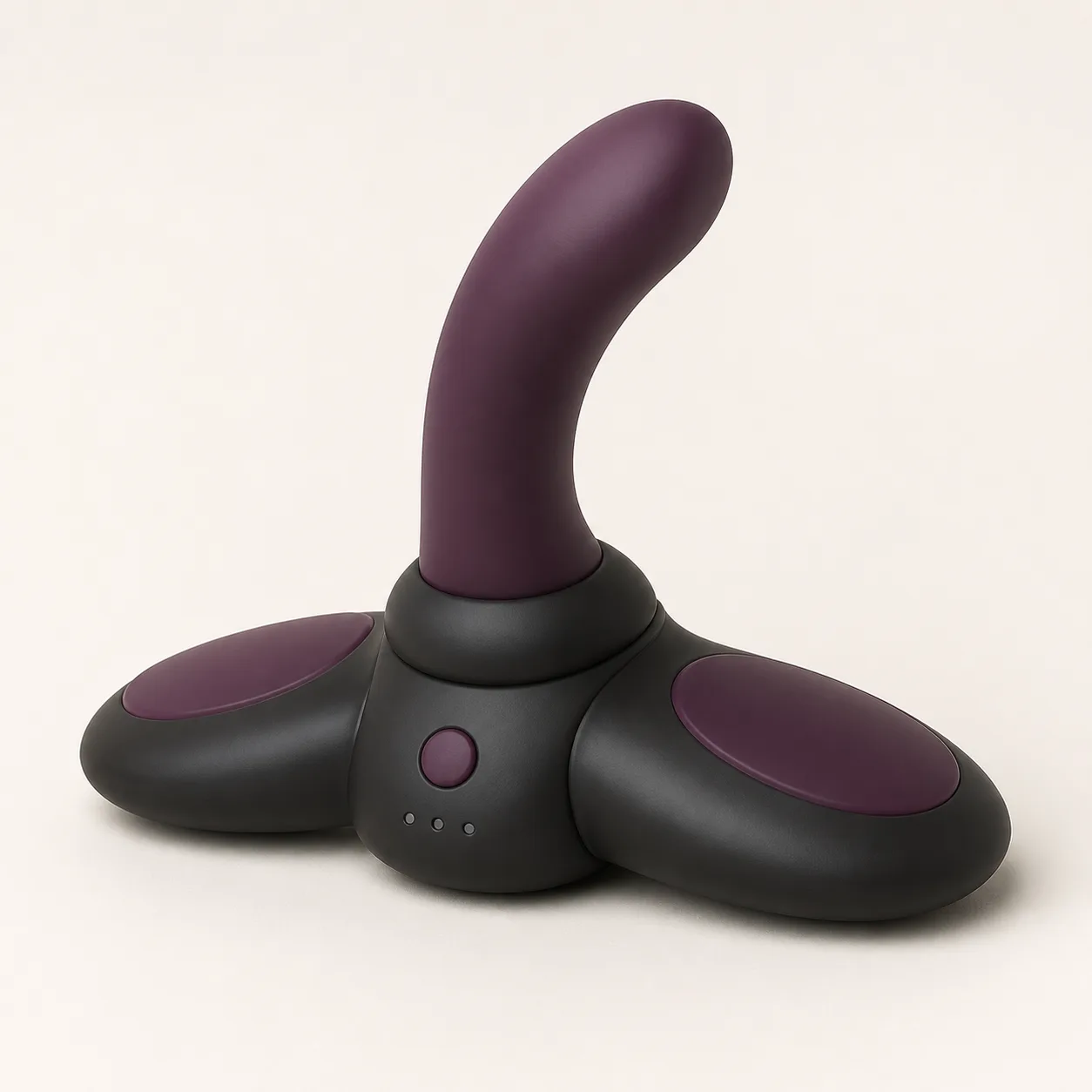
A couples vibrator ring concept with one central contact pod suspended by four guarded spring arches and a three-position preload selector.
68,99 $
200 in stock
Balance one contact pod on four spring arches
This four-arch torsion-balanced couples ring concept suspends one smoky-plum oval contact pod inside a thick charcoal oval loop. Exactly four curved spring arches meet four guarded plum joints, while a pod slider beside three white dots proposes three preload states.

The image defines an evaluation layout and does not confirm fit, arch behavior, output, materials, battery or production status.
Name every ring suspension and electrical part
Label outer loop O0; pod P0; arches A1-A4; guarded joints J1-J4; slider L0; states I1-I3; controls B1-B2; charging contacts C1-C2; actuator, mount, controller, cell, seals, pigments, adhesives and internal reinforcement.
Require exact-sample drawings showing the load path through every arch and joint.
Measure the outer oval loop
Record relaxed inner axes, cross-section, hardness, stretch force, torsional stiffness, recovery, seam placement and mass. Cycle symmetric and offset fixture expansion while logging permanent set.
Reject cracks, whitening, thin zones, tack, seam opening or nonuniform recovery.
Calibrate arch A1 through A4
Measure free curvature, cross-section, bending stiffness, torsional stiffness, attachment depth and pod reaction for each arch. Load each quadrant alone, adjacent pairs and diagonal pairs.
Four visible arches are not balanced until force-displacement curves and pod displacement agree within defined limits.
Inspect four guarded joint transitions
Probe J1-J4 through the supported ring and pod movement range. Record joint rotation, gap change, cover movement, bond strength and local stress during repeated expansion and torsion.
Reject accessible pinch gaps, cover lift, sharp edges, arch pullout or loop tearing.
Verify three proposed preload settings
Map L0 travel and I1-I3 to arch tension, pod height, pod tilt and ring distortion. Approach each state from both directions under no load and controlled fixture expansion.
Three dots remain reference marks until direct measurements establish repeatable preload states.
Characterize the central contact pod
Record pod length, width, thickness, edge radius, mass, surface hardness, shell seams, control travel and mount stiffness. Measure pod displacement and tilt under centered and offset forces.
Reject loose shells, exposed hard transitions, arch contact with the pod edge or uncontrolled mount movement.
Build ring fit and pod pressure maps
Use instrumented compliant forms spanning bounded fixture sizes. Record ring force, contact area, pod pressure, arch strain, joint rotation, pod tilt and slider drift at I1-I3.
Do not translate fixture results into universal-fit, comfort or hands-free claims.
Map vibration through pod arches and loop
Measure acceleration, frequency and harmonics at the pod center, four pod edges, A1-A4, J1-J4 and four loop quadrants for every confirmed program and preload state.
Compare desired pod output with energy lost into the ring or amplified at hard joints.
Document control priority and stop behavior
Map B1-B2 and L0 actions for startup, program, intensity, preload selection, pause, immediate stop, travel lock and low-battery indication. Test deliberate and accidental sequences.
The shortest stop action must work from every confirmed state without requiring program cycling.
Validate charging heat and power protection
Confirm C1-C2 polarity, input limits, charge time, operating time, low-voltage cutoff, standby drain and contact temperature. Log heat at the pod, actuator, controller, cell, arches, joints and loop.
Exact battery chemistry, capacity, charging cable and transport documents remain pending supplier evidence.
Probe seams gaps and cleaning traps
Apply visible test soil to the loop seam, all guarded joints, arch roots, pod mount, slider, buttons and contacts. Record cleaning access, residue, drying time, swelling, corrosion and joint fogging.
No waterproof or immersion claim is made without exact-model ingress documentation and testing.
Confirm materials and surface durability
Request declarations for the loop, arches, joint covers, pod shell, surface layer, pigments, adhesives and seals. Test odor, color transfer, abrasion, bond strength, flex cracking and chemical compatibility.
No silicone, body-safe, hypoallergenic or certification claim is accepted while traceable evidence remains pending.
Cycle ring expansion preload and fault events
Cycle bounded ring stretch, I1-I3 changes, pod output, stop, lock, charging, cleaning and storage. Challenge one-arch restraint, offset pod load, low voltage and power loss in guarded fixtures.
Retire samples for loop cracks, arch drift, joint damage, pod separation, abnormal heat, charging faults, fluid entry or cell swelling.
Build landed price after four-arch validation
An Alibaba wearable-vibrator category page showed one example starting at USD 7.99 with a one-piece minimum. It is a broad benchmark only and does not identify this four-arch ring or an approved supplier.
The public procurement benchmark supports an EUR 68.99 planning price after provisional allowance for China-origin freight, exact samples, ring and arch metrology, three-preload calibration, pressure and output maps, joint guarding, sound, heat, charging, cleaning, fault and fatigue work, protective packing and discreet fulfilment. Exact supplier, quote, MOQ, dimensions, materials, battery, packed weight, freight, duty, tax, certification, payment terms and lead time remain pending.
Frequently asked questions
What do the four arches do?
They propose a suspended pod support whose real stiffness and balance require direct measurement.
Are there three confirmed preload levels?
No. The three-dot slider requires pod-height, tilt and force calibration.
How much can the ring stretch?
Supported range and recovery remain pending exact-sample force-displacement testing.
Does vibration stay in the pod?
Transfer into arches, joints and loop must be measured for each program and preload state.
Is the device waterproof?
No ingress rating is claimed for the pod, joints, controls or charging contacts.
Which faults require retirement?
Loop cracks, arch drift, joint damage, pod separation, heat, fluid entry or cell swelling.
Reviews
There are no reviews yet.