



Emerald Crown-Collar Curved Vibrator
August 14, 2026
Temperature-Display Curved Vibrator
August 14, 2026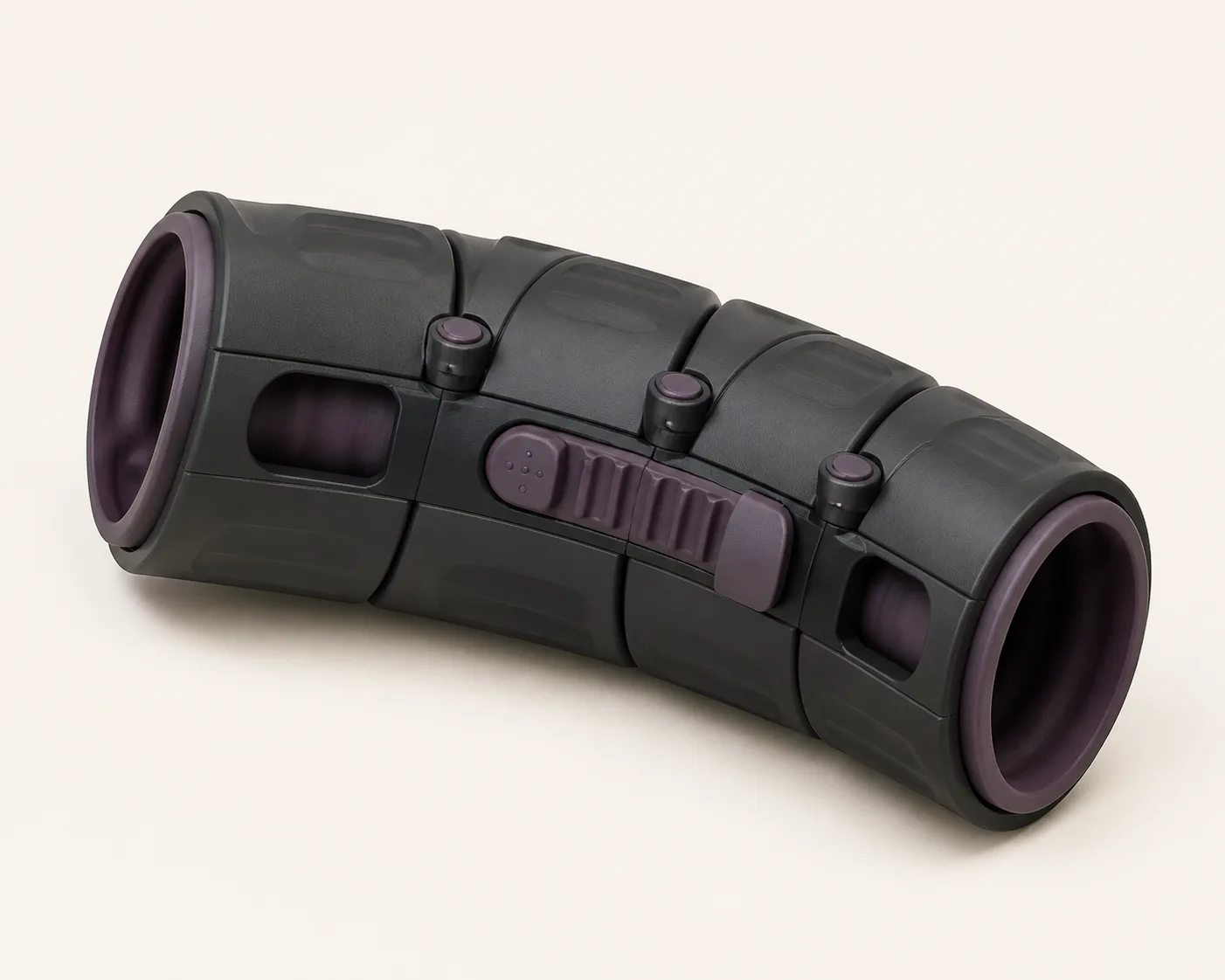
Four-Segment Flex-Hinge Manual Stroker with Three-Stop Curve Lock
A non-powered open-ended stroker concept with four rounded shell segments, three guarded spine hinges, a removable through-liner and a three-stop curve lock.
39,99 $
200 in stock
Curve four shell segments around one through-liner
This four-segment flex-hinge manual stroker concept divides one open-ended grip shell into exactly four rounded sections linked by three guarded spine hinges. A three-stop curve lock is intended to hold a selected shell profile around one removable through-liner.

The image does not establish hinge range, locking strength, fit, pressure, liner material, airflow, cleaning method or manufacturing availability.
Inventory every segment hinge and liner part
Require a complete-set list for shell sections S1 through S4, end collars, three hinge bodies, pins, bushings, pivot caps, stops, spine rail, curve slider, detents, unlock tab, keepers, liner, rims, internal retainers, inspection-window edges, grip inserts, thread, coatings, pigments, lubricants and adhesives.
Identify captive and removable parts plus the approved separation sequence before accepting serviceability.
Measure straight and curved geometry
Record total length, external width and height, opening diameters, segment lengths, gaps, hinge centers, spine offset, window positions, grip flats, mass and balance. Measure relaxed liner length, rim dimensions, wall thickness and installed tunnel path.
Repeat at every confirmed lock position approached from both directions and after bounded flex, cleaning and storage cycles.
Calibrate all three guarded hinges
For H1, H2 and H3, measure axis position, rotation range, friction, backlash, stop angle, restoring tendency and lateral play. Map segment alignment and shell-gap change through the complete permitted arc.
Reject pin migration, cap lift, hard stop impact, progressive loosening, torsional racking or an inward edge that approaches the liner.
Verify the three-stop curve lock
Measure slider travel, detent force, unlock force, backlash, indication and actual centerline curvature at all three stops. Test false seating, partial travel and one-handed local release without load escalation.
A lock state must remain obvious through both inspection windows and must not hide a hinge that is between stops.
Seat and retain the removable liner
Measure rim capture, axial insertion force, installed stretch, rotational alignment, end exposure, wall support, removal force and reassembly cues. Check whether bending makes the liner creep, bunch, twist or pull away from an end collar.
Specify which curve state permits removal; forcing the liner across a locked hard interface is not an accepted cleaning method.
Map tunnel contour and texture continuity
Use graduated compliant mandrels to map internal diameter, wall compression, texture height, transitions and minimum passage along the full curved centerline. Record local changes at every segment boundary and hinge plane.
Reject abrupt ridges, collapsed walls, thin spots or a curve that folds the liner into a hard crease.
Measure pressure at every curve state
Instrument the tunnel along entry, S1-S4 centers, three boundaries and exit. Record circumferential pressure, axial drag, compression recovery and local peaks under fixed mandrel size, lubrication condition and hand force.
Do not infer an anatomy fit or safe maximum compression from the external slider position; exact limits require sample evidence.
Verify airflow and immediate local release
Measure open-path airflow with the liner empty, on standardized mandrels and under hand compression at each curve state. Determine whether bending or rim loading can obstruct the through opening.
Document the fastest local pressure-release route and confirm it does not depend on cycling the curve lock through a higher-compression state.
Screen hard-soft interfaces and pinch gaps
Use soft film around collars, segment seams, hinge gaps, spine rail, slider, unlock tab and window edges while straight, curved, squeezed and released. Inspect inside the shell for hard projections toward the liner.
Challenge misaligned rims, twisted liner, partial lock, pin drift and side loading; no skin-contact area should reach a hard moving gap.
Characterize grip force and manual loading
Measure required grip span, shell friction, squeeze deformation, bending moment, lock drift and segment twist under representative two-hand and one-hand fixtures. Record how grip position changes tunnel pressure.
The hinge spine and slider should remain outside primary load zones, and the unlock tab should resist accidental operation without becoming inaccessible.
Confirm materials and compatibility
Request exact compositions for liner, rims, shells, hinges, pins, bushings, slider, grip inserts, coatings, pigments, lubricants and adhesives. Seek restricted-substance, skin-contact, corrosion, colorfastness and odor evidence for the production lot.
Test only supplier-approved lubricants and cleaners for swelling, tack, haze, pigment transfer, cracking and loss of hinge lubrication.
Validate cleaning separation and drying
Document unlock, straightening, liner removal, washing, rinsing, shell wiping, hinge protection, measured drying, inspection and reassembly. Check windows, rim grooves, hinge recesses and spine-channel ends for retained moisture or residue.
Store the liner and shell fully dry with hinges unloaded and the lock released; exact immersion limits remain pending.
Cycle curves grips cleaning and retirement
Cycle all three curve states, unlock, bending, liner seating, standardized manual loading, approved lubricant, cleaning, drying and storage. Recheck angles, play, detents, liner retention, tunnel pressure, airflow, gaps, grip and odor.
Retire the set for torn rims, liner thinning, permanent folds, pin migration, cap lift, hinge looseness, cracked segments, lock drift, false seating, sharp window edges, swelling, persistent tack or residue.
Build landed price from exact-set evidence
An Alibaba stroker-sleeve page showed an open reusable textured-liner category example at USD 1.24-1.41 with MOQ one. It is a liner benchmark only and does not confirm this four-segment hinged shell or an approved supplier.
The procurement reference supports an EUR 39.99 planning price after allowing for China-origin freight, exact-set sourcing, segment, hinge and curve metrology, liner fit and retention, tunnel pressure and airflow maps, interface and grip checks, materials and compatibility review, cleaning, drying and cycle work, protective packing and discreet fulfillment. Exact quotation, MOQ, packed size, weight, freight, duty, tax, insurance, payment fees, certifications and delivery terms remain pending.
Frequently asked questions
What curve does each stop create?
Exact centerline radius, hinge angles, tolerance and approved use boundary require sample measurement.
Can the liner be removed while curved?
The approved separation state and removal force remain pending; forcing it across locked interfaces is excluded.
Does bending increase pressure?
Pressure, drag and minimum tunnel diameter must be mapped at every segment and curve setting.
Can the hinges pinch?
All shell seams, hinge gaps, spine parts, windows and slider edges need soft-film screening through adjustment and grip.
Which lubricant is compatible?
Only exact-lot material evidence and controlled compatibility tests can establish an approved lubricant.
Which defects require retirement?
Torn or folded liner, rim damage, pin migration, loose hinges, cracked segments, lock drift, sharp edges, swelling, tack or residue.
Reviews
There are no reviews yet.