


Purple Double-End Flex-Neck Wand with Bulb Head and Tapered Tip
August 14, 2026
Six-Loop Ladder Positioning Strap with Twin Padded Quick-Release Cuffs
August 14, 2026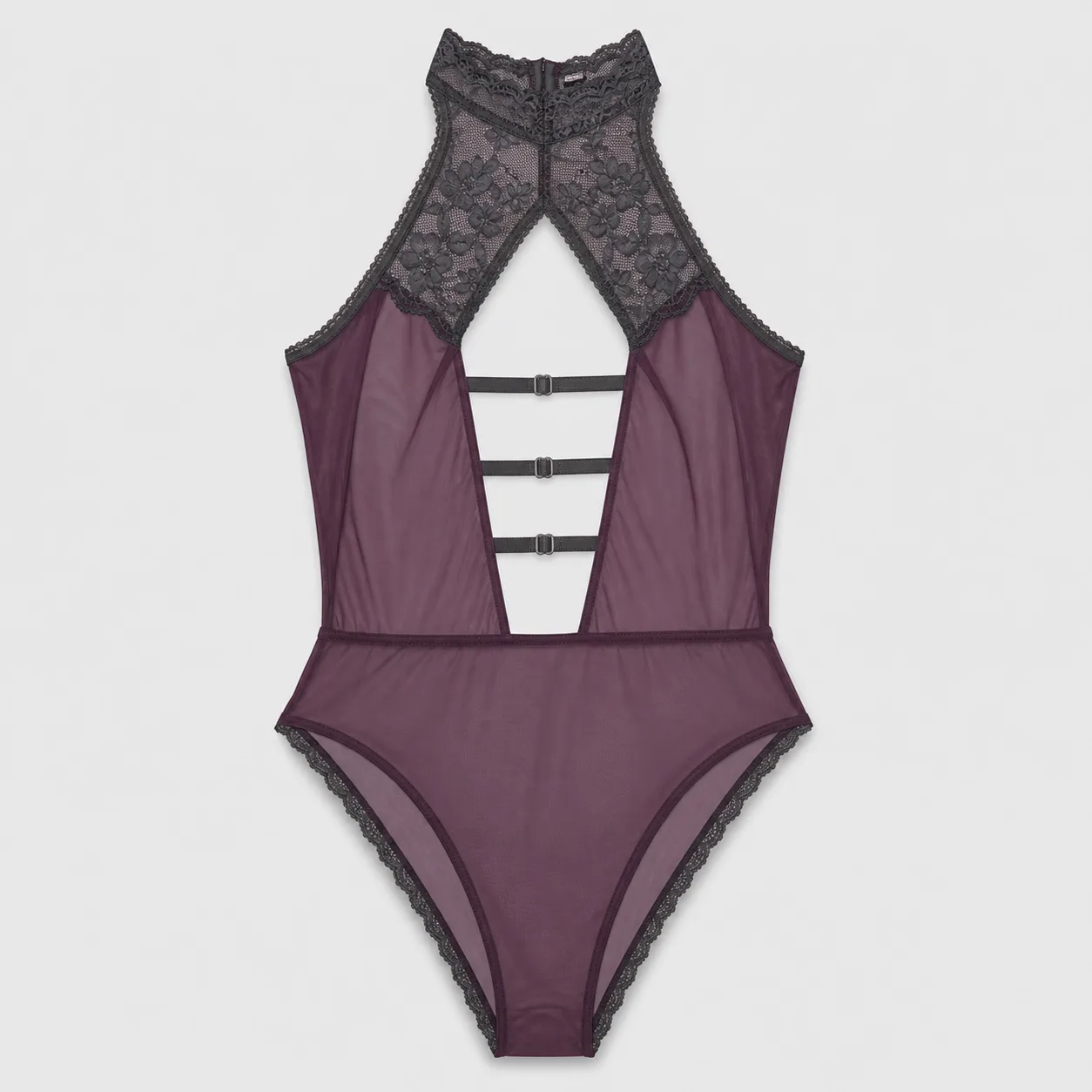
High-Neck Lace-and-Mesh Bodysuit with Inverted-V Front Cutout and Three Bridge Straps
A single smoky-plum mesh bodysuit concept with a charcoal floral-lace high-neck yoke, deep inverted-V front cutout, exactly three adjustable bridge straps and lace-edged high-cut legs.
39,99 $
200 in stock
Frame a high-neck lace and mesh bodysuit around one graphic cutout
This high-neck lace and mesh bodysuit concept combines a charcoal floral-lace shoulder yoke with a smoky-plum mesh body. A deep inverted-V front cutout and exactly three horizontal bridge straps create the central geometry, while narrow lace edging follows the high-cut leg openings.

The rendering fixes design direction, not production facts. Fibre content, opacity, stretch, dimensions, hardware, seam strength and available sizes remain pending.
Confirm one self-contained sales unit
The planned pack holds exactly one bodysuit. A bra, separate brief, robe, skirt, stockings, garters, gloves, jewellery, hanger and storage pouch are outside the proposed unit unless a later approved packing list states otherwise.
The yoke, mesh torso and brief section are joined into one garment; the three centre straps are construction features rather than detachable accessories.
Engineer the floral-lace yoke as a stable neckline anchor
Record finished neck circumference, yoke depth, shoulder width, lace motif position and closure method. The high neckline must lie flat without transferring excessive tension into the mesh side panels or distorting the upper edge of the cutout.
Motif symmetry, seam allowance visibility and any rear fastening require review on every graded sample, not just the flat-lay reference.
Define the inverted-V front cutout with measurable boundaries
Measure opening width at the top, midpoint and waist, plus the vertical distance from the yoke seam to the waist seam. Stabilize both diagonal edges so the shape remains balanced after stretching, dressing and the validated care cycle.
The design proposes one deep centre opening. Its actual coverage depends on body proportions, size selection and tested fabric recovery.
Space exactly three bridge straps across the opening
Specify three strap levels, finished widths, adjustment ranges, slider positions and attachment reinforcements. Confirm that each strap can be adjusted without twisting and that the spacing remains visually even when the garment is under expected wear tension.
No fourth bridge strap is included. Final hardware composition, coating, nickel status and corrosion resistance remain unverified.
Shape sleeveless armholes without cutting into the yoke
Map front and back armhole curves, binding width, underarm height and the transition between lace and mesh. Test forward reach and arm lift across the full proposed size range while inspecting the lace edge for curling, abrasion or seam separation.
Comfort and fit cannot be inferred from a front-facing product image; they require physical fit sessions.
Use the waist seam as a load-sharing line
Record relaxed and extended waist circumference, seam allowance, stitch type and the intersection with both diagonal cutout edges. The waist join should distribute tension into the lower body without creating a hard ridge or pulling the three bridge straps downward.
Any elastic, clear tape or reinforcement layer inside this seam must appear in the technical specification and component bill.
Grade the high-cut legs from body measurements
Publish garment waist, high hip, full hip, front rise, back rise, leg opening and torso-girth measurements for each size. Check that grading the leg curve does not reduce gusset width or shift the lace edging into a pressure point.
High-cut describes the pattern line only; it is not a promise of identical coverage on different bodies.
Resolve rear coverage and crotch construction before sale
Approve the back neckline, back opening, seat coverage, gusset layers and crotch closure or closed-seam method from a complete sample. Conduct dressing, sitting, bending and walking trials to identify edge roll, seam pressure and unintended exposure.
No snap closure, cotton gusset or specific rear shape is promised until the approved pattern and packing specification confirm it.
Verify mesh lace binding and thread as separate materials
Request fibre composition, fabric construction, mass per square metre, stretch, recovery, abrasion, snag resistance and restricted-substance documents for every textile, trim, elastic and sewing thread. Match test reports to the actual colour and production lot.
Polyamide, polyester, elastane, recycled, hypoallergenic and skin-friendly claims remain withheld without component-level evidence.
Test extension and recovery along the torso axis
Measure stretch in width and length, then repeat after controlled cycles and laundering. Compare neck, bust, waist, hip, torso girth, leg opening and bridge-strap dimensions before and after conditioning to set usable tolerances.
A bodysuit can fit differently from a two-piece set because shoulder-to-crotch length is a critical dimension, so generic one-size language is not acceptable without evidence.
Inspect sliders joins and strap ends under repeated adjustment
Cycle all three adjusters through their intended ranges while watching for sharp edges, coating loss, strap fray and slipping. Pull-test every strap attachment and inspect reinforcement after the same care sequence planned for the finished garment.
Hardware load limits and metal composition remain pending supplier documentation and laboratory review where required.
Check transparency shade and colour transfer in realistic conditions
Evaluate the plum mesh and charcoal lace over contrasting underlayers in daylight and warm indoor light. Test dry rubbing, damp rubbing, simulated perspiration and washing for each fabric, binding, elastic, thread and label.
Sheerness varies with stretch and lighting. The page must publish verified opacity observations rather than treating the visualization as a universal result.
Build care and risk guidance from the finished assembly
Validate water temperature, detergent, cycle, drying position and storage method on complete garments. Protect lace, mesh and adjusters from hooks, rough surfaces and high heat; stop use if torn mesh, exposed hardware, failed seams or colour transfer appears.
Flammability, chemical, fibre-label and apparel rules vary by destination. Market-specific testing, labels and professional compliance review remain pending.
Plan price from bodysuit benchmarks plus landed-cost reserves
An Alibaba black lace bodysuit page displayed a halter hollow-out bodysuit reference at USD 2.80 to 3.80 with MOQ 2, a floral-lace teddy at USD 1.19 to 2.03 with MOQ 100 and a floral-mesh one-piece at USD 5.30 to 6.10 with MOQ 2. A lace one-piece supplier page displayed a long-sleeve mesh bodysuit reference at USD 4.90 to 5.90 with MOQ 3. These are broad category examples, not quotations for this high-neck three-strap design or approved suppliers.
The public procurement benchmark supports an EUR 39.99 planning price after provisional allowance for China-origin freight, graded torso samples, lace and mesh testing, three-strap adjustment trials, seam reinforcement, discreet fulfilment and expected apparel handling loss. Exact supplier, quote, MOQ, sizes, colours, fibres, packed weight, freight, duty, tax, certification, payment terms, lead time and production availability remain pending.
Frequently asked questions about this high-neck bodysuit
How many straps cross the front cutout?
Exactly three horizontal bridge straps are proposed, each with an adjustment point that still requires sample testing.
Does the bodysuit include stockings?
No. The planned sales unit contains one bodysuit only, with no stockings, garters or separate underwear.
Is the mesh completely transparent?
Transparency changes with stretch, colour, lighting and underlayers, so verified opacity observations are still required.
Does it have a snap crotch?
No closure construction has been confirmed. The approved sample must establish whether the crotch is closed or uses tested fasteners.
Which sizes will be offered?
The range remains pending a graded measurement table and torso-girth fit sessions.
Can the garment be machine washed?
Only if the complete assembly, including lace, mesh, elastic, thread and three adjusters, passes a documented machine-care cycle.

Reviews
There are no reviews yet.