



Dual-Profile Flexible Double-Ended Dildo with Central Grip Saddle
August 14, 2026
Four-Cell Differential-Pressure Automatic Stroker with Captive Through-Liner
August 14, 2026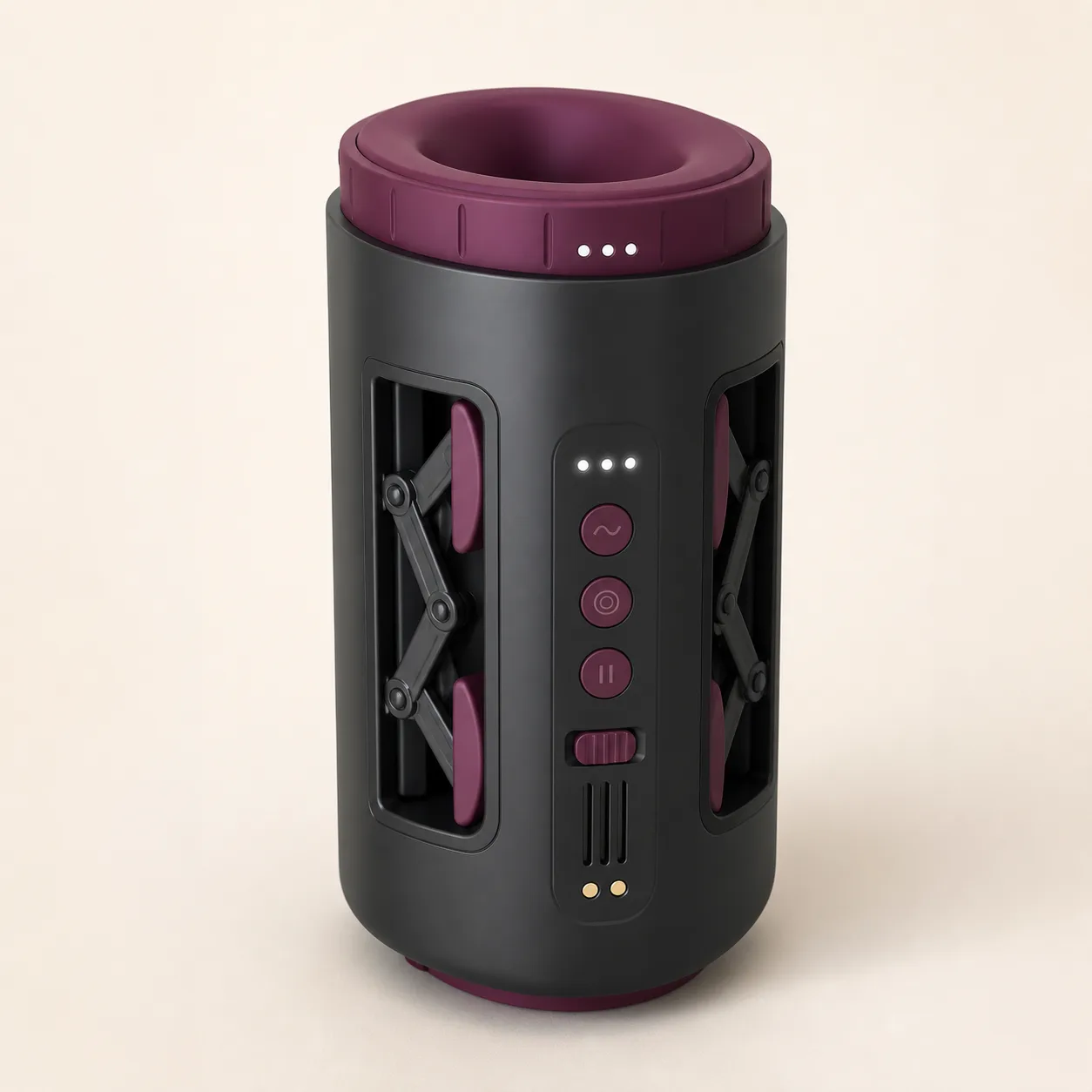
Opposed Dual-Scissor Four-Pad Automatic Stroker with Open-End Liner
A compact automatic stroker concept with two opposed guarded X-linkages proposed to drive four compression pads around a removable open-end liner.
64,99 $
200 in stock
Compress an open-end liner from two scissor panels
This dual scissor automatic stroker concept places one guarded X-linkage window on each side of a compact shell. Each opposed linkage carries an upper and lower compression pad, creating four proposed contact stations around a removable open-end liner without adding a thrust rail.

The image does not prove linkage count behind the guards, pad travel, compression force, liner fit, sequence, vent behavior, runtime, materials or supplier approval.
Inventory both complete drive sides
Request an exploded drawing and bill of materials for the rim, liner, collar, shell, two windows, two X-linkages, arms, center pivots, end pivots, guides, four pad carriers, four pad skins, actuators, cams, sensors, guards, frame, controller, buttons, indicators, emergency vent, cooling vent, cell, contacts, conductors, seals, pigments, lubricants and adhesives.
Trace loads from every pad through its linkage and frame to the opposite side.
Measure the baseline shell and liner geometry
Record overall height, width and depth, rim dimensions, open-end diameter, liner length, neutral channel dimensions, collar overlap, window size, pad faces, station spacing, linkage pivots, guide clearances, vent areas, control positions, mass and center of gravity.
Repeat with the liner installed, removed and standardized by collar orientation.
Solve each scissor linkage kinematically
Track every pivot coordinate, arm angle, mechanical advantage, carrier travel, pad tilt, backlash and hard-stop margin through the permitted cycle. Compare left and right sides under no load and standardized compliant resistance.
Reject over-center states, unequal arm contact, rotating fixed pins or a carrier that cocks in its guide.
Align all four compression pads
Measure face height, inward projection, parallelism, neutral clearance and play at the upper-left, lower-left, upper-right and lower-right stations. Approach each position from opening and closing directions.
Map manufacturing tolerance because one high pad can carry load before the other three engage.
Characterize compression timing
Record startup, inward travel, dwell, recovery, overlap and neutral parking for single-side, opposed, alternating and four-pad sequences where supported. Repeat across charge levels and compliant loads.
Log skipped stations, phase drift, unequal dwell and any program that closes before the emergency vent has reset.
Map liner pressure and deformation
Use an instrumented compliant mandrel to record local pressure, circumference change, channel displacement, liner folding, shear and migration at and between all four stations. Repeat with small axial and rotational offsets.
Set conservative limits from the highest local peak and liner crease, not average shell load.
Verify the removable open-end liner
Measure insertion force, collar rotation, engagement torque, axial play, false locking, creep, extraction force, cleaning access and drying time. Inspect the liner after repeated four-pad compression for thinning, tears, permanent folds and hard spots.
Confirm both ends remain open and unobstructed throughout approved operation and immediate stop.
Calibrate the quarter-turn collar
Record travel, detent depth, stop strength, index repeatability and resistance to loosening during compression. Test dry and damp grip conditions without using the visible three dots as proof of three settings.
A collar must not appear seated while leaving the liner or shell incompletely engaged.
Inspect all guarded mechanism gaps
Probe arm crossings, pivots, carrier guides, pad edges, window rims, collar seam, emergency slider and bottom opening throughout motion, liner changes and cleaning. Use articulated fixtures rather than fingers.
Guards must prevent access while allowing visual inspection and removal of residue by the validated method.
Document controls and emergency venting
Verify startup hold, level changes, sequence selection, pause, immediate stop, memory, lockout and indicator meanings. Measure emergency-slider force, vent opening time, airflow and reset under no load and compliant load.
Confirm loss of power, a jam or a failed sensor leaves the liner in a releasable neutral state.
Measure battery, current and heat
Confirm cell chemistry, capacity, protection, charger input, contact polarity, charge time, runtime method, storage guidance and transport paperwork. Log current and temperature at every pivot, guide, pad zone, liner, shell, controller, vents, contacts and cell.
Compare one-side, alternating and four-pad operation, including a partly obstructed cooling vent.
Test single and paired obstruction faults
Block one pad, two pads on one linkage and opposed upper pads using protected fixtures. Measure force, current, detection time, shutdown, neutral opening, cool-down and restart behavior.
Do not force a stalled X-linkage by hand or re-energize a cracked, rattling or hot sample.
Cycle compression, collar and cleaning together
Run repeated sequences, compliant loading, immediate stops, liner removal, collar locking, charging, cleaning, measured drying and storage. At checkpoints repeat linkage geometry, pad alignment, timing, pressure, liner condition, vent response, current, sound and heat.
Validate cleaning behind pad edges, within both guarded windows, around pivots and guides, at collar tracks, controls, vents and contacts.
Price after opposed-load testing
An Alibaba automatic male-masturbator listing currently shows an open-ended telescopic category example at USD 16.18-21.56 with MOQ one set. It is a powered-category benchmark only and does not confirm this opposed dual-scissor architecture, four compression pads or removable liner.
The procurement reference supports an EUR 64.99 planning price after allowing for China-origin freight, exact-model sourcing, teardown, kinematic metrology, four-pad alignment, compression timing, liner pressure maps, collar testing, guarded-gap inspection, emergency vent verification, battery, heat and obstruction review, combined cycle life, material evidence, cleaning validation, protective packing and discreet fulfillment. Exact quotation, MOQ, packed size, weight, freight, duty, tax, insurance, payment fees and delivery terms remain pending.
Frequently asked questions
Do both X-linkages move independently?
That remains pending teardown, per-side motion and current measurements.
Are there exactly four internal pads?
The visualization shows four; exact production count and geometry require an approved sample.
Does this design thrust or rotate?
No such claim is made; the concept centers on opposed inward compression.
Can the liner be removed for cleaning?
That is proposed, but collar release, compatibility and measured drying require validation.
Does the vent prevent every pressure fault?
No. Opening time, airflow, blockage response and neutral release must be tested.
Which faults require retirement?
A loose pivot, bent arm, skewed pad, torn liner, false collar lock, jammed vent, exposed conductor, swollen cell or abnormal heat.
Reviews
There are no reviews yet.