


Deep-Sea Spiral Fantasy Suction-Base Wand
August 14, 2026
Five-Size Stainless Steel Ball Stretcher Ring Series
August 14, 2026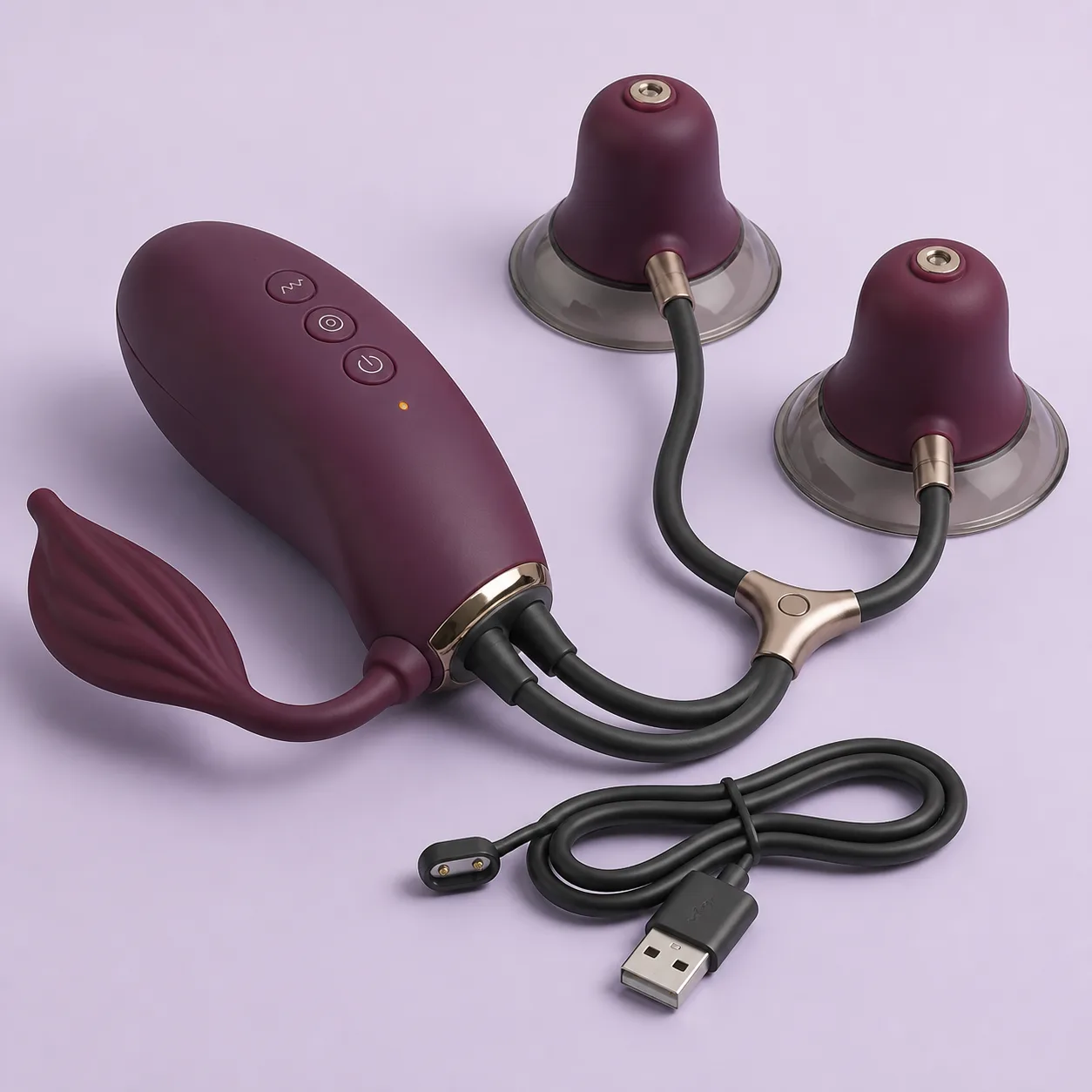
Oscillating Leaf Tongue and Dual-Cup Stimulator
A three-part external stimulator concept combining an abstract oscillating leaf paddle with two pressure cups and a measured quick-release plan.
54,99 $
200 in stock
A three-part set needs three independent checks
This tongue and dual cup stimulator concept pairs an abstract leaf-shaped oscillating paddle with two external pressure cups. Paddle travel, cup pressure and their combined electrical load must be documented separately before the functions are presented as one system.

Every contact component in this concept is intended for external use only.
The leaf paddle should be described by motion, not anatomy
Measure tip travel, sweep angle, frequency, edge thickness and flex at each setting. Confirm whether it oscillates side to side, flicks, vibrates or combines movements under a compliant load.
Stop for pain, numbness, persistent irritation or broken skin.
Paddle edges need a fatigue test
Cycle the flexible leaf through its full motion while warm and lightly loaded. Inspect the tip, ribbed surface, root and neighboring housing for whitening, splits, sharp flash and permanent deformation.
A torn root can expose a harder internal carrier and must be rejected.
Two cups should not be assumed to share pressure equally
Measure negative pressure and pulse timing at each cup simultaneously. Hose length, connector tolerances and rim leakage can cause one side to pull more strongly even when the pump has only one setting.
Publish the allowed imbalance and reject sets outside it.
Each smoky rim needs dimensional evidence
Record inside diameter, outer flange span, wall thickness, edge radius and compression set. The cup should create and release a seal without a rigid ring contacting the skin.
Lift an edge to vent pressure before moving the cup; do not drag a sealed rim.
The Y connector is a control point, not decoration
Verify barb depth, locking force, flow direction and whether the center button vents both branches. Pull and twist every hose joint under pressure, then inspect for cracks, whitening and leakage.
A quick release should work with one hand and without restarting the pump.
Pressure duration needs a conservative limit
Log peak pressure, pulse frequency, continuous-hold time and automatic release behavior. Because skin response varies, avoid promising a universal session length and stop when color, sensation or comfort changes.
Never apply pressure over injured, inflamed or numb skin.
Controls must distinguish paddle from pump
Map every button and indicator for power, paddle mode, cup pressure and release. Similar icons can cause the pump to start when a user expects only movement, so each state needs tactile and visible confirmation.
One reachable action must stop motion and vent both cups immediately.
Hose material affects both airflow and care
Confirm inner and outer diameter, durometer, kink radius, plasticizer content and resistance to cleanser. Repeated bending near the pump and cups should not narrow the bore or create a hidden crack.
Replace any hose that becomes cloudy, sticky, flattened or loose.
Material records must cover the entire fluid path
The marketplace’s broad silicone wording does not identify the mulberry shell, leaf paddle, smoky cup rims, hose, connector, adhesives or internal valve materials. Request lot-linked declarations for every component exposed to skin or cleaning fluid.
Check odor, tack, dye transfer, oil bleed, swelling and coating wear after conditioning.
Cleaning requires removable-path instructions
Determine which cups and hoses detach, which passages can be flushed and how the pump is protected from liquid. Clean the external paddle separately from the pressure circuit, then drain and air-dry all approved washable parts before reconnection.
Do not immerse the powered body, boil hoses or use abrasive cleanser without exact documentation.
Ingress claims cannot ignore open pneumatic ports
No water-resistance rating is approved for the concept. A test boundary must cover the paddle root, buttons, housing seam, charging contacts, pump inlet and hose outlets in both connected and disconnected states.
Charge only when the body, ports and cable are completely dry.
Combined runtime can differ sharply from paddle-only use
Confirm cell chemistry, capacity, charging input, full charge time and low-power behavior. Record runtime and temperature for paddle alone, pump alone and the highest permitted combination with both cups sealed on a test fixture.
Stop using a unit with abnormal heat, odor, swelling or erratic pressure.
The price reserves room for pressure instrumentation
The Alibaba lead displays USD 7.65 for 1 to 99 pieces, USD 6.94 for 100 to 499, USD 6.59 for 500 to 4,999 and USD 6.17 from 5,000. The accessible page does not expose supplier identity, cup layout, measured pressure or variant-specific documents.
The procurement reference is a sourcing lead only. The EUR 54.99 plan allows for China-origin freight, a complete sample set, paddle-fatigue tests, calibrated pressure and airflow measurement, sound and electrical review; freight, duty, tax, insurance, packaging, payment fees and destination terms remain pending.
This set suits buyers who want coordinated external contrast
It is aimed at adults interested in a flexible moving contact plus two adjustable pressure cups from one handheld system. A paddle-only vibrator or two manual cups may suit shoppers who prefer simpler controls, fewer hoses and a shorter drying routine.
Final mode descriptions will follow measured motion and pressure data, not marketplace adjectives.
Frequently asked questions
Is the leaf paddle anatomically realistic?
No. It is an abstract flexible shape whose travel, frequency and edge finish require measurement.
Do both cups pull with the same pressure?
That must be tested at both branches; hose and rim tolerances can create an imbalance.
Can the paddle and cups run separately?
Independent operation is a design requirement, but the production control map remains pending.
How is pressure released?
The final product must provide a verified quick vent; users should also be able to lift a cup edge to break the seal.
Can the powered body be submerged?
No immersion guidance is approved without ingress evidence for the pump ports, paddle root, buttons, seams and contacts.
What should be checked before use?
Inspect the leaf, cup rims, hoses, Y connector, ports, controls and charging contacts, then test stop and pressure release away from the body.
Reviews
There are no reviews yet.