


LCD-Window Teal Tentacle Vibrator
August 14, 2026
Twin-Slider Open Couples Ring with Opposed Contact Pads and Compact Remote
August 14, 2026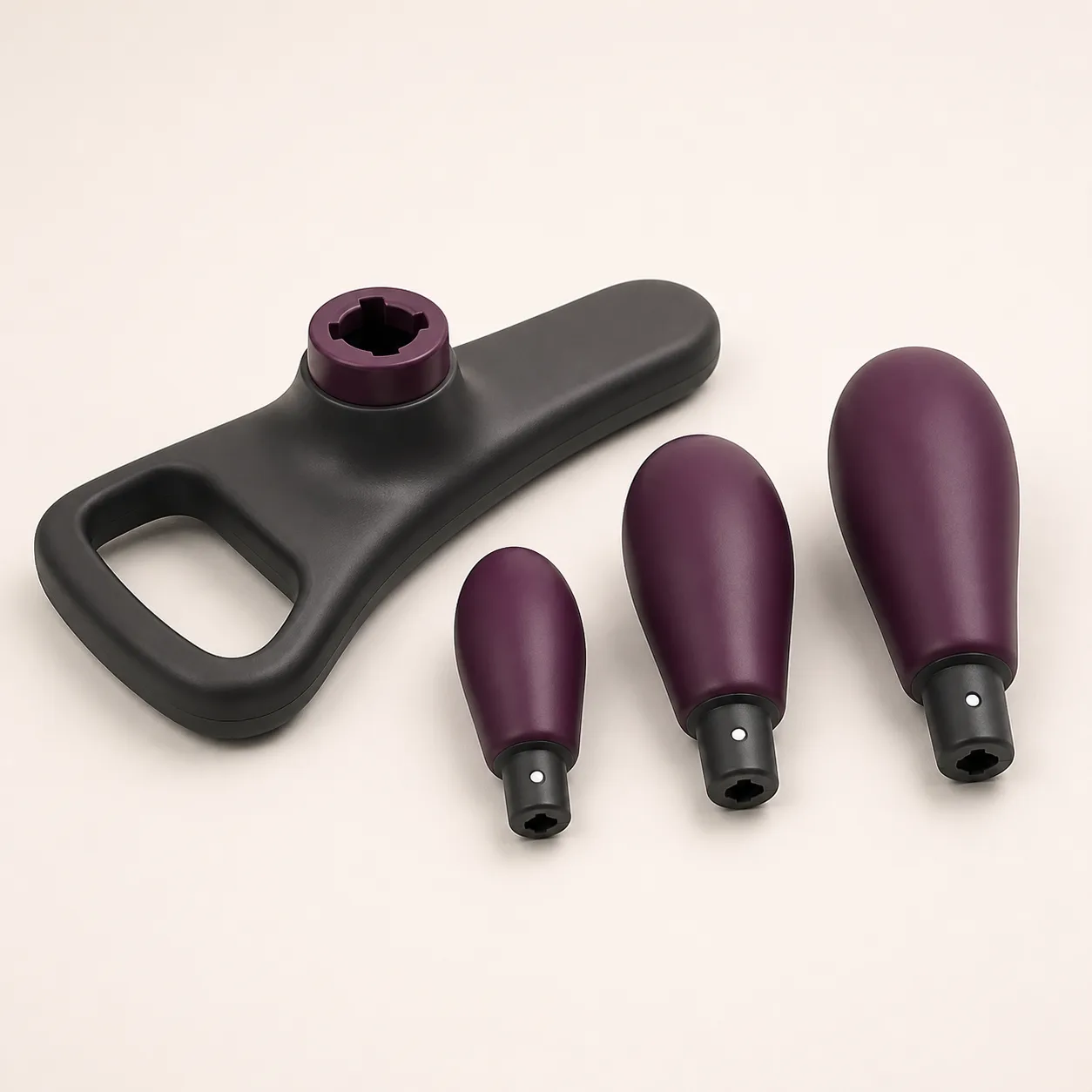
Quarter-Turn Interchangeable Anal Trainer with Three Graduated Heads
A non-powered modular anal trainer concept with one broad external T-base and three graduated smooth heads secured by keyed quarter-turn connectors.
34,99 $
200 in stock
Three graduated heads share one external safety base
This interchangeable anal trainer set concept separates three smooth deep-plum tapered heads from a broad charcoal T-base. Each head has a short keyed connector with an alignment dot; the base carries a raised quarter-turn socket and an open grip loop.

The proposed system is entirely non-powered. A shared base reduces stored bulk but makes connector security and socket hygiene critical qualification points.
Confirm all four primary pieces and hidden retainers
Inventory the base, small head, medium head and large head before first use. Ask the supplier to identify every hidden seal, spring, insert, pin, adhesive or reinforcement inside the keyed joint.
An incomplete set or mixed connector revision must be quarantined.
Build a measured head progression chart
Record total head length, maximum diameter, tip radius, taper angle, neck diameter, usable length and mass for all three sizes. Photograph each profile against the same calibrated grid.
Size names alone cannot establish a safe or meaningful progression.
Map the keyed connector on every head
Measure connector diameter, projection, key width, key depth, alignment-dot position and edge radius. Compare the three parts for molding drift, flash, cracks and deformation after storage.
A connector should enter the socket without tools, excessive stretching or lubrication inside the locking interface.
Document the complete quarter-turn path
With clean dry components, align the dot, insert to the measured seating depth and rotate to the positive stop. Record required angle, torque and final dot position for each head.
Color alignment and friction are not substitutes for a mechanical stop.
Apply axial and torsional retention tests
Mount the assembled product on a padded fixture and apply controlled pull, push and twist loads below a documented supplier limit. Watch for connector lift, base distortion, socket rotation or head wobble.
Any head that releases, creeps or develops play under qualification load fails the set.
Repeat the lock cycle before approving durability
Run a defined sequence of assemble, rotate, unlock and separate cycles with every head. Recheck engagement torque, stop position, retention and visible wear at planned intervals.
Permanent key rounding, socket cracking, sticky rotation or reduced holding force requires retirement.
Inspect the assembled interface for hard edges
Examine the head-to-socket shoulder under bright angled light and with a soft swab. Confirm that no connector, sharp rim, pinch gap or step becomes exposed when the base is bent gently on a fixture.
The connection must remain outside the supplier-defined insertable boundary unless exact evidence says otherwise.
Keep the entire T-base and loop external
Measure base span, thickness, neck width, socket height, loop opening and distance from the connector center to every outer edge. Test low-force deformation on a soft fixture.
The whole charcoal base, loop and socket stay outside the body at all times; the loop is a removal grip, not an anchor point for added weight.
Choose a head through comfort, not a schedule
Start with the smallest verified head, abundant compatible lubricant and unhurried external control. Advance only when insertion and removal remain comfortable and the base stays stable.
There is no required timeline. Pain, bleeding, numbness, unusual resistance, loss of base control or connector movement means stop.
Change heads only after complete removal
Remove the full assembly, separate the head from the base and clean and dry the lock before choosing another size. Never rotate the socket, swap a head or test connector security while the product is inserted.
If a head separates unexpectedly or any object is retained, stop and seek prompt qualified medical help rather than using tools.
Verify every material and lubricant pairing
Request composition for all head surfaces, connector bodies, base, socket, pigments, internal retainers, seals and adhesives. Review restricted-substance and skin-contact evidence for the exact factory revision.
Hardness, porosity, cure chemistry, lubricant compatibility and barrier compatibility remain pending and cannot be inferred from color.
Clean the socket as a separate high-risk cavity
Disassemble the set and follow confirmed mild-cleaning instructions for heads and base. Wash every head individually, then use a soft swab around the socket keys, floor, rim and loop without forcing debris deeper.
No boiling, dishwasher, bleach, alcohol, abrasives or shared use is approved without exact material and construction evidence.
Dry and store without loading the connectors
Dry each head, connector key, socket cavity, base underside and loop completely. Store heads separated in labeled compartments so no weight rests on the short keyed stems.
Before assembly, inspect for cracks, swelling, sticky texture, odor, staining, rounded keys, loose inserts or residue.
Price the modular design above a conventional set
An Alibaba showroom lists a three-size anal trainer kit at USD 3.18-3.44 with a 20-piece minimum. It is a conventional category benchmark and does not establish one shared quarter-turn base, keyed heads or a specific legal supplier.
The procurement reference supports an EUR 34.99 planning price after allowing for China-origin freight, exact-model quotation, component and dimension checks, key and socket mapping, engagement and retention testing, repeated lock cycles, interface and base-safety review, materials, lubricant and cleaning validation, protective packing and discreet fulfillment. Packed size, weight, freight, duty, tax, insurance, payment fees and destination terms require confirmation.
Frequently asked questions
Are the three heads separately usable?
No. Each head requires the verified shared T-base to provide the external safety stop.
How is a head locked into the base?
Align the keyed connector, seat it fully and rotate to a measured positive stop while all parts are clean, dry and away from the body.
Can heads be swapped during use?
No. Remove the complete assembly before unlocking, cleaning or changing any component.
Is the loop an attachment point?
No added weight or restraint is planned; the loop is an external grip for controlled removal.
Which size should be used first?
Begin with the smallest measured head and advance only according to comfort, never a fixed schedule.
Which faults require immediate retirement?
A rounded key, cracked socket, loose insert, head wobble, reduced lock torque, exposed rim, base deformation, sticky surface or trapped residue.

Reviews
There are no reviews yet.