


Fine-Mesh Care-Cloth Wash Bag with Covered Zipper
August 14, 2026
Sound-Reactive Curved Palm Vibrator
August 14, 2026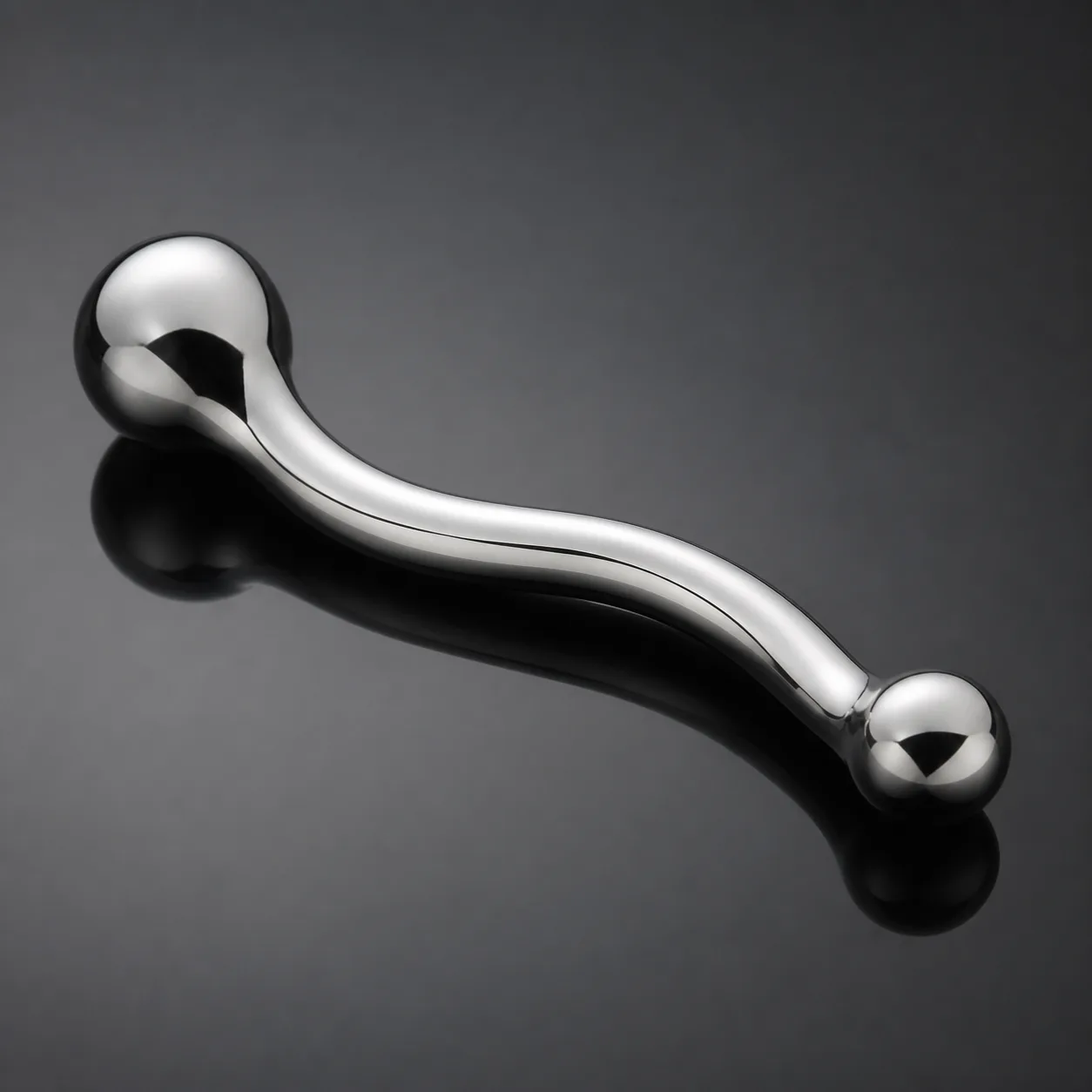
S-Curve Dual-Ball Metal Pleasure Wand
A polished rigid S-curve pleasure wand concept with unequal spherical ends and evidence-led checks for geometry, mass and alloy.
39,99 $
200 in stock
Two ball sizes make this a measurement-led design
This dual ball metal pleasure wand concept places one larger sphere and one smaller sphere at opposite ends of a shallow polished S curve. The two ends should be compared by verified diameter, weight distribution and angle, not by assuming that either one fits a particular body or experience level.

No therapeutic, pelvic-health, prostate-health or other medical outcome is claimed.
The large ball needs more than a diameter number
Record maximum diameter, sphere roundness, neck transition, distance from the tip to the center of the curve and projected insertion profile. Measure circumference directly rather than calculating it from an unverified nominal diameter.
Choose only from confirmed dimensions and stop for pain, numbness or bleeding.
The smaller end requires its own geometry sheet
Measure its diameter, transition radius, neck width and alignment with the centerline. A smaller sphere may still have a demanding approach angle if the shaft begins curving immediately behind it.
Do not treat the two ends as automatic progression stages.
The S curve should be mapped along its centerline
Record overall length, arc rise, bend locations, minimum shaft diameter and grip span. A side-profile drawing with tolerances will explain leverage and reach more accurately than a three-quarter photograph.
Do not lever the rigid wand against the body.
Mass and balance change the handling experience
Measure net mass and center of gravity, then record the holding force needed at the center and near each end. A solid metal tool can shift quickly if the heavier sphere passes beyond the hand’s balance point.
Maintain a secure dry grip and support the wand during every position change.
Every transition must be continuous under magnification
Inspect both spheres, both necks, the S bends and central grip under grazing light. Look for flats, grinding lines, ripples, pits, tool marks, seams and abrupt radii that are difficult to see in mirror reflections.
Reject any sample that snags a lint-free cloth or shows a visible joint line.
Alloy identity needs lot-linked evidence
The marketplace page uses stainless-steel language without a chemistry report tied to the offered unbranded model. Request composition, manufacturing method, passivation and any coating or surface-treatment documents for the complete wand.
No 304, 316 or medical-grade claim is approved without traceable evidence.
A mirror finish is not the same as verified smoothness
Specify and measure surface roughness at both ends, the transitions and inner and outer curves. Polish should remain consistent after cleaning and corrosion conditioning without revealing pores or directional scratches.
Retire a unit with roughness, pitting, flaking, staining or deep damage.
Temperature changes require conservative control
Metal responds quickly to ambient temperature, but no heating or cooling range is approved without material identity and a documented method. Check temperature with an independent thermometer and keep exposure within a comfortable, verified limit.
Do not use boiling water, open flame, freezers or extreme temperature sources.
Cleaning guidance depends on joints and surface treatment
Confirm whether the wand is one solid piece, welded, brazed, coated or plated. Validate the supplier-approved wash, rinse and dry method at both necks and the inner S curve where residue can hide in a poor joint.
Do not assume dishwasher, chemical soak or sterilization compatibility.
Corrosion tests should include handling residues
Condition the sample with approved cleaning agents, simulated-use media and repeated hand contact. Inspect for fingerprints that do not wash away, discoloration, crevice change, pitting and altered surface roughness.
Store only after the entire surface is clean and dry.
Storage must prevent impacts and scratches
A dense curved wand can damage itself or nearby objects if it rolls or falls. The final packaging should immobilize both spheres, protect the mirror surface and provide a separate lint-free storage pouch if included in the confirmed bill of materials.
Keep it away from harder metal tools, glass edges and abrasive fabrics.
Inspection before each use is fast but essential
Rotate the wand under bright light and run a clean lint-free cloth over both ends, transitions and curves. Confirm that no scratch, dent, burr, stain or joint change appeared during storage or cleaning.
A rigid damaged surface should not be used.
The provisional price includes metal-specific validation
The Alibaba lead displays USD 8.46 for 3 to 49 units, USD 7.89 for 50 to 99,999 and USD 6.99 from 100,000. Supplier identity, rights to the offered unbranded model, alloy, dimensions and finishing specifications require confirmation.
The procurement reference is a sourcing lead only. The EUR 39.99 plan allows for China-origin freight, a sample, dimensions, mass, balance, radii, surface, joints, alloy, corrosion and cleaning checks; freight, duty, tax, insurance, packaging, payment fees and destination terms remain pending.
Compare rigid precision with flexible alternatives
This concept is for adults intentionally comparing a dense rigid S-curve tool with two different spherical ends. A flexible wand offers more give, while glass offers different weight and breakage considerations; neither should be chosen without verified geometry.
The approved specification will state exact mass and both end profiles.
Frequently asked questions
What are the two ball diameters?
Large and small diameters, circumferences, neck widths and tolerances remain pending measurement.
Is the wand solid stainless steel?
Solid construction, alloy grade, joining method and passivation remain pending traceable supplier evidence.
Can it be heated or cooled?
Only within a conservative documented method after material identity and safe temperature limits are confirmed.
Is either end intended for beginners?
No. Suitability cannot be assigned from appearance; rigid geometry, diameter, curve and user experience all matter.
How should the mirror surface be protected?
Clean and dry it fully, then isolate it from harder objects, abrasives and uncontrolled rolling or impact.
What should be checked before use?
Inspect both spheres, neck transitions, inner and outer curves and the central grip for scratches, burrs, stains, pits or joint changes.
Reviews
There are no reviews yet.