



Dual-Pivot Angle-Lock Curved Vibrator with Tapered Oval Head
August 14, 2026
Five-Petal Thumb-Loop Palm Vibrator
August 14, 2026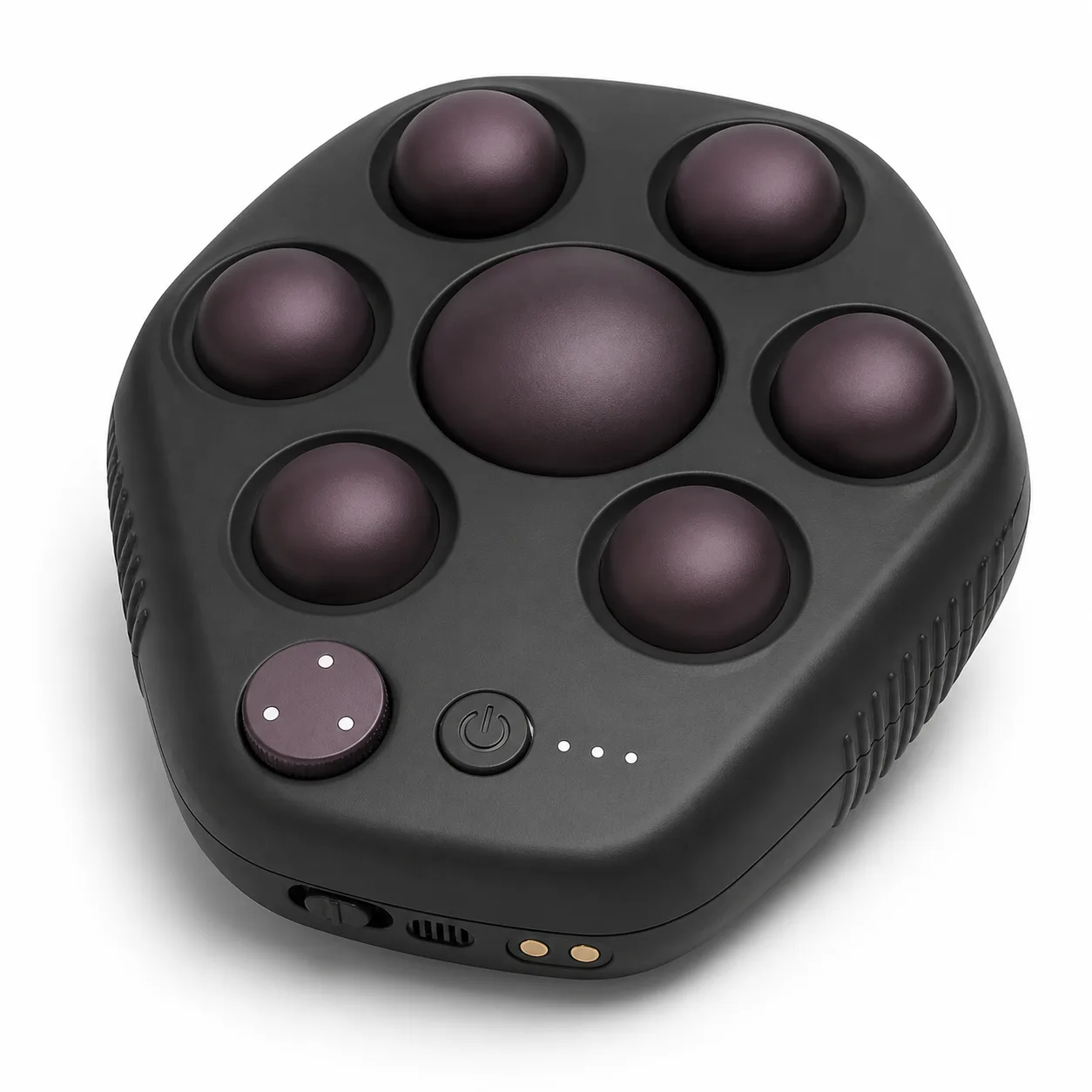
Seven-Node Hex-Ring Pocket Vibrator with Three-Zone Phase Dial
A compact pocket vibrator concept with one broad center dome, six smaller ring nodes, separated contact valleys and a three-stop phase dial.
46,99 $
200 in stock
Read one center node inside a six-node ring
This seven-node hex-ring pocket vibrator concept places one broad smoky-plum center dome inside exactly six smaller rounded nodes. Charcoal valleys separate all seven contact stations, while a three-stop phase dial sits beside the power control and output indicators.

The render does not prove actuator count, independent zones, phase behavior, amplitude, pressure, materials, ingress or manufacturing availability.
Inventory the seven stations and internal stack
Require a bill of materials for center node C, outer nodes R1-R6, skins, compliant cores, carriers, valley walls, backing plate, actuators, eccentric masses or linear drives, mounts, controller, phase dial, detents, power button, indicators, travel lock, cell, conductors, strain reliefs, contacts, vent, shell, grip ribs, seals, coatings, pigments, lubricants and adhesives.
Map mechanical and electrical coupling before assigning center, ring or sub-ring independence.
Measure face geometry node spacing and balance
Record body length, width and thickness, face curvature, C and R1-R6 diameters, heights and crown radii, center-to-ring radius, adjacent node spacing, valley width and depth, dial projection, grip dimensions, mass and center of gravity.
Repeat after loaded output, charging, cleaning, thermal and storage cycles.
Characterize the broad center dome
Map C surface profile, compliant-layer thickness, carrier boundary, local hardness, deformation, rebound, friction and attachment. Measure center height and tilt under axial and offset loading.
Reject thin edges, exposed carrier, delamination, hard spots, tack, pigment transfer, tearing or permanent lean.
Compare ring nodes R1 through R6
Measure each outer node separately for height, radius, angle, hardness, deformation, attachment and alignment. Preserve R1-R6 identity in all traces to expose local deviations.
Reject a node that sits proud, collapses, rotates, lifts at its rim or differs materially from the accepted ring tolerance.
Identify actuator count and zone allocation
Teardown must establish actuator quantity, orientation, moving mass, mount stiffness, backing paths and controller channels. Trace whether C, alternating ring nodes or the full ring share drive energy.
Seven visible nodes and three indicators do not prove seven motors or three independently controlled zones.
Calibrate the three-stop phase dial
Measure dial angle, detent force, backlash, indication and actual timing relationships at every stop approached from both directions. Test after startup, pause, mode changes and low-voltage operation.
Reject false seating, phase drift, skipped states or any dial movement caused by ordinary grip pressure.
Map output at all seven nodes
Record acceleration, dominant frequency, harmonics, startup, decay and phase at C and R1-R6 for every confirmed program and dial stop. Test unloaded and on standardized compliant fixtures.
Quantify center-to-ring transfer, adjacent-node cross-coupling, cancellation, beat frequencies and any station that exceeds its accepted output band.
Measure compliant contact area and pressure
Use instrumented compliant surfaces to measure engaged node count, area, peak pressure, valley bridging, shell contact and output loss under centered, edge and tilted loads. State fixture curvature and force.
Reject hard backing contact, isolated ring peaks, bottomed valleys or loading that leaves one node carrying a disproportionate share.
Review grip control reach and loaded stability
Measure palm pressure, side-rib friction, wrist angle, slip, rocking, dial contact, button reach, lock access and accidental activation with dry and approved damp hands. Test each face orientation.
Confirm the low body remains controllable without forcing fingers onto moving nodes or obstructing the vent.
Screen node rims valleys seams and cleaning access
Probe every node rim, all six inter-node valleys, center carrier edge, shell seam, dial, button, indicators, lock slot, grip ribs, vent and charging recess for pinch, abrasion, residue and moisture traps.
Define wiping, washing, rinsing and measured drying for the exact sample without flooding unverified electronics.
Verify controls battery charging and ingress
Document startup, program order, phase selection, pause, stop, memory, indicators and travel lock. Confirm cell chemistry, capacity, specified input, polarity, charge time, runtime, protection circuits, contact spacing and charging interlock.
Map node rims, face carrier, dial, button, lock, shell joint, vent and contacts. No ingress rating is accepted without exact-model evidence.
Log current sound and heat by zone
Measure current, A-weighted sound and temperatures at C, R1-R6, actuators, backing plate, controller, battery, grip, vent and contacts. Record stabilized and transient results by program, phase stop and charge state.
Investigate local heating, housing resonance, loose mounts, unstable current or sound changes that precede node or actuator faults.
Challenge faults and cycle every control
Test restrained nodes, offset loading, blocked vent, dial obstruction, low voltage, charging interruption and power loss in protected fixtures. Confirm stop timing, overcurrent response, charging interlock and safe cooling behavior.
Cycle output, phase changes, loading, grip, lock, charging, cleaning, drying and storage. Retire for torn nodes, rim lift, carrier contact, output imbalance, dial drift, intermittent controls, cracks, abnormal heat, exposed contacts, cell swelling or persistent residue.
Build landed price after seven-point mapping
An Alibaba mini-vibrator page showed a rechargeable category example at USD 2.42-3.09 with MOQ one. It is a benchmark only and does not confirm this seven-node phase-dial architecture or an approved supplier.
The procurement reference supports an EUR 46.99 planning price after allowing for China-origin freight, exact-sample sourcing, seven-station teardown, face metrology, per-node material and output mapping, phase calibration, compliant pressure, grip, gaps, cleaning, controls, charging, current, sound, heat, faults and cycle testing, protective packing and discreet fulfillment. Exact quotation, MOQ, materials, battery, packed size, weight, freight, duty, tax, insurance, payment fees, certifications and delivery terms remain pending.
Frequently asked questions
Are there seven separate motors?
No; actuator count, mounts and controller channels require teardown confirmation.
What does the phase dial change?
Actual timing relationships at its three stops require synchronized node measurements.
Do all six ring nodes feel identical?
R1-R6 geometry, hardness, pressure and output tolerances remain pending.
Can the center and ring run differently?
Drive allocation and confirmed programs must come from the exact sample.
Is the device waterproof?
No ingress rating is claimed for node rims, controls, seams, vent or contacts.
Which defects require retirement?
Tears, rim lift, carrier contact, imbalance, dial drift, heat, exposed contacts, swelling or residue.
Reviews
There are no reviews yet.