



Three-Stop Spacing Twin-Fork Counter-Phase Vibrator
August 14, 2026
KRSJJ M1087 Black Dual-Handle Automatic Stroker with Phone Holder
August 14, 2026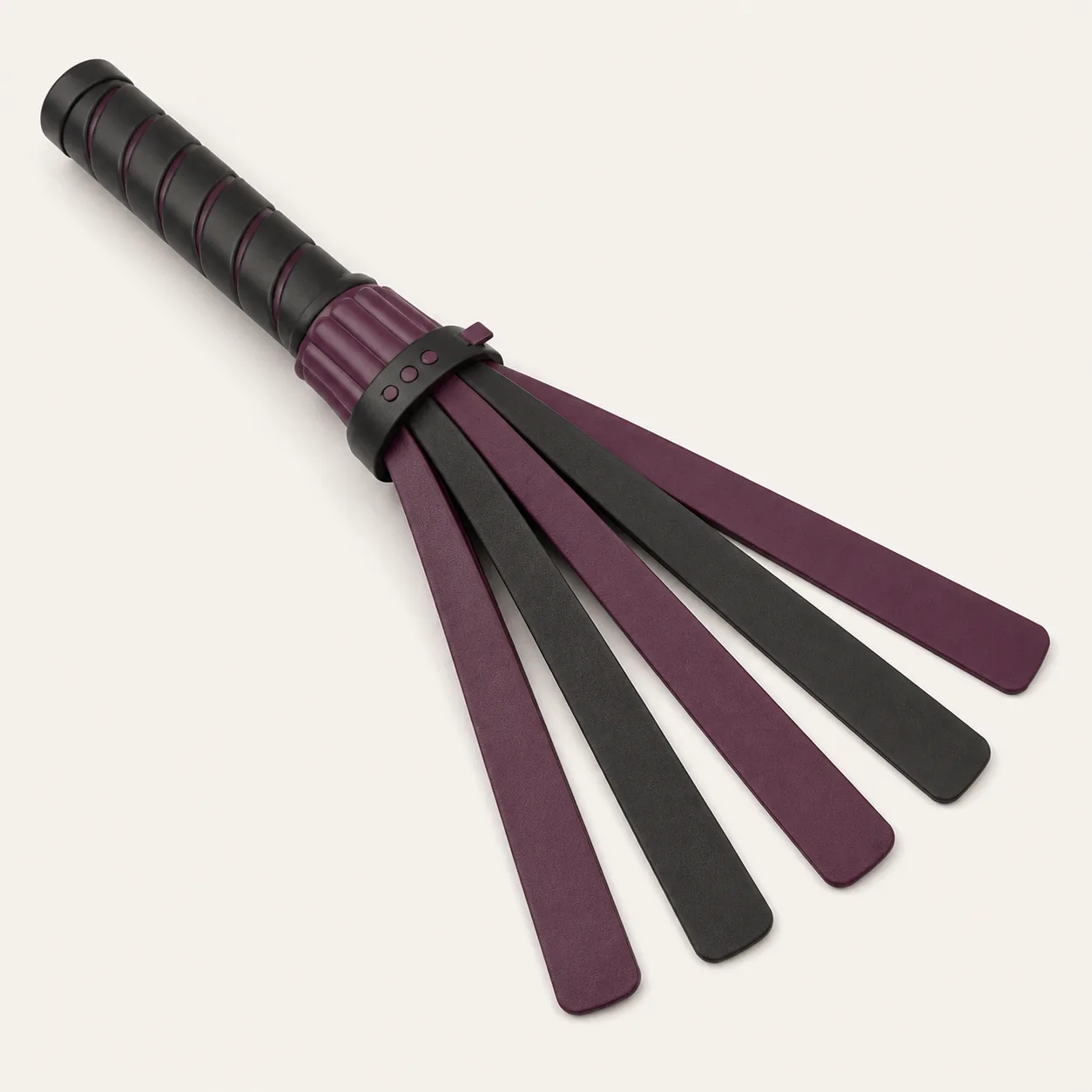
Six-Fall Adjustable-Spread Sensory Flogger with Sliding Guard Collar
A non-powered sensory flogger concept with six flat blunt falls and one sliding root collar for separately testable spread, crown retention, landing fan and low-intensity control.
22,99 $
200 in stock
Control six-fall spread with one sliding collar
This adjustable spread sensory flogger concept uses six broad flat falls held by a reinforced crown. A low sliding collar is intended to alter how widely the fall roots separate before a swing.

The image does not prove fall material, mass, exact length, collar settings, crown strength, impact level or supplier approval.
Inventory handle, crown, collar and falls
Request an exploded drawing and bill of materials for the handle shell, inner core, grip inset, end cap, crown body, fall anchors, thread, adhesive, six falls, edge finish, sliding collar, liner, grip tab, detents, stops, pigments and coatings.
Trace how every fall is fixed inside the crown and whether the collar contacts fall faces, edges or a separate guide sleeve.
Count and identify every fall
Assign a permanent test label to all six falls from left to right at a defined collar position. Record color, anchor location, surface face and any grain or weave direction.
Verify there are no hidden narrow strands, weighted tips, internal cables or doubled layers that change the effective count.
Measure fall-group geometry
Record each fall length, width, thickness, mass, end radius, edge profile, taper, flatness and distance from crown center. Compare the three plum and three charcoal pieces as separate groups.
Set tolerances for mass and length because small differences can change timing and where a fan lands.
Map collar travel and references
Measure collar position from the crown at each visible dot, total travel, detent force, free play, grip-tab force, stop compression and accidental sliding resistance. Approach every reference from both directions.
Document root spacing and fall angle at each position instead of naming the dots as intensity levels.
Test crown retention
Apply controlled axial pulls to each fall individually, then to neighboring pairs and the complete group within supplier limits. Measure anchor movement, crown deformation, handle twist and collar interference.
Inspect internal attachment on sectioned samples after cycling. Retire a sample after any fall migration, loosened wrap, cracked crown or exposed core.
Measure balance and grip control
Record total mass, center of balance, handle diameter, grip pressure, rotation, slip and end-cap security with the collar narrow, medium and wide. Include dry and lightly damp gloves.
Confirm the collar tab cannot contact the hand or shift under normal grip forces.
Map the moving fan on a test plane
Swing only through a mechanical guide toward a large instrumented pad. Record the two-dimensional landing envelope, order of fall arrival, tip speed, sound and wrap beyond the target at each collar reference.
Repeat at several low controlled swing energies. A wider root spread does not guarantee a wider or softer landing pattern.
Compare calibrated pad contact
Use pressure film or a suitable sensor layer on the pad to compare contact area, peak signal, number of distinct fall traces and edge concentration. Separate direct strikes from overlapping or crossed falls.
Stop testing for a damaged edge, hard internal feature, weighted end, unstable collar or a fall that lands far outside the measured fan.
Assess wrap and edge conditions
Measure how far each fall can wrap around cylindrical padded fixtures of several verified diameters. Inspect blunt ends and both long edges before and after every block.
Never direct impact toward the head, face, neck, spine, kidneys, joints, hands, feet or any injured, numb or medically vulnerable area.
Define a low-intensity practice protocol
Practice on a pad before any consensual adult use. Establish clear communication, a stop signal, target boundaries and a conservative progression based on measured control rather than appearance.
Stop immediately for distress, numbness, unexpected pain, broken skin, loss of communication, a slipping grip, moving collar or damaged fall.
Inspect color transfer and surface change
Rub each color group against standardized light fabric under dry, damp and approved-cleaner conditions. Record pigment transfer, tackiness, swelling, cracking, odor and surface abrasion.
Check the plum grip inset, crown and collar tab separately because molded coatings can behave differently from fall material.
Cycle collar, falls and crown
Run repeated collar adjustments, low-energy guided swings, individual-fall pulls, group pulls, handle torsion and cleaning cycles. At planned checkpoints measure detent force, collar creep, root spacing, fall length, mass, edge condition, anchor movement and handle balance.
Retire any sample with a loose fall, shifted crown, cracked collar, exposed core, sharp edge, permanent curl or grip damage.
Validate cleaning and individual drying
Obtain exact material and cleaner compatibility data. Clean both faces and edges of every fall, the root fan, crown grooves, collar liner, grip inset and end cap only by the verified method.
Separate the six falls for air circulation and measure drying by mass. Do not bundle damp layers or trap moisture beneath the collar.
Price after fall consistency is measured
An Alibaba braided-design flogger listing currently shows USD 0.35-0.45 with an MOQ of two. It is a category benchmark only and does not confirm this six-fall flat set, sliding spread collar or approved supplier.
The procurement reference supports an EUR 22.99 planning price after allowing for China-origin freight, complete material inventory, six-fall dimensional and mass matching, collar metrology, crown pull testing, balance and grip analysis, guided fan mapping, calibrated pad contact, wrap review, low-intensity practice documentation, color-transfer testing, full assembly cycling, cleaning validation, protective packing and discreet fulfillment. Exact quotation, packed dimensions, weight, freight, duty, tax, insurance, payment fees and delivery terms remain pending.
Frequently asked questions
Do the three dots represent intensity levels?
No. They are collar-position references until fan spread and pad contact are measured.
Are all six falls the same material?
Color and appearance do not prove composition; every layer and coating needs documentation.
Can the collar be moved during a swing?
No. Adjust it only while stationary, then verify the detent before practice.
Does a wider fan always feel lighter?
No. Timing, overlap, speed, edge condition and target geometry all affect contact.
How should the falls be dried?
Separate all six layers and follow the verified method until mass confirms they are dry.
Which faults require immediate retirement?
A migrating fall, cracked crown, creeping collar, exposed core, sharp edge, weighted tip, permanent curl, tackiness or color transfer beyond the accepted limit.
Reviews
There are no reviews yet.