


Twin-Belt Floating-Plate Strap-On Harness with Four-Point Height Adjustment
August 14, 2026
Washable Tuck-In Wing Care-Surface Protector
August 14, 2026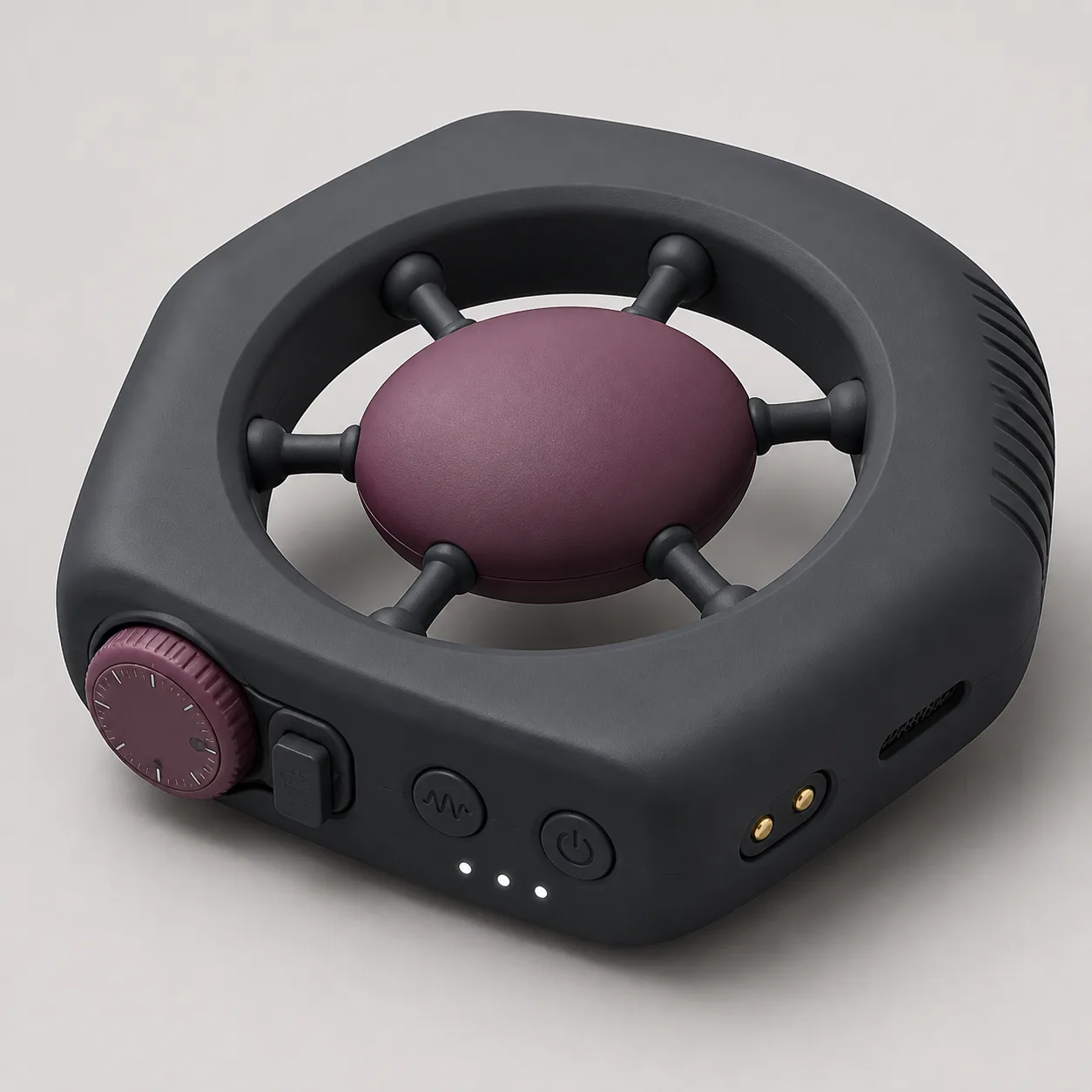
Six-Spoke Floating-Core Pocket Vibrator with Preload Dial
A compact pocket vibrator concept with one guarded floating contact core, six flexible spokes and a lockable three-stop preload dial.
48,99 $
200 in stock
Suspend one contact core on six flexible spokes
This six-spoke floating-core pocket vibrator concept centers one raised plum oval contact core inside a broad charcoal guard. Exactly six short spokes support the core at evenly distributed stations, while a side three-stop preload dial and separate lock tab are intended to change the suspension response.

The image does not prove core travel, spoke stiffness, preload control, output, dimensions, materials, sealing, charging safety, sound level or production availability.
Inventory both structural and electrical paths
Request an exploded bill of materials for outer shell, circular guard, central core skin, core carrier, spokes S1 through S6, inner and outer flex joints, retainers, actuator, moving mass, mounts, preload dial, three detents, linkages, lock tab, hard stops, two buttons, indicators, controller, cell, charging contacts, vent membrane, grip ribs, conductors, seals, pigments, lubricants and adhesives.
Link every part to drawing revision, tolerance, batch and approved reference sample.
Measure the shell guard and core geometry
Record shell axes, thickness, corner radii, circular-window diameter, guard depth, core major and minor axes, crown, neutral projection, dial position, button reach, contact recess, vent area, grip-rib profile, mass and center of gravity.
Measure core centering and shell flatness before and after defined thermal and humidity conditioning.
Characterize the floating contact surface
Measure core skin hardness, compression curve, recovery, friction, surface texture, seam position and local thickness. Inspect for flash, voids, hard inclusions, thin regions, tack change and pigment transfer.
Map the carrier beneath the skin so the compliant contact area and any internal edge remain distinguishable.
Measure all six spokes independently
For S1 through S6, record free length, section, joint diameter, angular position, alignment, axial stiffness, lateral stiffness, torsion, hysteresis, rebound and permanent set. Repeat after controlled flexing and cleaning exposure.
Individual results must remain traceable; visual symmetry does not establish equal stiffness or fatigue life.
Inspect every guard and spoke clearance
Measure inner and outer joint gaps, core-to-guard clearance and spoke-to-shell distance at neutral, maximum bounded displacement, centered preload, edge preload and powered operation. Use articulated probes and soft-film screening.
Reject contact with a hard rim, an exposed retainer, a gap that traps hair or film, or a recess that cannot be cleaned and dried by the validated method.
Calibrate the three-stop preload dial
Measure dial angle, detent torque, backlash, hysteresis and command or mechanical mapping at all three marks. Approach every stop from both directions while measuring core position, suspension stiffness and spoke load.
A position between stops must not create a false stable state, uneven spoke tension or sudden core shift.
Verify the dial lock and hard stops
Record lock-tab travel, engagement depth, actuation force and resistance to accidental brushing. Apply bounded vibration, core load and shell torsion while locked, then remeasure the dial index and six spoke loads.
Check tab, dial, stop and shell margins for pinch access through the full adjustment range.
Map core displacement and vibration output
Use synchronized optical tracking and tri-axial accelerometers to measure core orbit, axial and lateral displacement, frequency, harmonics, rise, decay and repeatability. Test every program and preload stop at several battery states.
Compare the core center, edge, each spoke junction, guard and shell to identify cancellation, amplification, tilt and structural cross-coupling.
Map contact pressure under centered and edge load
Use an instrumented compliant pad to measure contact area, peak pressure, core tilt and guard approach under centered, offset and swept load. Repeat for every verified preload position and output program.
Reject guard-first contact, unstable snap-through, one-spoke overload, exposed carrier pressure or dial creep under the accepted load envelope.
Evaluate grip isolation and control access
Measure shell acceleration, rear-rib friction, grip pressure and button reach in several dry and damp hand fixtures. Confirm that the device can be stopped without touching the preload dial or covering the vent and contacts.
Track transmitted vibration and local heat near fingertips, lock tab, buttons and charging recess.
Verify charging power loss and shutdown
Document charging polarity, specified lead, input limit, cell chemistry and capacity, protection circuits, charge time, runtime, low-voltage behavior and operation-during-charge interlock. Interrupt power in every mode and preload state and confirm a predictable off condition.
Ingress and washability claims remain pending until the open guard, six spoke joints, dial, lock, controls, contacts and vent pass appropriate tests.
Log current sound and temperature
Measure operating current, accessible temperature, actuator, cell and joint hot spots and A-weighted sound at a stated distance for every program and representative preload stop. Repeat with maximum approved core load, one protected spoke restrained and low battery.
Investigate current spikes, spoke chatter, core rattle, shell resonance, dial drift, asymmetric heat or intermittent indicators.
Challenge one-spoke faults then cycle and clean
In protected specimens, soften, stiffen or restrain one spoke at a time while monitoring core path, adjacent loads, pressure, current, temperature, sound and shutdown. Stop before damage and quarantine units with joint migration, core contact or uncontrolled tilt.
Cycle preload selection, locking, core flex, output programs, controlled loading, charging, defined cleaning, measured drying and storage. Recheck geometry, six-spoke stiffness, gaps, dial, lock, displacement, pressure, controls, contacts, heat, surface and seams.
Build landed price after suspension proof
An Alibaba mini-bullet-vibrator page currently shows a rechargeable category example at USD 1.91-2.19 with MOQ three. It is a benchmark only and does not confirm this six-spoke suspension, floating core, preload dial or an approved supplier.
The procurement reference supports an EUR 48.99 planning price after allowing for China-origin freight, exact-model sourcing, core and six-spoke metrology, preload and lock calibration, displacement, output and pressure mapping, gap and grip review, electrical, current, sound and heat tests, protected fault and cycle work, protective packing and discreet fulfillment. Exact quotation, MOQ, materials, battery, packed size, weight, freight, duty, tax, insurance, payment fees, certifications and delivery terms remain pending.
Frequently asked questions
Does the center core move in every direction?
The supported movement envelope is unknown until optical tracking maps axial, lateral and orbital displacement under load.
What does the preload dial change?
It is intended to alter suspension response at three stops, subject to measured stiffness, spoke load and repeatability.
Can a spoke pinch hair or film?
Every joint and gap needs articulated-probe and soft-film checks throughout flex, preload, vibration and wear.
Will the outer guard touch first?
Guard approach and contact pressure must be mapped under centered, offset and swept loads for each preload stop.
Is this device waterproof?
No ingress claim is confirmed; the open guard, joints, dial, buttons, contacts and vent require evidence.
Which faults require retirement?
Cracked or stretched spokes, joint migration, core-to-guard contact, unstable tilt, dial drift, failed locking, exposed contacts, abnormal heat, cell swelling or persistent residue.
Reviews
There are no reviews yet.