


App-Controlled Wearable Air-Pulse Massager
August 14, 2026
Mini Finger Vibrator – 10-Mode Concept
August 14, 2026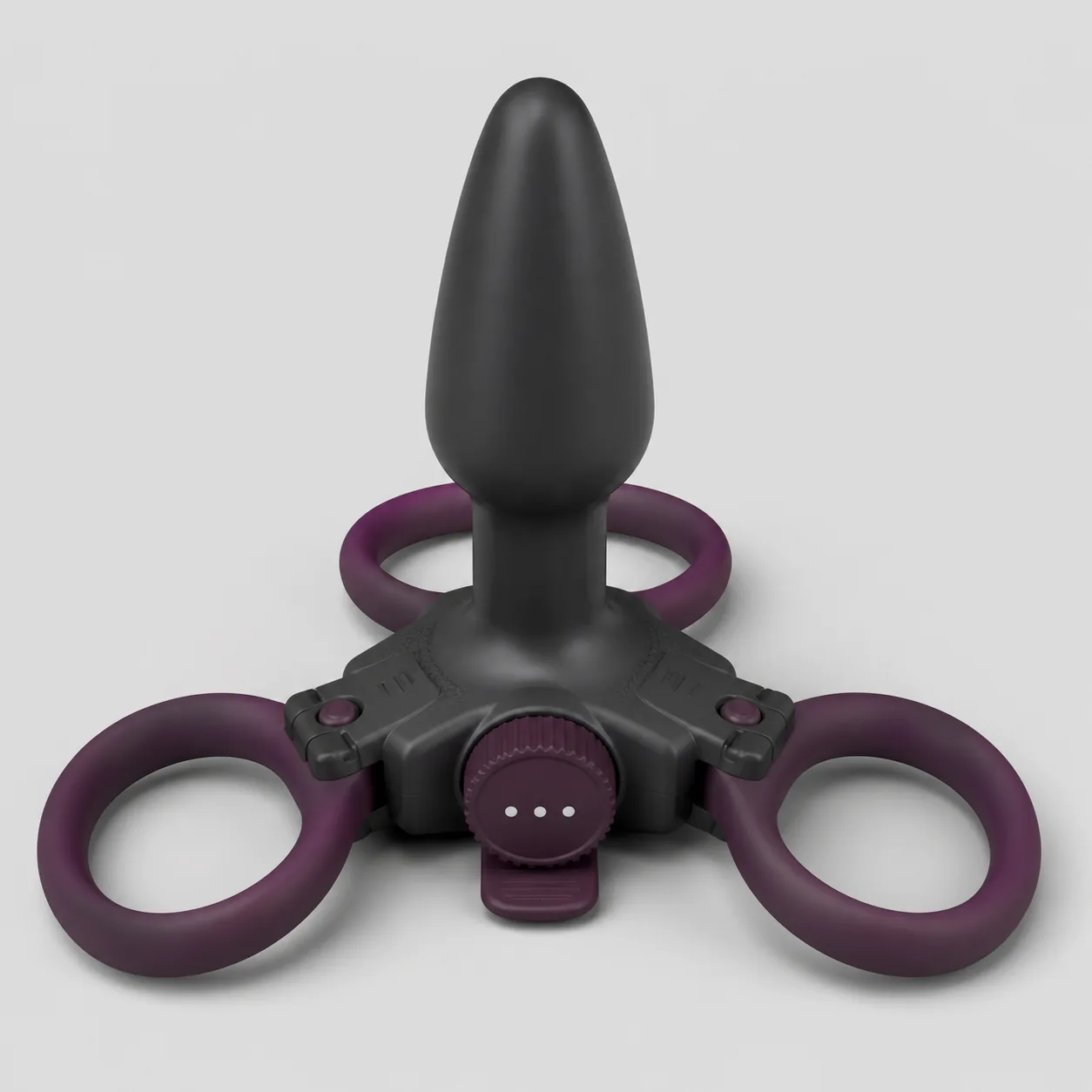
Three-Loop Adjustable-Spread Anal Plug with Ratcheting Safety Base
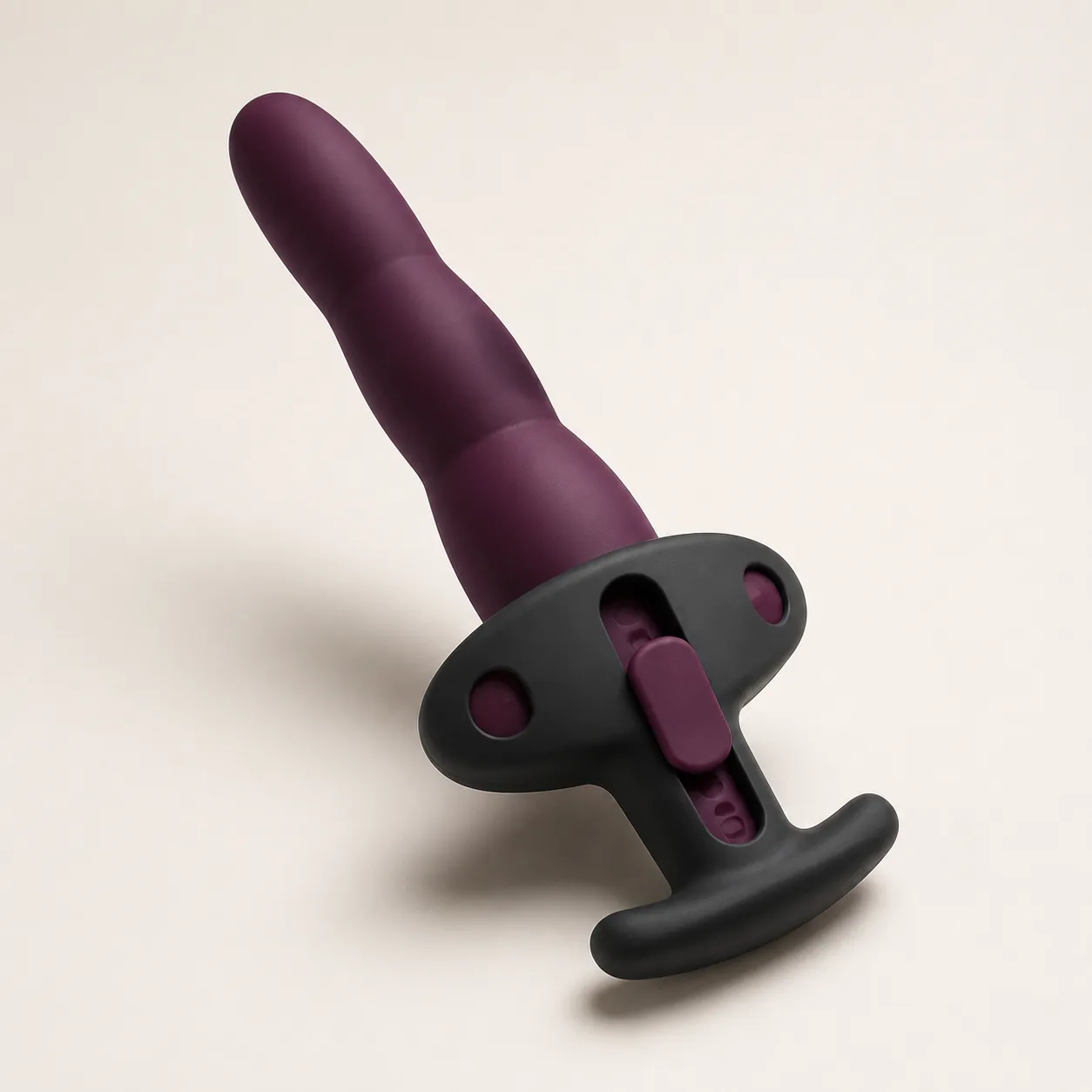
A tapered anal plug concept with three hinged oval safety loops, three spread stops, branch locks and a wide local release tab.
52,99 $
200 in stock
Make the safety base the primary comparison
This three-loop adjustable-spread anal plug concept combines one smooth charcoal tapered body and narrow neck with exactly three large smoky-plum oval loops arranged around a central hub. Each loop has a hinged root and lock button. A front knurled dial shows three spread stops beside a separate wide release tab.

The render proposes base geometry only; it does not prove size, material, retention, comfort or production readiness.
Inventory body neck hub and three loop branches
Require records for body, surface layer, core, neck, hub, loops R1-R3, hinges H1-H3, pins, lock buttons, detents, spread dial, ratchet, release tab, linkage, stops, drainage channels, grip texture, pigments, lubricants and packaging.
Trace every load path before accepting safety claims.
Measure the insertable and non-insertable envelope
Record total and insertable length, maximum body diameter, taper profile, tip radius, neck length and diameter, hub size, loop outer dimensions, base span, branch angle, mass and center of gravity at stops P1-P3.
Confirm the complete base remains wider than the body in every permitted state.
Profile the tapered body and neck
Map surface hardness, friction, wall or coating thickness, deformation, rebound, neck bending and attachment to the hub. Inspect the transition for stress concentration and cleaning traps.
Reject tack, pigment transfer, tears, hard exposure, cracks, permanent bend or separation.
Characterize loop R1 independently
Measure outer and inner geometry, cross-section, flexibility, hinge travel, lock engagement, pull strength and residual set at P1-P3. Inspect its guarded root under offset load.
Keep results separate from the other two loops.
Characterize loop R2 independently
Repeat geometry, stiffness, hinge, lock and load tests for the second branch. Check whether its travel changes dial torque or forces hub rotation.
Reject rubbing, root lift, cracks or asymmetric seating.
Characterize loop R3 independently
Measure the rear branch across all spread states and storage positions. Verify it remains visible, reachable and structurally separated from the narrow neck.
Reject a state that folds the loop into the body envelope.
Calibrate spread stops P1 P2 and P3
Measure dial angle, ratchet force, indication, branch angle and total base footprint at each stop approached from both directions. Challenge centered and uneven loop loads.
Reject false seating, spontaneous narrowing, skipped teeth or travel beyond guarded stops.
Validate the wide release tab under load
Measure access, force, travel, ratchet disengagement and loop relaxation at every approved state and asymmetric fixture load. Confirm reset steps and one-hand reach from the base.
The release path must not require moving to a narrower unsafe footprint first.
Quantify anti-migration geometry without overclaiming
Use rigid gauges and compliant laboratory forms to compare body diameter, neck, hub and base span. Record base deflection, loop collapse, hub tilt and branch force under bounded axial and lateral loads.
No universal fit or migration-proof statement is accepted.
Map neck bending and hub leverage
Measure neck moment, lateral deflection, hub rotation and residual set as loads move across R1-R3. Repeat at P1-P3 because base spread changes leverage.
Set conservative limits for visible damage, excessive tilt and loop contact.
Screen hinge gaps pinch edges and snag paths
Probe all loop roots, buttons, dial teeth, release tab, hub seams, neck junction, drainage channels and grip texture through adjustment and loading.
Reject sharpness, exposed pins, trapping gaps, abrasive flash or controls blocked by a loop.
Validate cleaning drying and storage
Identify seams, hinges, ratchet cavities and drainage paths. Test only confirmed cleaning agents, rinse exposure and drying methods for the exact sample.
Store fully dry in a verified spread state that does not preload loops, locks or neck.
Cycle the body base locks and release
Cycle P1-P3, hinges, buttons, release, bounded loop loads, neck flex, cleaning, drying and storage. Remeasure spread, dial torque, lock strength and residual deformation.
Retire for tears, neck cracks, loop set, hinge play, ratchet drift, delayed release, exposed hardware or persistent residue.
Build landed price after base proof
An Alibaba butt-plug page showed one plug set example at USD 1.90-3.80 with MOQ one. It is a category benchmark only and does not confirm this adjustable three-loop base or an approved supplier.
The procurement reference supports an EUR 52.99 planning price after provisional allowance for China-origin freight, exact samples, body and hub teardown, three-loop and lock tests, spread calibration, release validation, geometry, neck, hazard, cleaning and fatigue work, protective packing and discreet fulfilment. Exact quote, MOQ, dimensions, materials, packed weight, freight, duty, tax, certification, payment terms and lead time remain pending.
Frequently asked questions
How wide does the base become?
Exact span at P1-P3 requires sample measurement.
Do all three loops lock separately?
The concept shows branch buttons; linkage and independent retention need teardown.
Can the dial narrow under load?
Ratchet retention and uneven-load behaviour require guarded testing.
What does the release tab do?
Its exact disengagement path and relaxation time remain pending.
Which material is used?
Body, loop, pigment and lubricant composition require documentation and confirmation.
When should it be retired?
Retire it for tears, neck cracks, loop set, hinge play, lock drift or failed release.
Reviews
There are no reviews yet.