


SH2209 Plus-Size Neon Geometric Mesh Teddy: XL, 3XL, 4XL
August 14, 2026
Emerald Polka-Dot Mesh Babydoll with Floral-Lace Cups and Centre Bow
August 14, 2026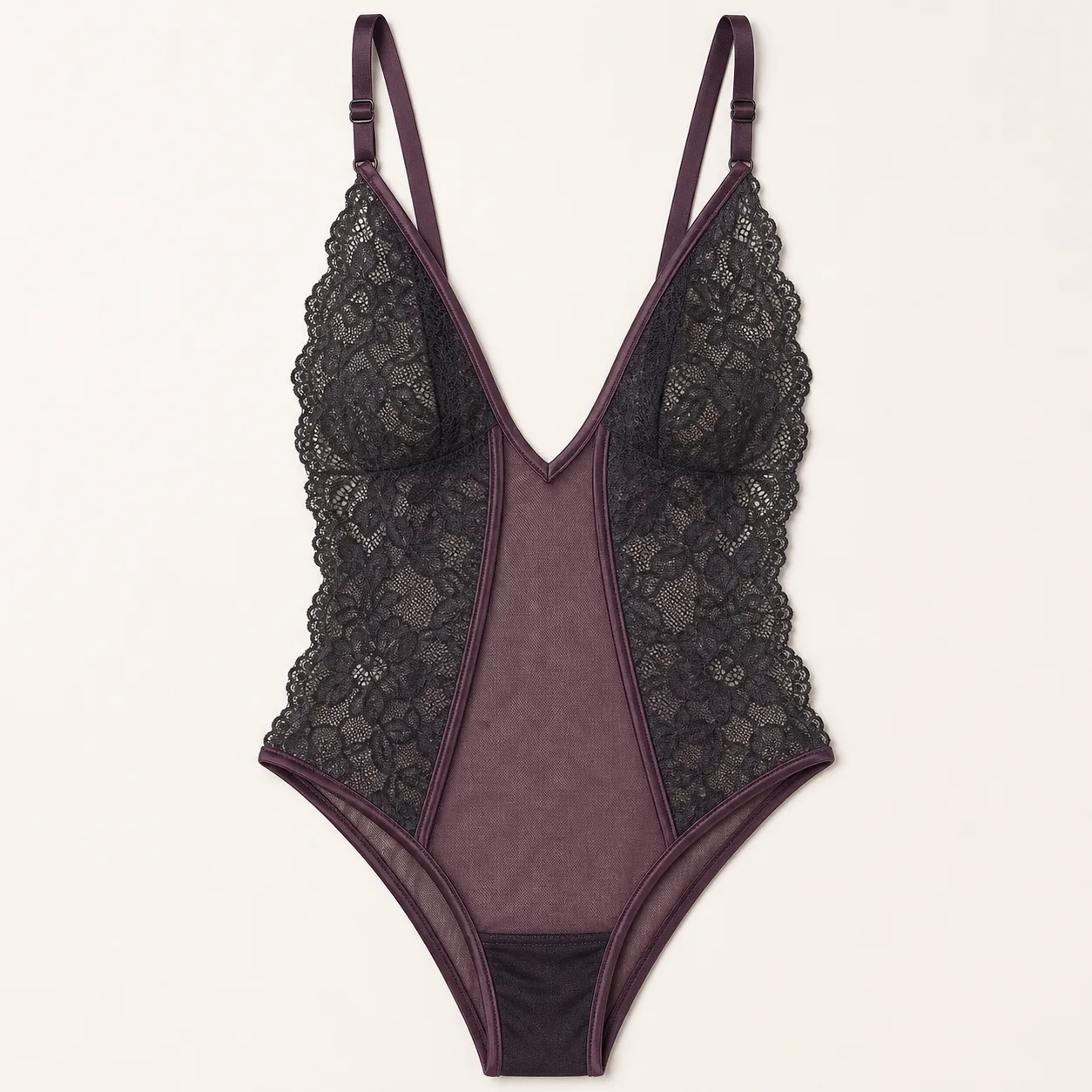
Three-Panel Scallop-Lace Deep-V Teddy
A smoky-plum and charcoal one-piece teddy concept with one central mesh panel, two scalloped floral-lace side panels, satin piping and two adjustable shoulder straps.
39,99 $
200 in stock
Divide one teddy into three visible torso panels
This three-panel scallop-lace deep-V teddy concept uses one narrow smoky-plum mesh centre panel between two symmetrical charcoal floral-lace side panels. Satin piping separates the three zones, while scalloped lace edges shape the outer silhouette.

The image records design intent only. It does not confirm graded dimensions, fibres, opacity, support, stretch, strap hardware, gusset construction, colourfastness or production readiness.
Confirm a one-garment retail inventory
The planned pack contains exactly one one-piece teddy. Stockings, robe, gloves, jewellery, hanger, display form and detachable trim are not included.
Require the final pack list, size and colour identifiers, fibre declaration, care label and traceable production lot before procurement approval.
Grade the deep-V shape from fixed seam points
Measure bust width, underbust, waist, high hip, leg opening, front rise, back rise, torso girth, centre-front length and neckline depth for every proposed size. Record tolerances and the relaxed measuring method.
A flat-lay neckline cannot predict coverage or fit on an individual body.
Map the central mesh panel independently
Record the centre panel width at neckline, underbust, waist and lower torso, then measure its length, weight, openness, two-direction stretch and recovery. Check the upper V point and lower join for distortion.
Fine mesh, sheer and breathable descriptions remain pending exact fibre and performance evidence.
Compare the left and right lace panels
Label the lace zones L1 and L2. Measure motif placement, panel width, scallop repeat, edge depth, stretch, recovery and seam alignment, then compare mirror symmetry across graded samples.
Inspect floral openings for broken yarns, snags, rough cut points and local weakness near the neckline, arm edge and leg line.
Inspect satin piping at every panel boundary
Trace both long piping seams from neckline to lower torso. Record tape width, fibre, stitch type, extension, seam allowance and junction reinforcement without assuming the piping contains elastic.
Reject twisting, puckering, exposed thread ends, skipped stitches or hard seam stacks that could create persistent pressure.
Verify both adjustable shoulder straps
Label the straps S1 and S2, then measure width, free length, adjustment range, elasticity, slider travel, anchor placement and cyclic slippage. Check left-right equality after adjustment and conditioning.
The visible sliders do not establish hardware composition, corrosion resistance or a universal fit range.
Document bust construction without support promises
Request technical views showing cup seams, lining, elastic, stabilizers and any concealed frame. Measure bust-panel depth, base width, apex position and neckline stretch by size.
Shaped lace does not prove padding, underwire, lift, compression or suitability for a particular bust profile.
Specify the lower lining and gusset
Record lining coverage, gusset length and width, layer count, attachment, seam position and fibre percentages. Inspect the lower V junction and leg-binding overlap for bulky or abrasive construction.
Cotton-lined, moisture-wicking, hygienic and antimicrobial statements are unavailable without exact-model evidence.
Test leg openings and edge comfort
Measure both leg openings relaxed and at bounded extension, then record binding width, force, recovery and seam elasticity. Examine the high-cut transitions for left-right balance and edge rolling.
Stop wearing if any edge, seam, strap, slider or panel causes pain, numbness, restricted breathing, broken skin or persistent irritation.
Validate stretch and dimensional recovery
Test centre mesh, both lace panels, shoulder straps, neckline, waist, leg openings and gusset seams separately. Record force-extension curves, permanent set and dimensional change before and after the approved care cycle.
Flexible, adaptive and comfortable-fit language requires a documented method and size-specific acceptance limits.
Build sizing guidance from finished measurements
Create the chart from approved garment measurements, intended ease and stretch data. Explain how to measure bust, underbust, waist, high hip and torso girth, then direct shoppers to the most restrictive dimension.
Do not convert a supplier letter size into a retail size without checking the complete graded sample set.
Check colour transfer across plum and charcoal zones
Test centre mesh, floral lace, satin piping, elastic, thread, lining, labels and sliders for dry and wet rubbing, perspiration exposure, wash migration and prolonged storage contact.
Colourfast and non-staining claims remain pending lot-matched results for the final sellable construction.
Clean delicate lace without snagging the scallops
Use only the validated water temperature, detergent, agitation, rinse and drying method for the approved fibres and hardware. Close or protect any documented fasteners and separate the garment from hooks or rough surfaces.
Bleach, solvents, high heat, wringing, machine drying and direct ironing are excluded unless the exact care study permits them.
Build landed price from a lace-teddy benchmark
An Alibaba lace-teddy category page displayed one underwire sheer-mesh bodysuit at USD 3.98 to 4.59 with MOQ 2 sets. It is a broad procurement benchmark only and does not identify this three-panel construction or an approved supplier.
The public procurement benchmark supports an EUR 39.99 planning price after provisional allowance for China-origin freight, graded samples, panel, neckline, strap, bust, gusset, seam, stretch, colourfastness and care validation, discreet fulfilment and expected apparel handling loss. Exact supplier, quote, MOQ, sizes, colours, fibres, packed weight, freight, duty, tax, certification, payment terms and lead time remain pending.
Frequently asked questions
How many torso panels are shown?
Exactly three: one smoky-plum mesh centre panel and two charcoal floral-lace side panels.
Is this a set or one garment?
It is planned as one one-piece teddy with no stockings, robe or separate brief.
Are the shoulder straps adjustable?
Two sliders are visible, but the final adjustment range and hardware specification require approved samples.
Does the teddy contain underwire?
That is unconfirmed until the supplier provides technical construction views and a component specification.
Which sizes will be offered?
The size run and finished-garment chart remain pending graded production samples.
How should the lace be washed?
Follow only the validated care label for the final fibres, piping, elastic, lining and slider hardware.

Reviews
There are no reviews yet.