



Squeeze-Activated Mini Air-Pulse Stimulator
August 14, 2026
Remote Telescopic Thrusting Vibrator
August 14, 2026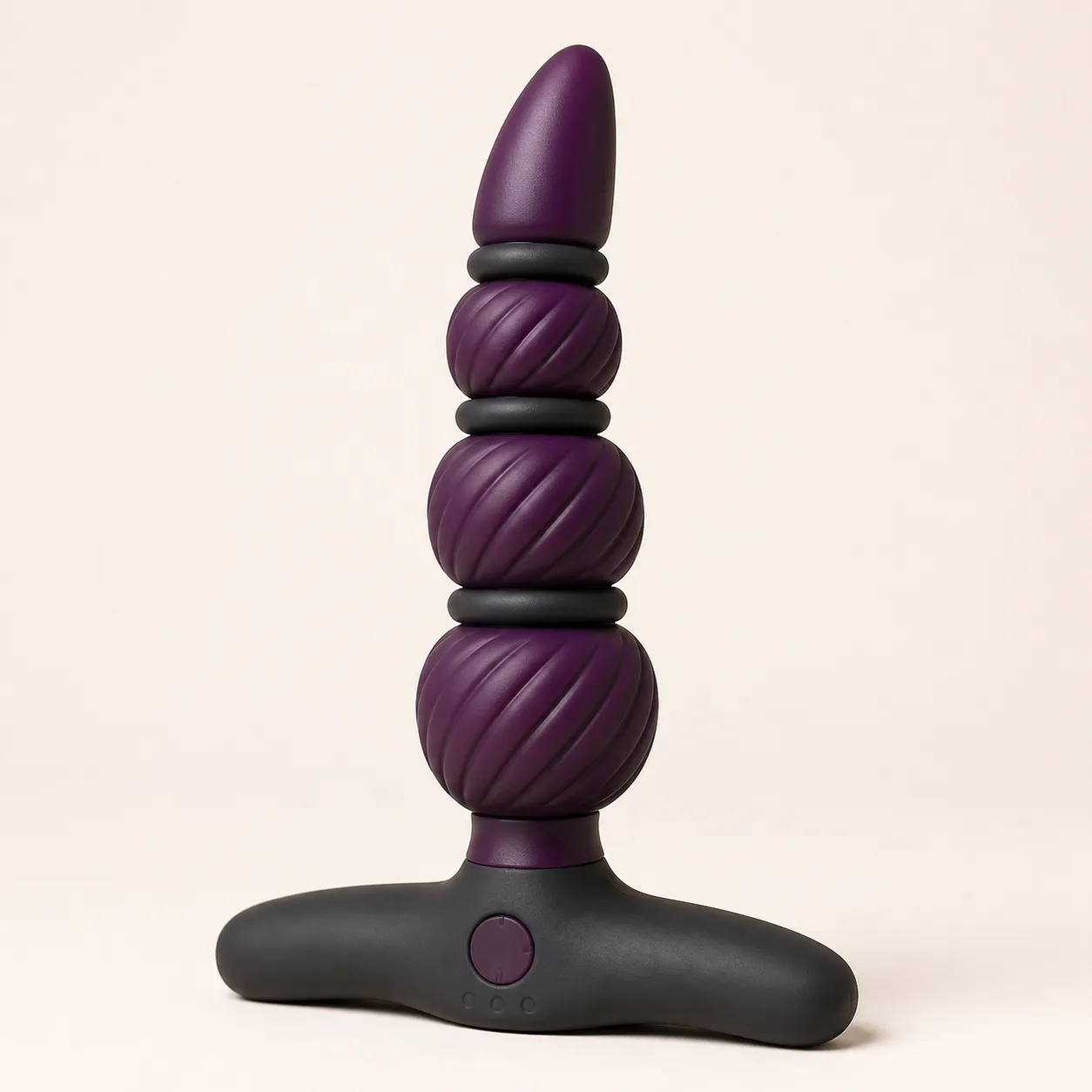
Three-Roller Captive-Spine Anal Trainer with Wide T Base
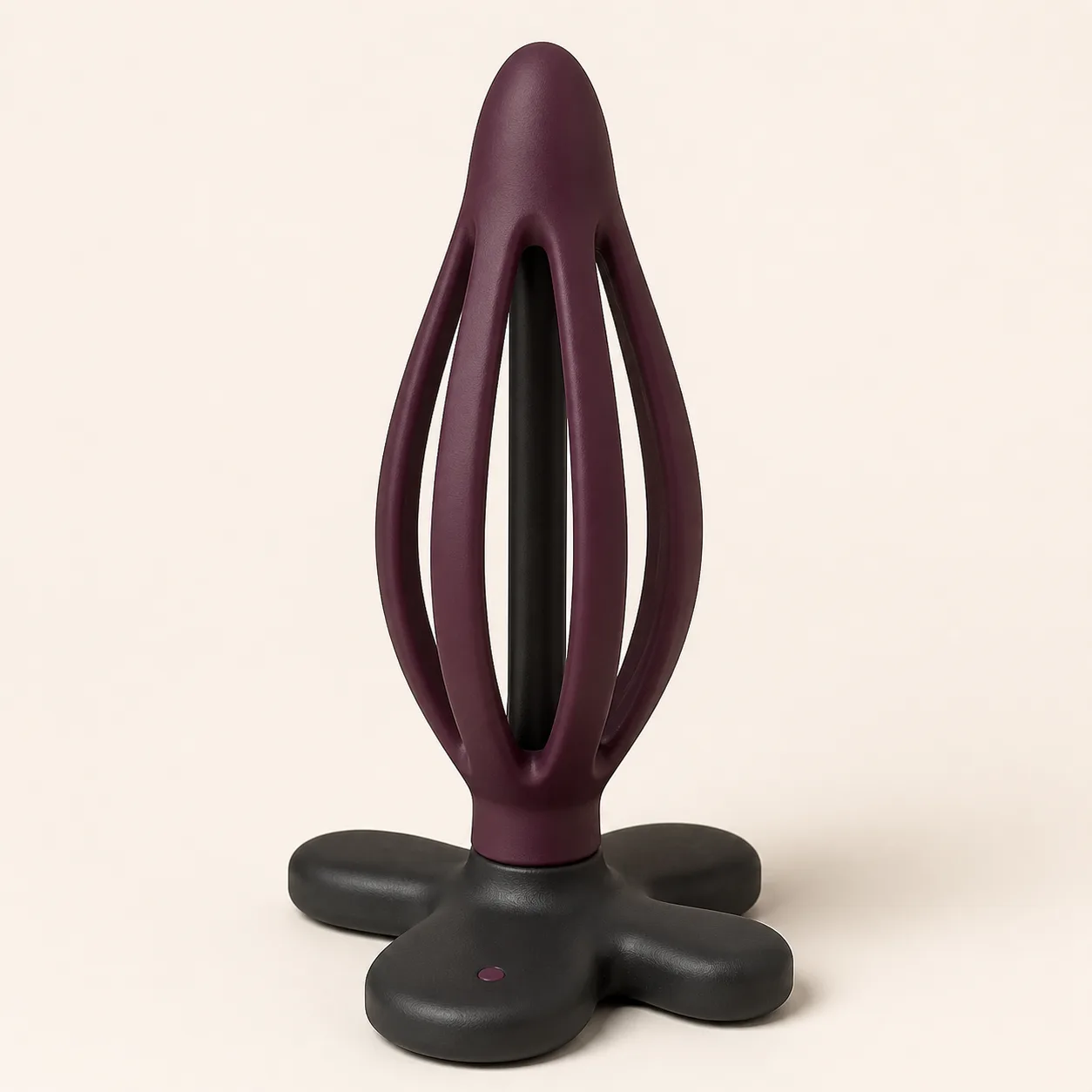
A non-powered anal trainer concept with three graduated ribbed rollers captured on a continuous curved spine above an oversized T base.
35,99 $
200 in stock
Let three graduated barrels roll without detaching
This captive roller anal trainer concept places three independently rotating oval barrels on one continuous curved spine. Rounded guard collars separate the rollers, while a smooth tapered tip, narrow neck and exceptionally wide T base preserve a visibly continuous retrieval structure.

The image does not prove internal axles, free rotation, exact progression, spine continuity beneath every roller, dimensions, materials, cleaning access or production availability.
Inventory the complete rolling assembly
Request an exploded drawing for the tip, continuous center spine, upper, middle and lower rollers, three internal sleeves, thrust faces, bushings or bearings, upper and lower retainers, guard collars, neck, T base, recessed access latch, three alignment markers, pigments, lubricants, adhesives and any concealed fasteners.
Confirm that no roller depends on the next roller to remain captured.
Establish all external dimensions
Measure total and proposed insertable length, tip axes and radius, each roller height and maximum width, progression between stages, guard-collar diameter and thickness, spacing, neck dimensions, T-base span and thickness, latch position, mass and center of gravity.
Record the overall curved centerline and maximum profile at several rotational positions.
Prove the spine stays continuous
Use imaging or controlled teardown to document spine section, curvature, surface, joints and attachment to the tip, neck and base. Measure bending stiffness, torsional stiffness and permanent set before and after conditioning.
No concealed separation, sharp retainer or unsupported gap should interrupt the structural path.
Characterize each roller independently
For A, B and C, measure oval profile, rib height, pitch, diagonal direction, edge blend, bore axes, sleeve length, mass, balance and runout. Inspect for flash, voids, hard spots, rough transitions and color transfer.
Graduation should be specified by measured width and profile rather than by small, medium and large labels.
Verify axle capture and end restraint
Measure radial play, axial play, thrust clearance, retainer overlap, sleeve migration and guard-collar coverage at every roller. Apply conservative push, pull, twist and off-axis fixture loads separately.
Any path that lets a barrel climb a collar or expose an internal edge requires redesign.
Map rolling friction and startup torque
Record breakaway torque, steady rolling torque, direction bias, drag variation and residual rotation for all three barrels when dry and after the approved compatible lubricant is applied externally. Repeat under controlled normal load.
Increasing friction after cleaning can indicate swelling, residue, bushing wear or hidden corrosion.
Measure pressure shear and roller slip
Use an instrumented compliant fixture to map local pressure, tangential force, roller angle and surface slip during slow axial movement at several clock positions. Compare forward and reverse travel and small rotational offsets.
A roller that skids instead of turning can create more shear than the ribbed geometry suggests.
Inspect guard collars and all gaps
Probe tip-to-collar, roller-to-guard, roller-to-spine, collar-to-spine, neck, base and access-latch clearances around the full circumference while rotating, bending and loading the trainer. Use articulated gauges rather than fingers.
Guards should prevent access to retainers while leaving enough visibility for wear, residue and drying checks.
Prove the T base remains external
Measure both arms from the neck center, minimum diagonal span, edge radii, thickness, flex, twist resistance and visibility under standardized coverings. Apply controlled axial, rocking and off-axis retention loads in all approved orientations.
The base must remain substantially wider than the largest roller and must not fold into a narrower profile.
Validate the recessed access latch
Identify whether the illustrated base control opens a cleaning path, releases a service cover or is cosmetic. If functional, measure travel, force, false closure, lock retention, seal compression and accessibility without disassembling the captive spine.
Consumer access must not expose sharp hardware or permit a roller to become detachable.
Verify material and surface evidence
Obtain composition, hardness, pigment, cure, restricted-substance and contact-safety evidence for every external and hidden component. Inspect seams, coating continuity, odor, lubricant compatibility, cleaner compatibility, compression recovery, tear resistance and color transfer.
Marketing labels cannot replace batch-linked material records and sample tests.
Challenge one seized or loose roller
Increase drag on one barrel, add controlled axial play and immobilize a roller with a protected fixture while monitoring spine bend, neighboring rotation, pressure, shear, collar contact and retainer movement. Stop before permanent damage.
Quarantine a sample with seizure, wobble, rising play, collar climb, exposed hardware, cracked spine, torn surface or base deformation.
Cycle rolling cleaning and storage together
Run repeated forward and reverse rolling, compliant loads, small bends, conservative retention checks, cleaning, measured drying and storage. At checkpoints repeat dimensions, spine stiffness, roller runout, friction, capture, pressure, gaps, latch behavior and base retention.
Cleaning validation must reach every rib valley, roller end, guard collar, hidden sleeve entrance, neck, base seam and latch recess without releasing a captive part.
Build landed price after roller proof
An Alibaba silicone anal-trainer results page currently shows a category example at USD 0.51-2.99 with MOQ one. It is a category benchmark only and does not confirm this three-roller captive spine, guarded collars, wide T base or approved supplier.
The procurement reference supports an EUR 35.99 planning price after allowing for China-origin freight, exact-model sourcing, complete assembly inspection, spine and progression metrology, three-roller characterization, capture and friction tests, pressure and shear mapping, guard-gap and base-retention review, latch analysis, material evidence, combined rolling and cleaning cycle life, protective packing and discreet fulfillment. Exact quotation, MOQ, materials, packed size, weight, freight, duty, tax, insurance, payment fees and delivery terms remain pending.
Frequently asked questions
Are the three barrels detachable?
No; the concept requires each roller to remain captive on one continuous spine.
Do the rollers spin freely?
Breakaway and loaded rolling torque must be measured for A, B and C after cleaning and conditioning.
How is progression evaluated?
Measure every roller profile, guard transition and step in maximum width rather than relying on size labels.
Can the guard collars pinch?
Full-circumference articulated gap tests are required during rolling, bending, loading and wear.
What is the base latch for?
Its function remains pending; any service access must keep the spine continuous and all rollers captive.
Which faults require retirement?
A seized or loose roller, collar climb, exposed retainer, cracked spine, torn surface, deformed base, unreliable latch or persistent residue.
Reviews
There are no reviews yet.