


Three-Size Remote Vibrating Anal Training Set
August 14, 2026
Interchangeable-Cup Rotating Suction Massager
August 14, 2026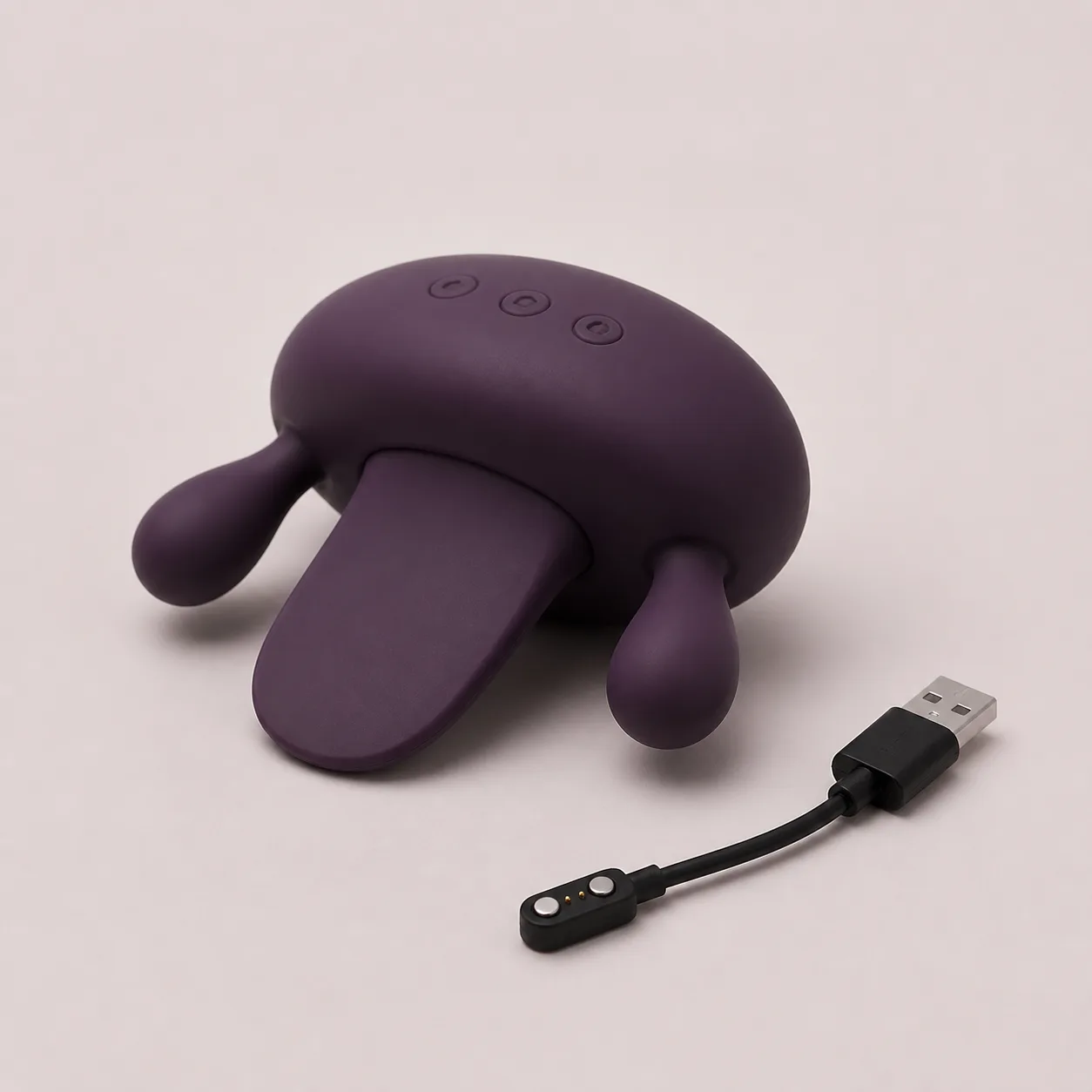
Triple-Contact Tongue-and-Bud Vibrator
A compact triple-contact vibrator concept with one broad flexible leaf, two rounded side buds and evidence-led checks for motion and spacing.
29,99 $
200 in stock
Three contact shapes create three separate questions
This triple contact tongue vibrator concept combines one broad center leaf with two smaller rounded side buds in a palm-sized plum body. The layout may offer simultaneous external contact, but only measured spacing, flexibility and motor mapping can show how the three elements actually behave together.

No therapeutic, hormonal, fertility or pelvic-health outcome is claimed.
The center leaf should be measured in more than length
Record projection, width, thickness, tip radius, root width and free-angle position. Flex it in each direction at repeatable loads, then inspect whether the root buckles, twists or exposes a firmer internal support.
Begin with the lightest verified contact and stop for irritation or numbness.
Side buds need a clear purpose and identical geometry
Measure each bud’s diameter, projection, stem thickness and distance from the leaf centerline. Compare left and right output so a visual pair is not marketed as balanced before its symmetry is tested.
Reject a sample with mismatched firmness, seams or unstable stems.
Spacing determines whether contacts cooperate
Map the gap between the center leaf and both buds at rest and under compression. Different body positions can push the three elements together, so compliant-pad testing should identify collision, rubbing and possible pinch lines.
Do not trap skin between neighboring contacts.
Three buttons should not imply three independent motors
Document every short press and long press for power, leaf motion, side-bud vibration and any intensity control. If one button changes multiple channels, show that sequence plainly rather than naming each contact as independently controlled.
An accessible action must stop all motion without cycling through modes.
Motion language needs slow-motion evidence
The source mixes licking, vibration and suction wording, which may describe different variants or generated text. Film the approved sample at high frame rate to distinguish bending, oscillation, vibration, tapping or air movement at each contact.
No sucking function is accepted until pressure change is measured at a defined opening.
Mode mapping should separate leaf and bud behavior
Record dominant frequency, acceleration, travel and pattern length at all selectable states. Build a table showing which elements are active, whether their timing is synchronized and what happens after power cycling.
Publish a mode count only after duplicate states are removed.
The compact shell needs a secure palm grip
Measure body width, height, mass and control reach with dry and damp hands. The rounded housing should not rotate unexpectedly when the projecting contacts meet resistance.
Controls should remain usable without squeezing the contact stems.
Material evidence must distinguish three contact zones
Request lot-linked documentation for the center leaf, both buds, plum housing skin, internal frame, pigments, buttons, seals, adhesives and charging-contact surround. A single generic silicone statement does not cover a mixed-hardness assembly.
Check odor, tack, oil bleed, dye transfer, swelling and surface change after conditioning.
Seams are most important where the contacts flex
Inspect around the leaf root, both bud stems, body split, buttons and charging area under side light and magnification. Repeated flex and motor heat can open a small manufacturing line that appears harmless when the device is still.
Stop using a unit with peeling, cracks, exposed cores or liquid behind the skin.
Cleaning access depends on the valleys between contacts
Use the supplier-approved method to reach beneath the leaf and around both bud stems without bending them beyond their tested range. Validate rinsing and drying in the three narrow valleys where residue can remain hidden.
Do not boil, bleach, machine-wash or use abrasive brushes.
Ingress testing must include every moving root
No immersion or shower claim is approved without evidence for the leaf root, two bud stems, body seam, buttons and magnetic contacts. A one-piece outer appearance does not prove that the flex zones stay sealed under motion.
Charge only when all valleys and contacts are fully dry.
Battery and heat tests should run all contacts together
Confirm cell chemistry, capacity, input, charge time, runtime and low-power behavior. Monitor the leaf root, buds, palm shell and contacts while every available motor or actuator runs against repeatable loads.
Stop for abnormal heat, swelling, odor, noise or unscheduled restart.
The provisional price allows for three-channel inspection
The Alibaba lead displays USD 7.65 for 1 to 99 pieces, USD 6.94 for 100 to 499, USD 6.59 for 500 to 4,999 and USD 6.17 from 5,000. Generated marketplace content leaves the contact mechanism and channel design unclear.
The procurement reference is a sourcing lead only. The EUR 29.99 plan allows for China-origin freight, a sample, contact geometry, flex, spacing, motion, controls, vibration, thermal, cleaning and material checks; freight, duty, tax, insurance, packaging, payment fees and destination terms remain pending.
Compare the three-contact layout with simpler tools
This concept is for adults interested in a broad leaf plus two smaller external contacts from one compact body. A single-tip vibrator offers easier placement, while an air-pulse device or small wand may suit shoppers who want a different contact mechanism and fewer narrow cleaning zones.
Final positioning advice will follow the approved geometry and motion table.
Frequently asked questions
Do all three contacts vibrate independently?
That remains pending motor mapping and control testing on the exact production unit.
Does the center leaf move like a tongue?
The source uses tongue language, but bending, oscillation, tapping and simple vibration must be distinguished by measurement.
Is there an air-suction function?
No air-pressure function is accepted until a defined opening and measurable pressure change are verified.
Can the device be submerged?
No immersion guidance is approved without ingress evidence for all three contact roots, seams, buttons and charging contacts.
What materials touch the body?
Compounds, pigments, internal supports, seals and adhesives remain pending lot-linked documentation.
What should be checked before use?
Inspect the leaf, both buds, the three valleys, body seam, controls and charging contacts, then confirm low motion and immediate stop away from the body.
Reviews
There are no reviews yet.