


Yaofei wl-02 Pink Floor-Length Lace Butterfly-Sleeve Robe
August 14, 2026
SF027 App-Controlled U-Shaped Wearable Vibrator – Pink or Purple
August 14, 2026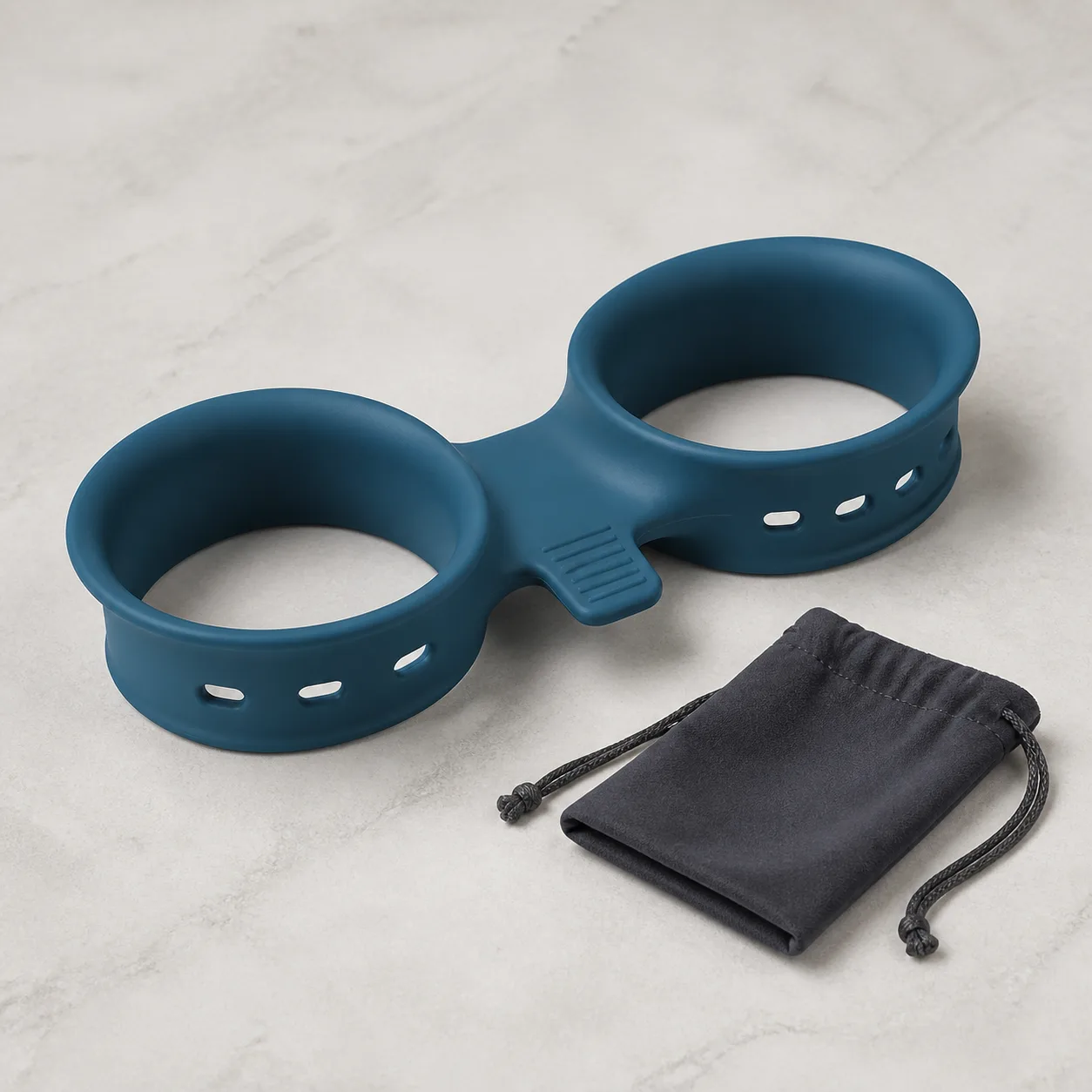
Vent-Slot One-Piece Stretch Wrist Cuffs
A petrol-blue one-piece wrist cuff concept with two broad flared openings, outer ventilation slots, a textured center pull tab and graphite storage pouch.
19,99 $
200 in stock
One continuous cuff body simplifies hardware, not safety
The vent-slot one-piece stretch wrist cuffs concept uses two broad petrol-blue openings joined by a short flexible bridge. Rounded rims, three outer slots per band and a textured center pull tab create a distinct soft restraint layout without buckles, chains or metal locks.

The image shows the design language only and does not establish fit, holding force, release time or material identity.
Each wrist opening needs its own fit window
Measure relaxed internal diameter, rim width, band height, wall thickness and extension force at defined circumferences. Manufacturing variation between the two sides matters because a one-piece mold can still produce unequal wall thickness or cure.
Use only a verified size that allows regular circulation checks. Remove the cuffs immediately for pain, numbness, coldness, tingling, swelling or unusual color.
The pull tab must be reachable by the supervising partner
Confirm its direction, grip texture and the movement required to unload the bridge. The tab must not be described as a release until timed trials show how the actual production sample opens or peels away under realistic hand positions.
Keep safety shears suitable for the verified compound within reach, and never use a method that depends on the restrained person solving the release alone.
Ventilation slots are also tear starters
Inspect every slot for radius, flash, thin corners and distance from the band edge. Stretch samples longitudinally, transversely and diagonally while tracking whitening, notch growth and permanent distortion.
A slot that improves airflow may still reduce load capacity, so visual openness cannot substitute for tear and fatigue data.
The central bridge defines movement range
Record free bridge length, minimum cross-section, bending radius and force under pull, twist and offset loading. Short bridges restrict arm position quickly and can transfer movement from one wrist to the other.
These cuffs are not approved for suspension, overhead loading, weight bearing, dragging, vehicle attachment or use as exercise equipment.
Flared rims should spread contact without rolling inward
Cycle the cuffs onto compliant wrist forms representing the verified size range, then observe whether the lip folds, concentrates pressure or catches at the slot row. Test dry and with the exact approved dressing aid if one is permitted.
Stop if an edge rolls into a cord-like line or if movement makes the band climb toward the hand.
Consent planning needs a nonverbal stop signal
Agree on duration, position, permitted movement and an unmistakable nonverbal signal before fitting the cuffs. The supervising partner stays attentive, maintains the release route and checks comfort and circulation at short intervals.
Never leave a restrained person alone, asleep, intoxicated or unable to communicate.
The material name must come from a lot-linked record
Obtain formulation, hardness, pigment, cure method, residual limits and traceability for the blue cuff body. Marketplace wording such as silicone, soft or skin-friendly is not sufficient to identify a production compound.
Condition samples with intended cleanser, skin products and storage pouch fabric, then inspect odor, tack, staining, swelling, cracks, surface transfer and color migration.
Stretch recovery should be measured after repeated fitting
Record opening dimensions before cycling, immediately after the target cycle count and after a defined recovery period. A cuff that stays enlarged may slip; a rim that hardens or shrinks may create excessive local pressure.
Reject permanent set, asymmetry, thin glossy zones, edge splits or a bridge that no longer lies flat.
Cleaning the slots requires a clear drying route
Wash only by the approved method, opening each slot gently enough to remove residue without propagating a notch. Rinse all groove surfaces and dry the cuffs fully unfolded so moisture does not remain between touching bands.
Do not boil, bleach, machine wash or use solvents unless the supplier provides model-specific compatibility evidence.
The pouch must not trap damp cuffs
Confirm pouch fiber, dyefastness, closure cord and usable internal size. Store the clean, fully dry cuffs without tight folds, sharp objects or prolonged contact with unknown soft plastics.
Inspect both the cuff and pouch for odor, dye transfer, lint adhesion or moisture before the next use.
Temperature and aging can change release behavior
Measure fit force and pull-tab action after controlled warm, cool, humid and light-aging exposure within the planned storage range. Flexible compounds can stiffen, soften or lose tear strength even when their appearance remains unchanged.
Discard any sample that becomes brittle, sticky, chalky, unusually loose or difficult to grip.
No rigid hardware means no rated anchor point
The slots, bridge and tab are functional geometry, not attachment eyes. Do not connect carabiners, ropes, chains, spreader bars or furniture hardware unless an exact production model has documented load directions and limits.
The default evaluation is low-force, supervised wrist positioning with immediate manual access.
Incoming inspection needs gauges and destructive sampling
Use diameter gauges for both openings, thickness checks around every slot, a force fixture for stretch and a timed release protocol for the tab. Sample tear propagation, bridge fatigue, rim rolling, color transfer, pouch abrasion and post-cleaning recovery.
Opening tolerance, maximum stretch, tear minimum, cycle target, aging conditions and carton testing remain pending supplier agreement.
The low unit quote excludes safety validation
An Alibaba silicone handcuff showroom lists a soft cuff entry at USD 0.52-0.90 with MOQ 10 pieces. Supplier identity, exact model, dimensions, compound, slot geometry, bridge strength, release method and compliance evidence remain pending.
The procurement reference supports sample inquiry only. The EUR 19.99 plan includes a China-origin freight allowance plus fit, circulation, pull-tab, slot-tear, bridge, material, cleaning and aging review; actual freight, duty, tax, insurance, payment fees and destination terms remain pending.
Frequently asked questions
Are the two openings the same size?
The target geometry appears paired, but each opening and its tolerance must be measured on production samples.
Does the center tab guarantee instant release?
No. Its exact function, force and timed access need verification before any release claim is approved.
Can these cuffs support body weight?
No. This concept has no rated anchor and is not approved for suspension, overhead or weight-bearing use.
Can the slots be used to attach a clip?
No attachment use is approved; the slots are treated as ventilation geometry and possible tear points.
Are the cuffs waterproof?
No water-use claim is made. The verified compound, cleanser compatibility and complete drying method remain pending.
What should be inspected before use?
Check both rims, every slot, the bridge and pull tab for tears, thinning, tack or distortion, then confirm fit and a timed removal method away from the body.
Reviews
There are no reviews yet.