


Open U-Bridge External Male Vibrator with Dual Contact Pods
August 14, 2026
Fold-Flat 12-Clip Care-Cloth Airing Hanger
August 14, 2026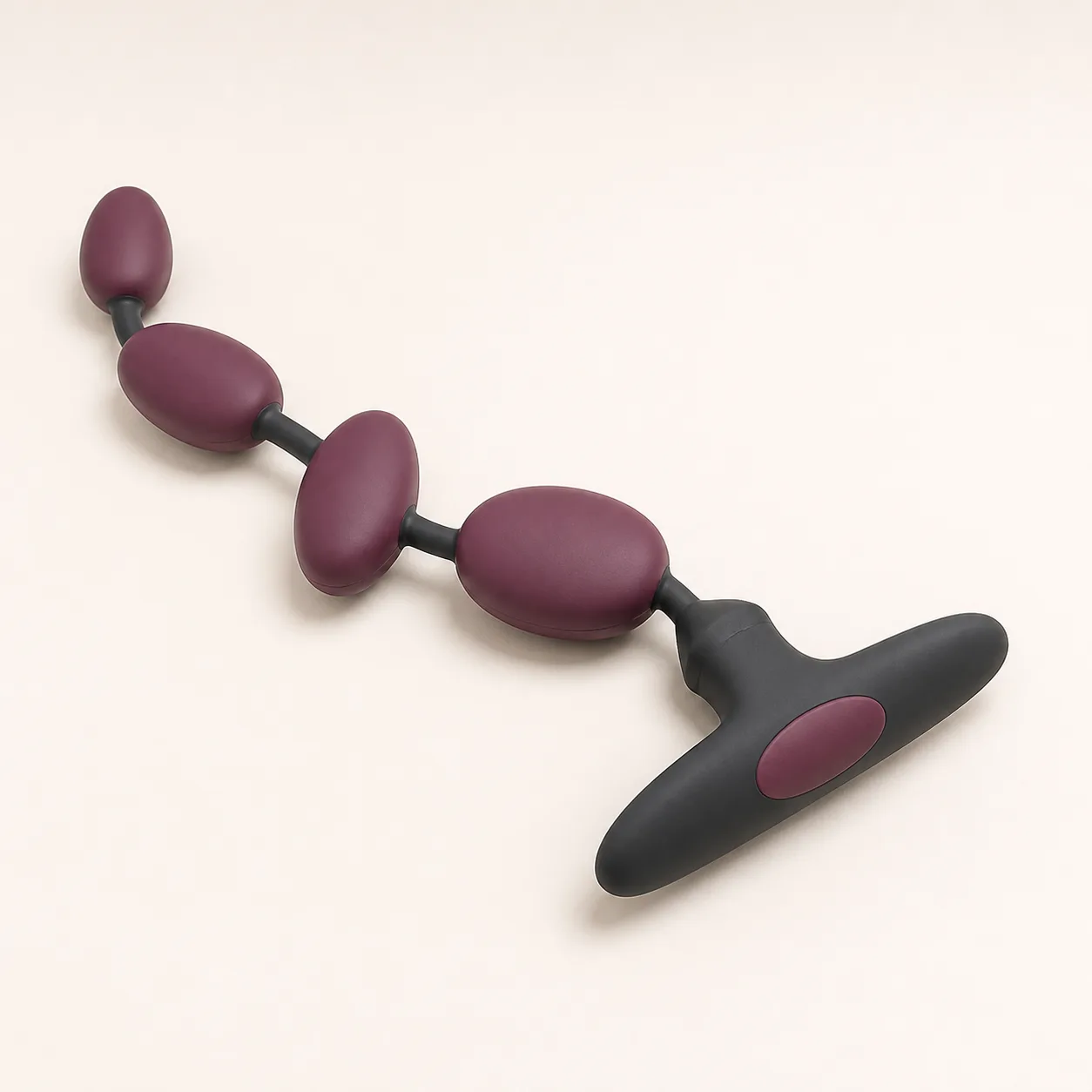
Four-Paddle Alternating-Axis Anal Bead Strand with Wide Cross Handle
A non-powered anal bead concept with four flattened oval stages, alternating face directions, flexible connector necks and an oversized cross handle.
25,99 $
200 in stock
Alternate stage orientation instead of diameter alone
This alternating axis anal bead strand concept uses four flattened oval paddles whose broad faces change direction from one stage to the next. Narrow connector necks link the stages to an oversized cross handle intended to remain externally accessible.

The image does not prove stage count in a supplied sample, usable dimensions, flexibility, material, load strength, fit or supplier approval.
Inventory every molded and reinforced region
Request an exact drawing and bill of materials for the tip stage, three following paddles, all connector necks, any internal cord or spine, paddle cores, surface skins, handle junction, central shield, two handle wings, grip insert, pigments and adhesives.
Confirm whether the strand is one continuous molding, an overmold around a reinforcement or a set of bonded sections.
Measure each paddle in three axes
For every stage record axial length, broad-face width, narrow-face thickness, edge radius, circumference, spacing, centerline offset and mass contribution. Measure total and proposed usable length separately.
Use profile scans rather than one diameter because a flattened oval presents different dimensions after a quarter rotation.
Define the alternating orientation sequence
Assign a datum to the cross handle and record the face angle of each paddle along the relaxed centerline. Measure twist between neighboring stages and production variation across samples.
Check whether the stated alternation is molded into the strand or created only by uncontrolled connector twist.
Map connector bending in both planes
Measure each neck diameter, free span, fillet radius, initial bend force, torsional resistance and elastic recovery parallel and perpendicular to the adjacent broad face. Inspect for whitening, creasing or skin separation.
The same neck may bend easily in one plane but resist the next orientation, creating a local hinge that must be characterized.
Inspect the tip and every transition
Map the first tip radius, tip-to-neck blend, neck-to-paddle fillets and the smallest radius around each oval edge. Inspect seams, flash, voids, pits, pigment streaks and exposed reinforcement under magnification.
Reject sharp ledges, abrupt hard spots, open seams, sticky patches or transitions that trap the inspection cloth.
Measure entry force by paddle orientation
Use compliant fixtures across the proposed fit envelope and measure entry force for the narrow edge, broad face and intermediate angles of each stage. Record paddle rotation, connector stretch and force spikes.
Do not assume that a modest increase in width creates a gradual step when the next broad face changes axis.
Trace the strand through curved fixtures
Guide the strand through documented compliant curves while monitoring stage angle, connector bend, torsion, paddle stacking and handle alignment. Repeat slowly in both directions.
Stop if a paddle flips suddenly, two stages overlap, a neck kinks, reinforcement becomes palpable or the handle is pulled toward the fixture.
Measure extraction as a separate event
Record peak and sustained extraction force at controlled speed for every approved stage combination. Track paddle rotation, neck elongation, suction effects, handle deflection and any delayed movement.
Establish a conservative removal sequence from direct testing rather than assuming the entry behavior is reversible.
Validate the wide cross handle geometry
Measure wing span, central-shield width, thickness, edge radii, junction distance and centerline-to-edge margins. Test the handle against flat and curved external fixtures under centered and asymmetric low loads.
Confirm both wings remain wider than every approved paddle orientation and that the grip insert does not reduce the effective stopping span.
Inspect the handle junction and reinforcement
Map the transition from the final connector into the central shield and identify any cord, spine, insert or overmold boundary. Measure axial pull, twist and side-load response only within a documented test protocol.
Retire a sample after junction lift, cracking, permanent lean, internal movement, exposed insert or a meaningful change in handle angle.
Cycle every neck and axis change
Run repeated bending in both principal planes, controlled twisting, compliant entry, staged movement, extraction, handle loading, cleaning and storage cycles. At checkpoints measure stage angle, neck diameter, recovery, surface condition and junction play.
Alternate the test direction so one connector is not evaluated only along its easiest bending plane.
Audit surfaces after deformation
Inspect each broad face, narrow edge, valley and fillet while relaxed, bent and lightly compressed. Use lint-free cloth and magnification to find new roughness, cracks, tack, color transfer or residue-catching defects.
Compare samples before and after cleaner, lubricant, heat-aging and storage-contact trials using exact approved formulations.
Validate cleaning and measured drying
Obtain exact material and cleaner compatibility data before testing. Clean every paddle face, oval edge, connector neck, transition, handle junction, wing underside and grip-insert seam.
Measure drying by mass and inspect the tight neck valleys and insert boundary for retained moisture or residue before closed storage.
Price after axis-specific testing
An Alibaba anal-bead listing currently shows USD 4.98 with an MOQ of three. It is a category benchmark only and does not confirm this four-paddle geometry, alternating orientation, cross handle, reinforcement or approved supplier.
The procurement reference supports an EUR 25.99 planning price after allowing for China-origin freight, exact stage metrology, axis and twist mapping, connector bending, compliant force tests, extraction review, handle geometry and junction checks, repeated cycling, material evidence, cleaning validation, protective packing and discreet fulfillment. Exact quotation, packed dimensions, weight, freight, duty, tax, insurance, payment fees and delivery terms remain pending.
Frequently asked questions
Why are the paddle faces rotated?
The concept explores orientation as a separate variable, but exact angles and force effects require sample measurement.
Are all four paddles the same size?
No exact dimensions are confirmed; each stage must be measured across its broad and narrow axes.
Is there a reinforcing cord inside?
The internal construction is unknown until an approved sample is documented and inspected.
Does the handle have a rated load?
No. Wing span, junction strength and low-load behavior require exact-model testing.
Can the strand be fully immersed?
Only after the manufacturer confirms the construction and a compatible cleaning method for all seams and junctions.
Which faults require immediate retirement?
A split neck, exposed reinforcement, sharp edge, torn surface, loose stage, deformed handle, weakened junction, permanent kink, sticky patch or trapped residue.
Reviews
There are no reviews yet.