


GM-408 Dual-Motor Open-Clamshell Masturbator
August 14, 2026
Slim Ventilated Care-Cloth Hamper with Hinged Lid
August 14, 2026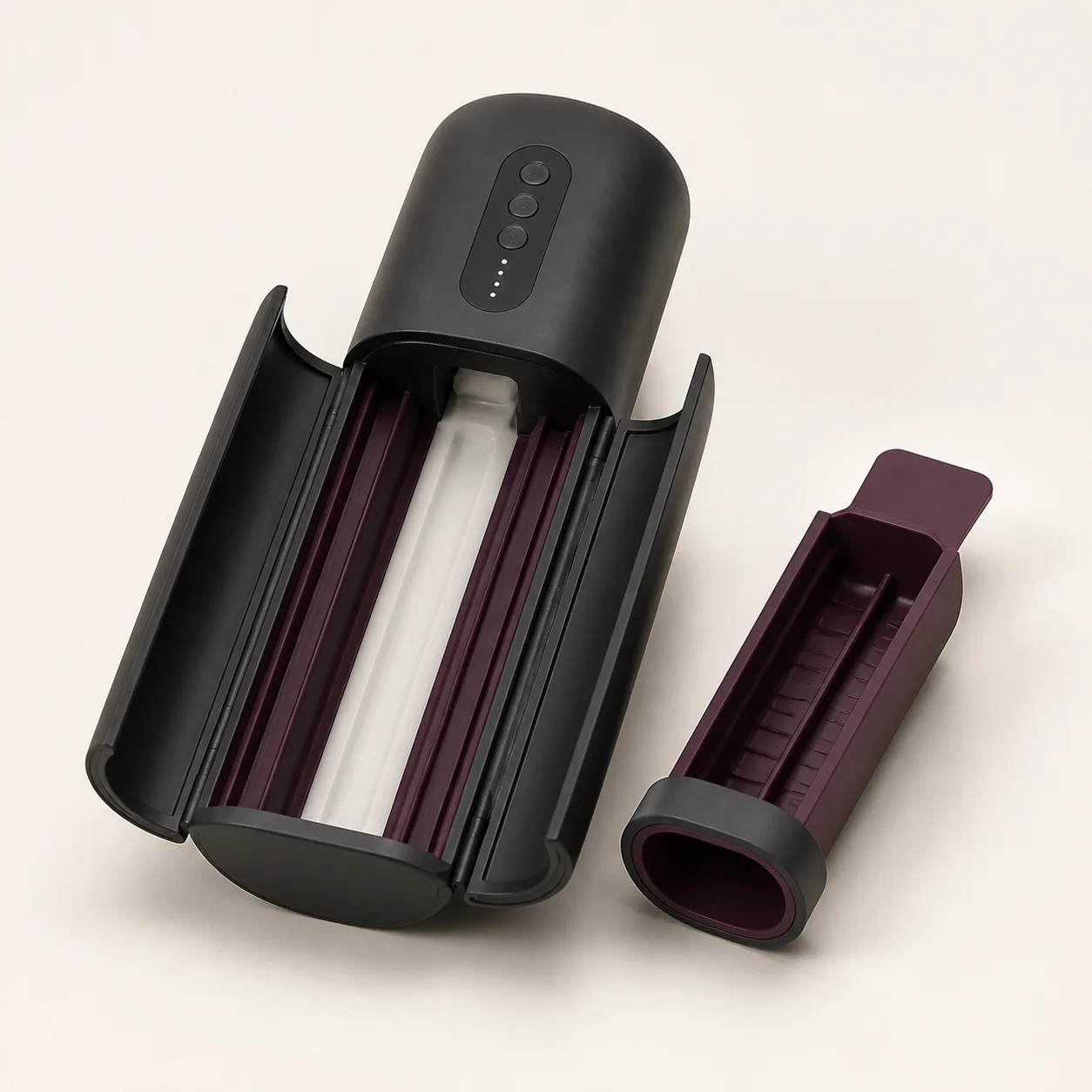
Three-Rail Reciprocating Automatic Stroker with Split-Cleaning Shell
A rechargeable automatic stroker concept with a removable open-ended liner cartridge, three guide rails and a powered housing that opens for dry mechanical inspection.
69,99 $
200 in stock
A removable cartridge rides inside a three-rail drive
This three-rail automatic stroker concept combines a removable open-ended plum liner cartridge with a compact charcoal powered housing. Two hinged service doors expose three longitudinal guide rails for inspection when the unit is switched off and separated from the body.

The shell architecture is meant to make wet-path separation and rail inspection easier to audit, not to imply that the motor chamber is washable.
Account for every cartridge and drive component
Inventory the powered housing, left and right shell doors, three rails, carrier, removable liner cartridge, collar, pull-through tab and exact charging accessory. Request disclosure of hidden gears, belts, bearings, magnets, latches, seals, adhesives and fasteners.
A mismatched cartridge revision or unmarked power accessory should stop qualification.
Measure the complete dimensional envelope
Record housing length, width, depth, mass, entrance height, centerline, door clearance, hinge projection and control reach. Measure the cartridge separately for total length, channel length, opening dimensions, wall thickness, collar span and rear-tab projection.
Published styling images cannot establish usable fit or storage volume.
Inspect the removable liner before every installation
Use bright angled light and a soft swab to inspect the full channel, collar groove, exterior ribs, end tab and molded seams. Flex only within a supplier-confirmed limit while watching for tears, whitening, sticky areas or trapped debris.
A damaged liner must not be installed simply because the outer shell still operates.
Map collar seating and pull-through removal
With the device powered off, align the cartridge collar and carrier key, press to the documented seating stop and confirm that the rear tab remains reachable. Measure insertion force, collar overlap and removal force across repeated dry assembly cycles.
The tab is for controlled cartridge extraction outside use; it is not a tension handle or anchor.
Verify all three rails share one straight travel path
Open the service doors only after shutdown and check rail spacing, parallelism, end stops, carrier contact marks and visible lubricant migration. Close and latch the shell before any powered test.
Rail skew, a loose stop or uneven carrier wear can create binding and must be treated as a mechanical fault.
Keep every pinch and drive boundary inaccessible
Probe door seams, hinge gaps, entrance transitions and the cartridge-to-shell interface with a standardized test gauge while stationary. Confirm that latches cannot be opened by ordinary grip pressure during operation.
Never power the device with either service door open, a missing liner or an exposed rail chamber.
Characterize stroke before contact testing
On a secured fixture, record no-load travel distance, cycle rate, reversal position, vibration, noise and housing movement at every mode. Repeat with a compliant instrumented cartridge load below documented limits.
Compare left, center and right rail behavior for lag, chatter, asymmetric travel or unexpected impact at either end stop.
Challenge stall detection and immediate shutdown
Use a controlled test fixture to introduce increasing resistance without exceeding a written supplier limit. Measure motor current, time to stop, automatic reversal behavior, restart logic and the response of the nearest power control.
A unit that continues pushing, overheats or restarts unexpectedly after a stall must fail evaluation.
Make startup and speed changes deliberate
Identify each local button by physical position, then document hold duration, mode order, last-setting memory, indicator behavior and full power-off sequence. Test accidental activation in a packed storage case.
No app, account or remote is planned; all essential control must remain available on the housing.
Set conservative fit and operating boundaries
Confirm channel geometry and cartridge compliance on a dimensional fixture before any personal use. Begin at the lowest verified motion setting, keep the shutdown control accessible and stop for pain, pinching, numbness, coldness, marked color change, liner displacement or unusual resistance.
No universal fit, fixed session duration or performance outcome is claimed.
Validate battery and thermal protection
Request cell chemistry, rated capacity, charge voltage and current, cable specification, charging time, runtime test method, cycle life, transport documents, low-voltage cutoff and over-temperature protection. Map surface temperature during charge, continuous motion and a controlled stall test.
Do not charge while the unit is wet, hot, damaged, operating or unattended.
Separate the washable path from the rail chamber
Switch off, remove the cartridge and follow confirmed mild-cleaning instructions for the liner alone. Wipe only supplier-approved exterior housing areas; use a dry soft brush or swab for accessible rail-chamber dust unless exact documentation authorizes another method.
No submersion, rinsing of the opened drive bay, boiling, dishwasher, bleach, alcohol or abrasive cleaning is approved without exact evidence.
Dry, inspect and store with the shell unloaded
Dry the liner channel, collar groove and pull tab completely away from the powered housing. Inspect the empty shell for moisture, residue, corroded contacts, rail debris, cracked latches, hinge play and unusual odor.
Store the cartridge uncompressed and the housing powered off, with doors latched only after the chamber is confirmed dry.
Price from an automatic-stroker benchmark with testing allowance
An Alibaba wholesale page lists an open-ended telescopic automatic male masturbator at USD 16.18-21.56 with a one-set minimum. It is a category benchmark only and does not establish this three-rail split-shell design, a legal supplier or a production quotation.
The procurement reference supports an EUR 69.99 planning price after allowing for China-origin freight, exact-model quotation, dimensional and cartridge checks, collar-cycle testing, rail alignment, pinch guarding, stroke and stall validation, battery and thermal review, wet-path separation, materials, cleaning validation, protective packing and discreet fulfillment. Packed size, weight, freight, duty, tax, insurance, payment fees and destination terms require confirmation.
Frequently asked questions
Can the device operate with its shell open?
No. Both service doors must be closed and positively latched before any powered test or use.
Is the inner cartridge removable?
That is the proposed design; seating force, collar lock, pull-tab access and compatible replacement revision require sample confirmation.
Does it need a phone or remote?
No external controller is planned. Local buttons should provide startup, mode selection and shutdown.
Can the motor chamber be rinsed?
Not without exact ingress and cleaning instructions. The concept separates a washable liner from a drive chamber that should remain dry.
What should happen if motion is obstructed?
The user should stop immediately; stall cutoff and restart behavior must be verified on a fixture before approval.
Which faults require retirement?
A torn liner, loose collar, jammed carrier, skewed rail, cracked latch, exposed pinch gap, abnormal noise, unexpected restart, corrosion, swelling battery or unusual heat.
Reviews
There are no reviews yet.