


Three-Dome Sequential-Pulse Palm Vibrator with Isolation Channels
August 14, 2026
Blue Rabbit BR-YL-01 Purple or Red Rose-Cup 10-Mode Vibrator Pair
August 14, 2026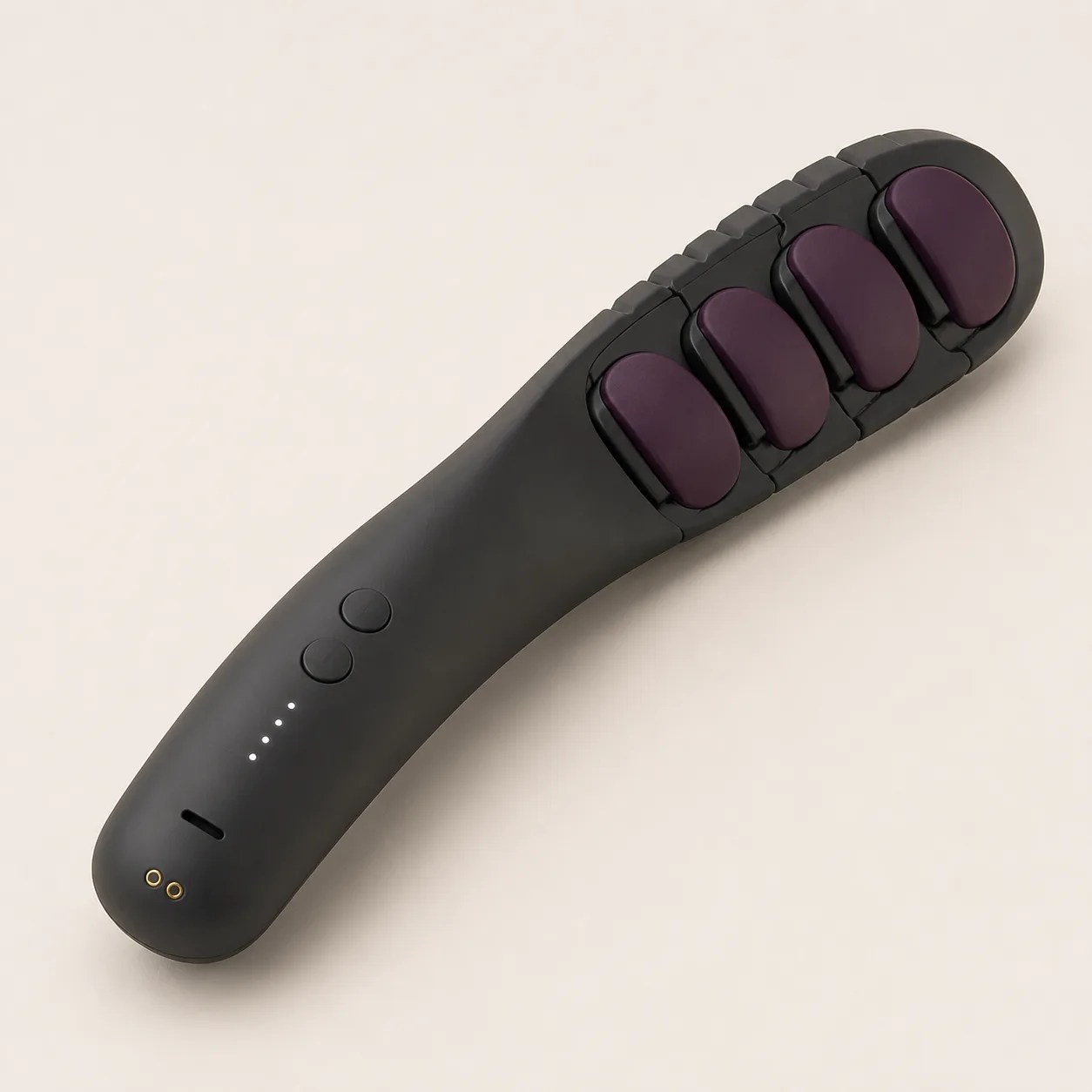
Four-Pad Lateral-Wave Bar Vibrator with Segmented Spine
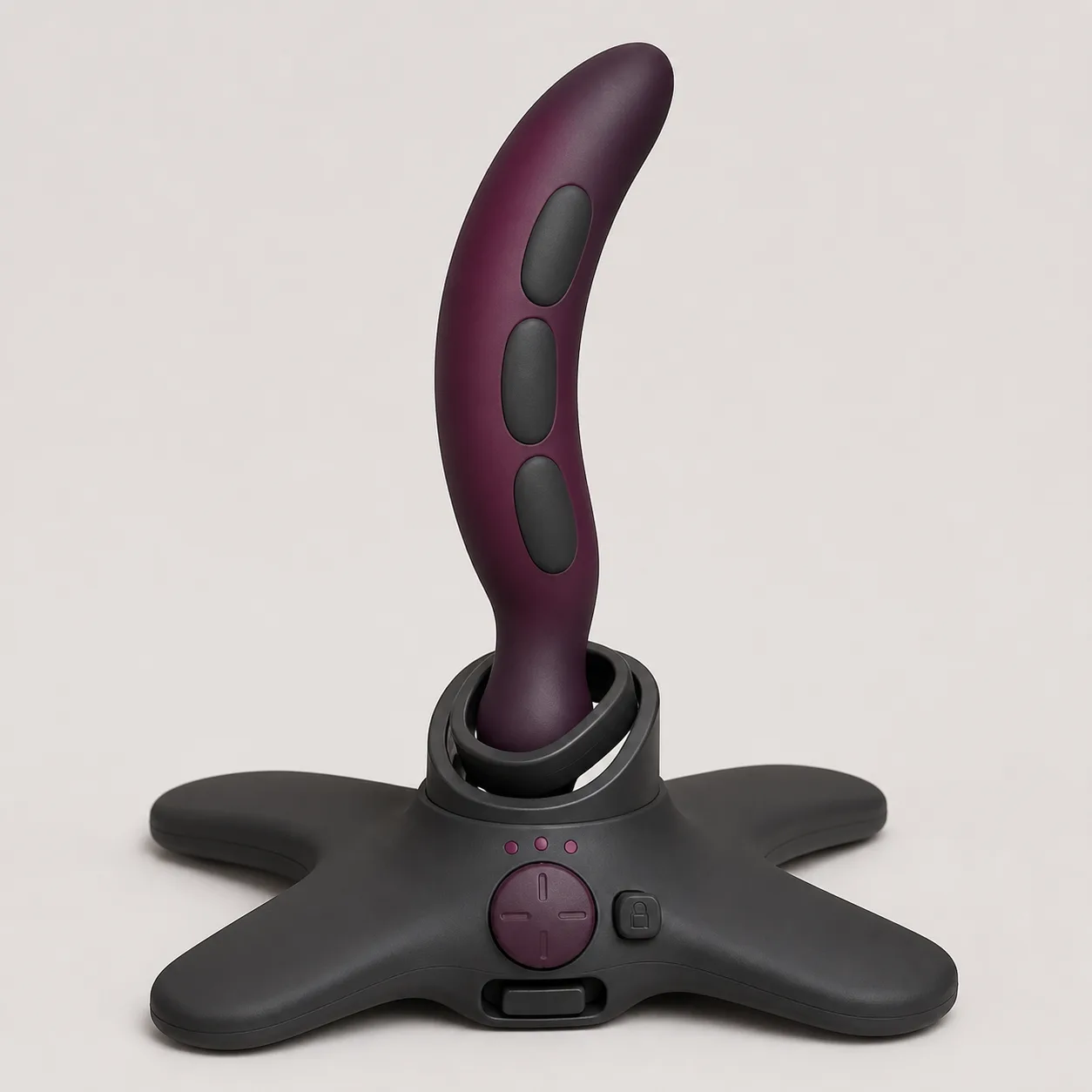
A curved handheld vibrator concept with four isolated rocker pads proposed to create a bidirectional lateral wave across a segmented flexible spine.
39,99 $
200 in stock
Move four contact pads as a lateral wave
This four pad wave vibrator concept places four shallow oval contact pads along a curved handheld bar. Each pad is proposed to rock across the bar on a transverse axle, allowing a programmed side-to-side wave to travel from the first station to the fourth without using rolling spheres.

The image does not prove pad travel, independent actuation, sequence timing, flexibility, output, ingress protection, runtime, materials or supplier approval.
Inventory the complete pad train
Request an exploded drawing and bill of materials for all four pad skins, carriers, rocker axles, pins, bushings, stops, guards, links, actuators, counterweights, sensors, spine segments, flexible joints, frame, shell, controls, indicators, vent, cell, contacts, conductors, seals, pigments, lubricants and adhesives.
Identify whether each station has its own actuator or shares a cam, shaft or linkage.
Establish the baseline bar geometry
Measure overall length, handle width, bar curvature, working-end width, pad dimensions, pad pitch, station spacing, axle location, neutral tilt, isolation gaps, segment length, control position, vent area, contact spacing, mass and center of gravity.
Repeat the measurements with the spine straight, naturally curved and held under a standardized bending load.
Map each rocker mechanism
Track left and right angular travel, axle play, stop contact, pad-edge displacement, actuation force and neutral-position error for every station. Approach both limits slowly and record hysteresis.
A visible pad does not establish that its carrier rocks rather than simply transmitting shell vibration.
Measure wave timing in both directions
Record station startup, peak, crossover, dwell, decay and neutral parking for forward and reverse sequences. Repeat at low, medium and full charge under free and compliant-contact conditions.
Log skipped stations, phase drift, overlap changes and any abrupt direction reversal that raises load or noise.
Characterize output station by station
Measure three-axis acceleration, dominant frequency, harmonics, rocking angle, sound, current and shell transfer while driving one station at a time. Then compare paired, sequential and simultaneous programs.
Shared drive components can make a nominally inactive pad move, so isolation must be quantified rather than inferred.
Map contact area through the wave
Use an instrumented compliant surface to record contact footprint, peak pressure, edge pressure, shear and migration as each pad rocks. Repeat with small bar-angle and curvature changes.
Set conservative limits from local peaks and station transitions, not from the average across all four pads.
Inspect every isolation gap
Measure pad-to-pad, pad-to-shell, carrier-to-guard and axle-end clearances through full travel, bar flex and loading. Use articulated probes to check access from every direction.
Reject a gap that pinches hair, film or loose material, traps a cleaning tool or closes against a neighboring pad.
Verify the segmented flexible spine
Measure bending moment, permitted radius, segment rotation, springback, twist, permanent set and the effect of flex on pad alignment. Inspect internal conductors and linkages under combined bend and wave motion.
The spine must not create a hinge hard spot, exposed edge, wire fatigue point or hidden cavity that cannot be dried.
Test grip stability and control access
Record grip friction, wrist moment, button force, accidental presses and visibility of the four indicators with dry and damp hands. Confirm flexing the working end does not distort the control panel.
Document startup hold, level changes, direction selection, pause, immediate stop, memory and lockout without assuming the four dots represent fixed programs.
Verify charging and battery behavior
Confirm cell chemistry, capacity, protection, charger input, contact polarity, charge time, runtime method, low-charge indication, storage voltage and transport paperwork. Test charging interlock and contact contamination response.
Inspect conductor routing across every spine joint after bending cycles and fault tests.
Measure heat and obstruction response
Log temperature at every pad, axle, spine joint, actuator zone, handle, controls, vent, contacts and cell across representative sequences and compliant loads. Obstruct one station at a time and then two adjacent stations using protected fixtures.
Verify current limiting, shutdown, neutral release, cool-down and restart behavior without forcing a stalled mechanism by hand.
Document materials and surface durability
Obtain exact material declarations and restricted-substance evidence for all contact skins, segment covers, shell, pigments, coatings, lubricants and adhesives. Inspect odor, tack, color transfer, swelling, cracking, delamination and hardness change after heat, cleaner and storage exposure.
Silicone, waterproof, body-safe, quiet, powerful and certification claims remain pending exact-model evidence.
Cycle wave motion, flex and cleaning together
Run repeated forward and reverse waves, paired and simultaneous programs, bar bending, grip loading, immediate stops, charging, cleaning, measured drying and storage. At checkpoints repeat geometry, rocker travel, phase, pressure, gaps, spine stiffness, output, current, sound and heat tests.
Clean beneath pad edges, within every isolation channel, around axle guards, between spine segments, at controls, the vent and contacts using only the validated method.
Price after loaded sequence validation
An Alibaba mini portable vibrator showroom currently displays a rechargeable wand-style category example at USD 1.80-2.20 with MOQ three. It is a sourcing benchmark only and does not confirm this four-pad rocker train, lateral-wave sequence or segmented spine.
The procurement reference supports an EUR 39.99 planning price after allowing for China-origin freight, exact-model sourcing, teardown, pad-train metrology, rocker kinematics, bidirectional timing, station output, pressure maps, gap inspection, spine fatigue, controls, battery, heat and obstruction review, material evidence, combined cycle life, cleaning validation, protective packing and discreet fulfillment. Exact quotation, MOQ, packed size, weight, freight, duty, tax, insurance, payment fees and delivery terms remain pending.
Frequently asked questions
Do all four pads move independently?
That remains pending teardown and individual-station motion and current measurements.
Does the wave travel in both directions?
Forward and reverse timing, overlap, drift and neutral parking require instrumented tests.
Can the bar be bent to any curve?
No. The permitted radius, twist, springback and conductor fatigue limits must be verified.
Do the gaps create a pinch risk?
Every clearance needs full-travel, flexed and loaded probe testing before approval.
Is the product waterproof?
No ingress claim is made; moving pads and spine joints require exact-model test evidence.
Which faults require retirement?
A loose pad, seized rocker, widening axle play, closing gap, cracked segment, exposed conductor, swollen cell, erratic sequence or abnormal heat.
Reviews
There are no reviews yet.