


Counter-Rotating Twin-Helix Automatic Stroker with Split Drive Collars
August 14, 2026
Cross-Web Suspended-Orb Palm Vibrator with Twin Tension Tabs
August 14, 2026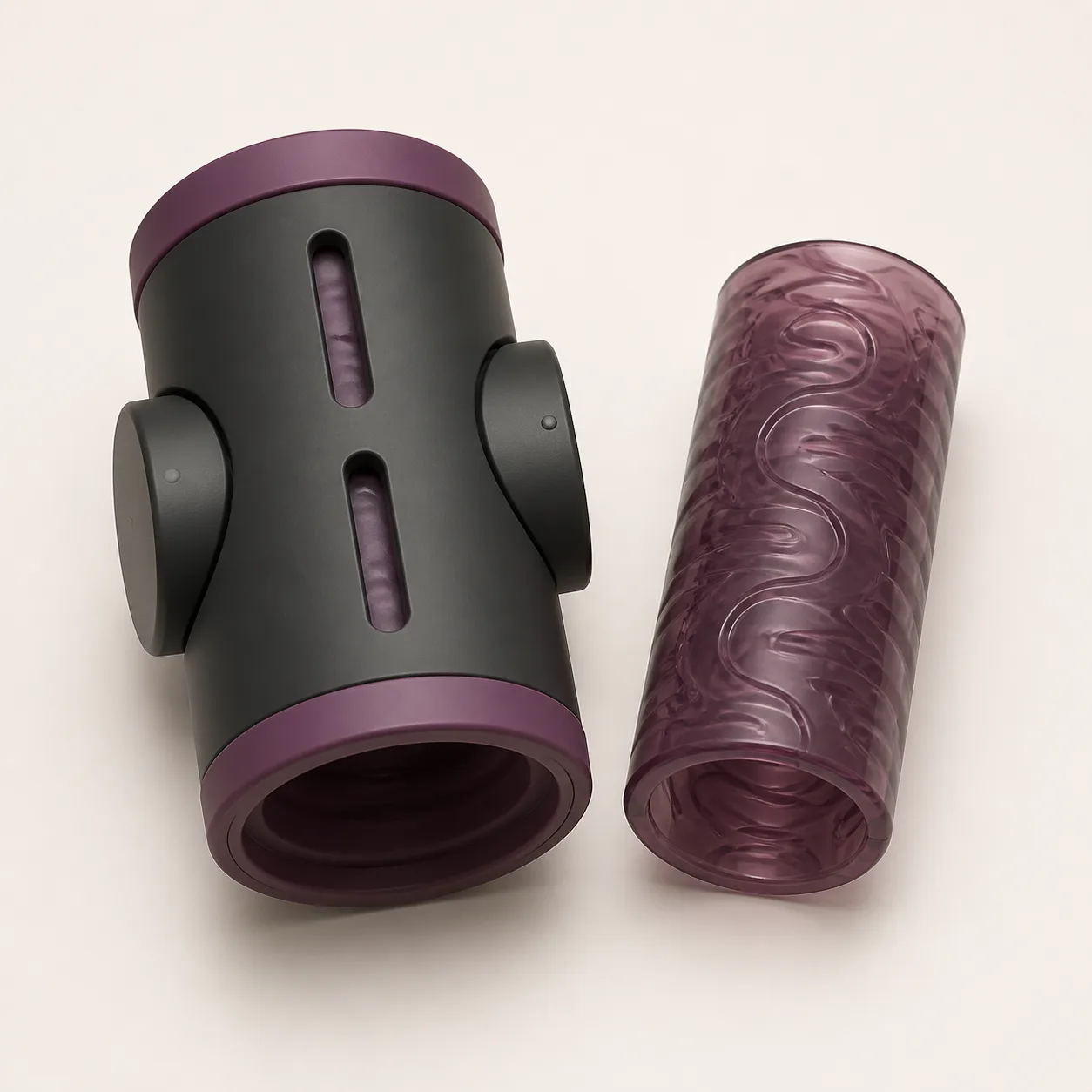
Twin-Dial Compression Manual Stroker with Removable Liner
A non-powered manual stroker concept with two independently mapped compression dials, an open-ended shell and a removable wave-textured through-liner.
34,99 $
200 in stock
Two dials divide compression into two zones
This twin-dial manual stroker concept combines a short open-ended shell, opposing side controls and a removable wave-textured through-liner. Each dial is intended to change pressure in its own zone so hand motion and compression can be adjusted separately without motors, batteries or wireless controls.

The image defines the planned component layout only; it does not prove dimensions, materials, pressure limits, liner fit or cleaning performance.
Calibrate each dial before assigning settings
Mark the fully open position, then measure rotation and internal displacement at evenly spaced steps. Repeat for the left and right controls because identical-looking dials can act on different shell areas or carry different tolerances.
Any scale used on the sales page must come from measured production samples rather than visual estimates.
Map pressure across the complete channel
Place soft cylindrical gauges at entry, center and exit positions while changing one dial at a time. Record diameter reduction, force and rebound, then repeat with both controls engaged to identify overlapping pressure zones.
Qualification should define a conservative maximum that avoids hard pinch points or a closed passage.
The through-channel preserves an airflow path
Confirm that both ends remain open at every approved dial setting and under normal hand grip. Measure airflow with the liner dry and lubricated, since folds or displaced texture can narrow the path.
Do not block either opening or create suction beyond the verified operating envelope.
Check liner retention without hiding release effort
Install the liner in the documented orientation and inspect both collars for even seating. Use controlled axial pulls to measure how securely it stays inside the shell and how much force is needed for deliberate removal.
A liner that creeps, twists, bunches or traps an edge beside a compression element fails the fit check.
Measure the shell and liner as separate parts
Record shell length, outer diameter, opening size, grip circumference and mass. For the liner, measure relaxed length, wall thickness, entry and exit diameter, internal checkpoints and texture height before and after installation.
The installed liner must not inherit dimensions copied from an uncompressed loose component.
Inspect every hard-soft interface
Use bright angled light around collars, inspection slots, dial housings and internal compression surfaces. Look for sharp flash, exposed fasteners, gaps, rough edges or contact points that could cut or abrade the liner.
Cycle the dials repeatedly and examine the same areas for new scuffs, thinning or particles.
Verify composition before describing touch
Obtain documentation for the liner, collars, shell, dial faces, pigments and any internal pads. Compare documents with independent screening and retain samples for odor, migration and aging review.
No silicone, TPE, body-safe, hypoallergenic or medical claim is assigned without matching evidence.
Choose lubricant through compatibility trials
Expose retained liner sections to the intended lubricant for a documented interval, then compare mass, dimensions, tack, color, softness and tensile condition. Water-based lubricant is the planning default, but even that choice needs exact-material confirmation.
Stop use if friction rises or the surface swells, clouds, becomes sticky or sheds residue.
Start fully open and increase one zone slowly
Set both dials to their measured open positions before contact. Adjust only one small step at a time, confirm comfort, and keep both openings unobstructed throughout manual movement.
Pain, numbness, discoloration, trapped skin or an inability to reduce pressure means stop immediately and disengage the shell.
Use the shell as a grip, not a clamp
Hold the main cylinder without leaning on a dial or squeezing the inspection slots. The external housing should guide hand motion while the liner provides the verified contact surface.
Do not attach improvised straps, weights, powered drives or vacuum equipment.
Dismantle in a controlled sequence
Open both dials completely, remove the liner by its collar and inspect it before washing. If a collar resists, check the seating path rather than pulling on the liner wall.
Keep cleaning liquids away from any concealed metal, lubricant or compression mechanism unless the supplier documents full washability.
Clean the liner apart from the shell
Wash the removable through-liner using the confirmed mild method, passing water through both ends and flexing each internal wave gently. Rinse until no cleaner or lubricant remains.
Wipe the shell, dial faces, slots and collars separately; immersion, boiling, dishwashers, alcohol, bleach and abrasive brushes need model-specific approval.
Dry open ends, slots and dial gaps
Stand the liner vertically in a dust-controlled space and rotate it during air-drying. Dry the shell with both dials open, paying attention to collar channels, inspection slots and the seams around each control.
Store the fully dry pieces separated in a ventilated pouch away from heat, sunlight and unknown plastics.
Price the control shell and replaceable part together
An Alibaba listing from Shenzhen Kovida Medical Products Co., Ltd. shows a transparent manual textured sleeve at USD 2.68-2.77 with MOQ 50. It is a liner benchmark only; the legal contracting entity, exact twin-dial shell, complete-set quote and all specifications remain pending.
The procurement reference supports an EUR 34.99 plan after allowing for China-origin freight, component inventory, dimension checks, dial calibration, pressure and airflow mapping, liner retention and wear tests, compatibility trials, protective packing and discreet fulfillment. Packed size, weight, freight, duty, tax, insurance, payment fees and destination terms require confirmation.
Frequently asked questions
Do both dials control the same area?
No shared action is assumed; each zone must be mapped on the production sample.
Can the channel be fully closed?
The approved range should keep a measurable through-path and exclude hard closure or pinch points.
Is the liner washable under running water?
Only after its composition and model-specific cleaning method have been verified.
Can the shell be immersed?
Immersion is not planned because hidden dial and compression parts may retain moisture.
Is the removable liner sold separately?
Separate availability, model coding and dimensional interchangeability are pending supplier confirmation.
Which faults disqualify the unit?
Dial binding, pressure spikes, blocked airflow, liner creep, collar damage, sharp shell edges, tearing, tackiness, odor change or residue shedding.
Reviews
There are no reviews yet.