


Twin-Dial Compression Manual Stroker with Removable Liner
August 14, 2026
Two-Rib Hand-Pump Vacuum Stroker with Smoke Chamber and Guarded Quick-Vent
August 14, 2026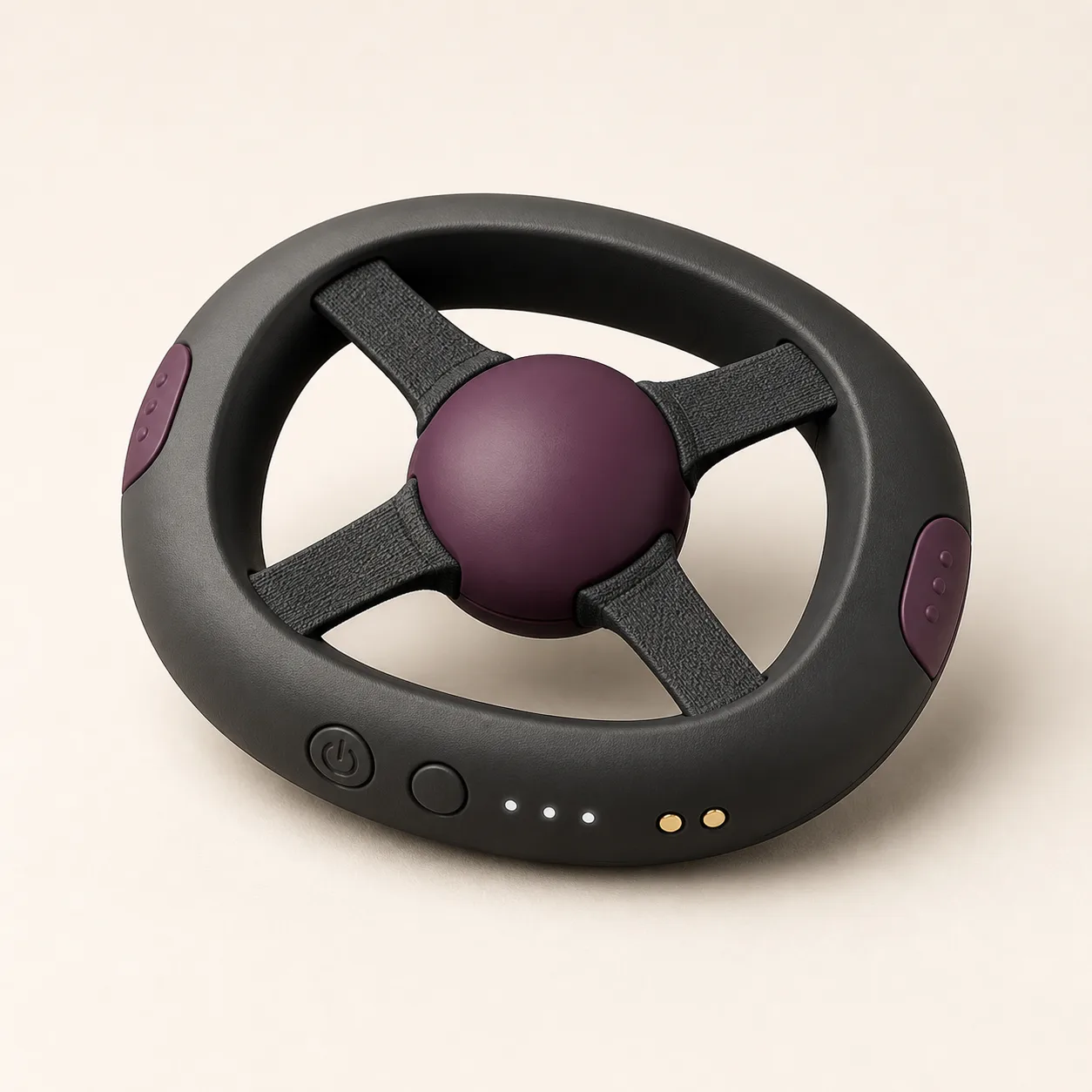
Cross-Web Suspended-Orb Palm Vibrator with Twin Tension Tabs
A rechargeable palm-vibrator concept with one captive center orb suspended on four diagonal web arms inside a low oval grip frame with twin tension tabs.
36,99 $
200 in stock
Suspend one contact orb on four diagonal web arms
This suspended orb palm vibrator concept holds one rounded center contact inside a low oval frame using four broad web arms arranged diagonally. Twin side tabs appear to adjust suspension tension, while four open gaps make the arm roots and orb boundary visible for inspection.

The image does not prove orb travel, tension range, independent motion, motor count, output, materials, ingress protection, runtime or supplier approval.
Inventory the complete suspended assembly
Request an exploded drawing and bill of materials for the oval frame, inner rim, four web arms, arm cores, skins, orb shell, orb carrier, center insert, twin tension tabs, linkages, guides, detents, stops, actuator, controller, buttons, indicators, cell, charging contacts, conductors, pigments, seals, lubricants and adhesives.
Trace the load, vibration and electrical paths between orb, web arms and frame and identify all hidden retainers or moving interfaces.
Measure frame, opening and orb geometry
Record overall length, width, height, grip circumference, frame cross-section, inner opening, orb diameter, protrusion, center height, four gap areas, charging-contact recess and total mass.
Map center alignment and minimum hard-edge clearance with the product relaxed and after a controlled conditioning period.
Map every web arm independently
Measure each arm’s free span, width, thickness, root fillets, attachment angle, surface texture and neutral tension. Label arms against a consistent frame datum.
Compare bending, torsional and axial stiffness so a visually symmetrical cross does not conceal one dominant or weakened arm.
Calibrate the twin tension tabs
Measure each tab’s direction, force, travel, detents, free play, stop compression and accidental movement resistance. Identify whether the tabs act independently, in opposing pairs or through one linked carrier.
Record orb height, arm strain and gap geometry at every approved combination rather than treating the visible dots as verified tension levels.
Inspect roots, gaps and moving clearances
Measure the narrowest spaces at every arm root, orb junction, inner rim, tab slot and hidden linkage. Move each tab slowly while observing all four gaps under magnification.
Use soft witness film to detect pinch, shear and abrasion paths and stop for arm crossing, root lift, exposed reinforcement or a gap that closes unexpectedly.
Measure orb travel in three axes
Apply controlled compliant loads vertically, laterally and diagonally to the orb. Record displacement, tilt, rotation, restoring force, arm strain, frame distortion and permanent offset.
Repeat from multiple directions and at all approved tension settings to identify asymmetric stops or carrier contact.
Map the contact pressure footprint
Press the orb and surrounding frame into an instrumented compliant surface at centered and edge-biased angles. Record contact area, peak pressure, orb tilt, web deflection, frame contact and recovery.
Stop for a sudden hard point, orb carrier lift, arm inversion, inner-rim contact, tab movement or incomplete rebound.
Trace vibration from orb to frame
Map amplitude, frequency, startup, decay, sound and surface temperature at the orb center, four orb junctions, arm midpoints, roots, frame quadrants and controls. Repeat across verified programs and charge states.
Compare unloaded and compliant-load values to separate useful orb output from frame resonance and hand transfer.
Compare tension positions under power
Repeat displacement, pressure and vibration tests for every approved tab combination while logging current, sound, heat, arm phase, orb drift and gap width. Include asymmetric loads.
Confirm whether tighter settings raise actuator load, reduce recovery or bring the orb carrier into contact with hidden frame surfaces.
Evaluate grip and control access
Measure dry and damp grip pressure, slip, frame twist, button force, control reach and accidental tab movement in several hand orientations. Check that open gaps do not create finger traps.
Verify the power and mode buttons remain distinguishable by touch and that charging contacts stay outside normal pressure zones.
Document power, heat and obstruction behavior
Record startup hold, program order, transitions, memory, indicators, lockout, immediate shutdown, cell chemistry, rated capacity, charger input, contact polarity, charge time, runtime method, charging interlock and protection circuits.
Log current and temperature during long programs, compliant loading, partial orb obstruction and several tension settings. After a protective stop, document cool-down and reset without repeatedly energizing a stalled or overheated sample.
Cycle the orb, webs and controls together
Run repeated tension adjustment, detent selection, three-axis orb loading, powered compliant contact, frame flex, program changes, charging, cleaning and storage cycles. At checkpoints measure tab force, arm geometry, gaps, orb center, carrier play, output, sound, heat and battery behavior.
Retire a sample after split arms, root lift, exposed core, orb looseness, tab creep, lost detent, frame crack, faulty contact, seal separation or abnormal heat.
Validate cleaning through four open gaps
Obtain exact material and cleaner compatibility data before testing. Clean the orb surface, every arm face and edge, orb junctions, arm roots, inner rim, gap corners, tab slots, controls, frame underside and charging contacts.
Measure drying by mass and inspect hidden carrier, root and linkage cavities for retained moisture or residue before charging or closed storage.
Price after suspension behavior is proven
An Alibaba portable handheld vibrator listing currently shows USD 1.94-2.29 with an MOQ of one. It is a category benchmark only and does not confirm this captive orb, cross-web suspension, twin tension tabs or approved supplier.
The procurement reference supports an EUR 36.99 planning price after allowing for China-origin freight, complete teardown, frame and orb metrology, per-arm stiffness, tab calibration, moving-gap review, three-axis travel, compliant pressure maps, loaded output, grip, control, battery and thermal evaluation, full cycling, material evidence, cleaning validation, protective packing and discreet fulfillment. Exact quotation, packed dimensions, weight, freight, duty, tax, insurance, payment fees and delivery terms remain pending.
Frequently asked questions
Does the center orb roll freely?
No free rotation is assumed; travel, tilt, carrier limits and friction require sample measurement.
Do the side tabs work independently?
The linkage is unconfirmed and must be mapped for every approved combination.
Are the dots verified tension levels?
No. They remain visual references until direct arm and orb measurements establish a scale.
Can fingers enter the open gaps?
Gap dimensions, collapse and pinch paths need review before any handling guidance is approved.
Can the device be immersed?
Only after exact ingress evidence and a compatible cleaning method are supplied.
Which faults require immediate retirement?
A split web, lifted root, exposed core, loose orb, creeping tab, collapsed gap, cracked frame, faulty contact, damaged seal or abnormal heat.
Reviews
There are no reviews yet.