



Three-Position Curvature Prostate Trainer with Wide Rocker Base
August 14, 2026
Black Air-Suction and Vibration Stroker with Removable Sleeve
August 14, 2026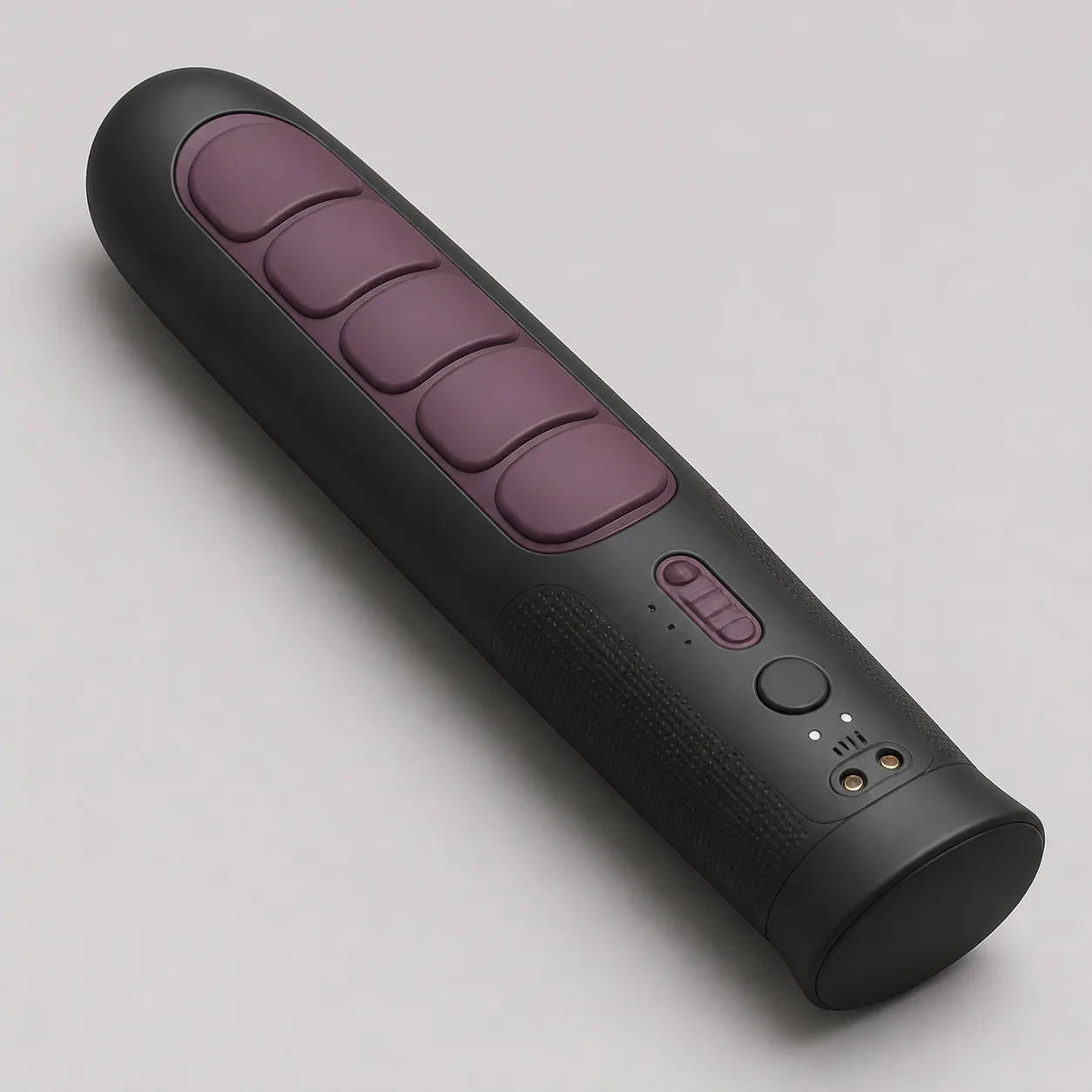
Five-Rib Sequential-Wave Pocket Vibrator with Three-Stop Phase Slider
A slim pocket vibrator concept with five separated contact ribs, guarded channels and a local three-stop slider intended to select sequence timing.
52,99 $
200 in stock
Arrange five ribs on one linear contact deck
This five-rib sequential-wave pocket vibrator concept presents exactly five separate rounded plum contact ribs along a slim charcoal capsule. Narrow guarded channels divide the stations, while a recessed three-stop slider is intended to select timing behavior without changing the external rib geometry.

The image does not prove actuator count, independent station control, sequence direction, phase accuracy, output, dimensions, materials, sealing, charging safety or production availability.
Inventory the five-station drive stack
Request an exploded bill of materials for ribs R1 through R5, face skins, carriers, channel guards, drive links, actuators, moving masses, bearings, isolators, internal frame, slider, detents, stop button, controller, indicators, vent, cell, charging contacts, conductors, seals, shell, grip panels, pigments, lubricants and adhesives.
Trace every shared drive element so synchronized rib motion is not misrepresented as five independent motors.
Measure shell deck and balance geometry
Record overall length, width, thickness, nose radius, rear-cap flare, contact-deck length, rib center spacing, channel width, control recess, grip zones, vent area, contact recess, mass and center of gravity. Check shell straightness and deck twist on a reference fixture.
Repeat measurements after charging, bounded load, cleaning and storage cycles to detect frame creep or skin migration.
Map each rounded rib surface
For R1 through R5, measure length, width, crown, height, end radius, edge blend, hardness, compression, recovery, friction and local thickness. Preserve station identity rather than averaging the five results.
Inspect for hard inclusions, voids, thin corners, flash, uneven bonding, pigment transfer and changes in tack after the supplier-specified cleaning process.
Characterize guarded channel isolation
Measure every channel depth, width, floor radius, guard height and closing movement while adjacent ribs are driven and gently loaded. Use soft film and articulated probes to screen for capture, shear and residue traps.
Map mechanical and vibrational cross-coupling between neighboring stations; visual separation alone does not prove functional isolation.
Resolve actuator allocation and force paths
Document whether the device uses one shared motor, multiple eccentric drives, linear actuators or another mechanism. Trace bearings, links, counterweights, frame supports and rib carriers from input to each contact face.
Measure backlash, free play, carrier tilt and housing transmission before assigning any sequential-wave claim to a production sample.
Capture sequence timing direction and drift
Synchronize five three-axis accelerometers to record startup order, peak timing, dwell, crossover, direction, amplitude, frequency, phase, skipped events and shutdown order at every confirmed program. Repeat free and under a compliant standardized load.
Challenge low charge, temperature variation and repeated direction changes to identify drift, stalled stations or a sequence that collapses into uniform vibration.
Calibrate the three-stop phase slider
Measure slider travel, detent positions, actuation force, backlash, wet and dry grip, indication and response latency. Approach each stop from both directions and compare actual five-channel timing to the intended map.
Partially seated positions must produce a defined safe state rather than an ambiguous or unstable timing pattern.
Verify controls immediate stop and lockout
Document startup, level change, program change, pause, immediate stop, restart, memory and transport lockout using the broad local control and slider. Verify that stop remains available regardless of slider position or communications.
Test accidental activation in storage and control behavior during a stalled rib, controller reset, low voltage and unexpected charging connection.
Map contact pressure and edge loading
Use a compliant instrumented fixture to measure each rib footprint, peak pressure, load sharing, local shear, deck rocking and channel-guard engagement under center, nose, rear and oblique loads. State fixture stiffness and preload.
Reject exposed hard edges, progressive rib tilt, concentrated guard contact or unstable shell motion within the accepted test envelope.
Measure grip isolation and handling stability
Record dry and damp grip friction, balance, control reach, hand-transmitted acceleration and unintended slider contact at every measured output. Compare rib-deck motion with both grip panels and the rear cap.
Do not infer fit or suitability for a specific body area from the product silhouette; intended contact boundaries require supplier evidence and risk review.
Verify charging power loss and ingress boundaries
Confirm cell chemistry and capacity, specified input, contact polarity, alignment, retention, protection circuits, charge time, runtime and low-voltage shutdown. Check that output cannot start unexpectedly during charge or immediately after disconnect.
Map seams around the rib deck, slider, stop button, indicators, vent, contacts and rear cap. No water-resistance claim is accepted without appropriate exact-model evidence.
Log current sound and temperature by station
Measure current, accessible surfaces, each rib carrier, controller, cell, contact and vent temperatures, plus A-weighted sound at a stated distance. Capture every verified sequence under free and compliant load.
Investigate rib-to-rib temperature imbalance, frame resonance, clicking channels, rising current, intermittent indicators or thermal throttling that changes the sequence.
Challenge faults then cycle clean and inspect materials
In protected fixtures, simulate one restrained rib, high channel drag, slider between stops, vent obstruction, low voltage and interrupted power. Stop before damage and quarantine samples with delayed shutdown, exposed parts, swelling, abnormal heat or uncontrolled restart.
Cycle startup, all confirmed sequences, phase selection, immediate stop, bounded loading, charging, specified cleaning, measured drying and storage. Recheck geometry, rib adhesion, channels, output, timing, controls, current, sound, heat and odor. Exact materials, restricted-substance evidence and certification remain pending.
Build landed price after five-channel proof
An Alibaba mini-bullet-vibrator page currently shows a rechargeable category example at USD 1.91-2.19 with MOQ three. It is a benchmark only and does not confirm this five-rib deck, sequential drive, phase slider or an approved supplier.
The procurement reference supports an EUR 52.99 planning price after allowing for China-origin freight, exact-sample sourcing, five-rib and channel metrology, drive teardown, synchronized timing capture, slider calibration, pressure and grip mapping, charging, current, sound, heat, protected fault and cycle work, protective packing and discreet fulfillment. Exact quotation, MOQ, materials, battery, packed size, weight, freight, duty, tax, insurance, payment fees, certifications and delivery terms remain pending.
Frequently asked questions
Does each rib have its own motor?
That is unconfirmed; teardown and synchronized measurements must establish the actuator allocation and shared force paths.
What does the phase slider change?
Its actual timing maps, directions and detents remain pending until all five station traces are compared at each stop.
Can a channel pinch or trap residue?
Every moving gap needs probe, soft-film and cleaning-access checks under load and through the full measured sequence.
Is the device waterproof?
No ingress rating is confirmed; the deck, controls, vent, charging contacts and rear-cap seams require exact-model evidence.
Can it be used while charging?
Charging-time operation is not assumed and should remain disabled unless the approved instructions and electrical tests explicitly permit it.
Which faults require retirement?
Loose or torn ribs, growing channel gaps, exposed hard parts, failed stop or lockout, unstable timing, abnormal noise or heat, damaged contacts, cell swelling or persistent residue.
Reviews
There are no reviews yet.