


Five-Rib Concave-Waist Suction-Base Dildo
August 14, 2026
Quad-Cam Three-Zone Compression Stroker with Reversible Open-End Liner
August 14, 2026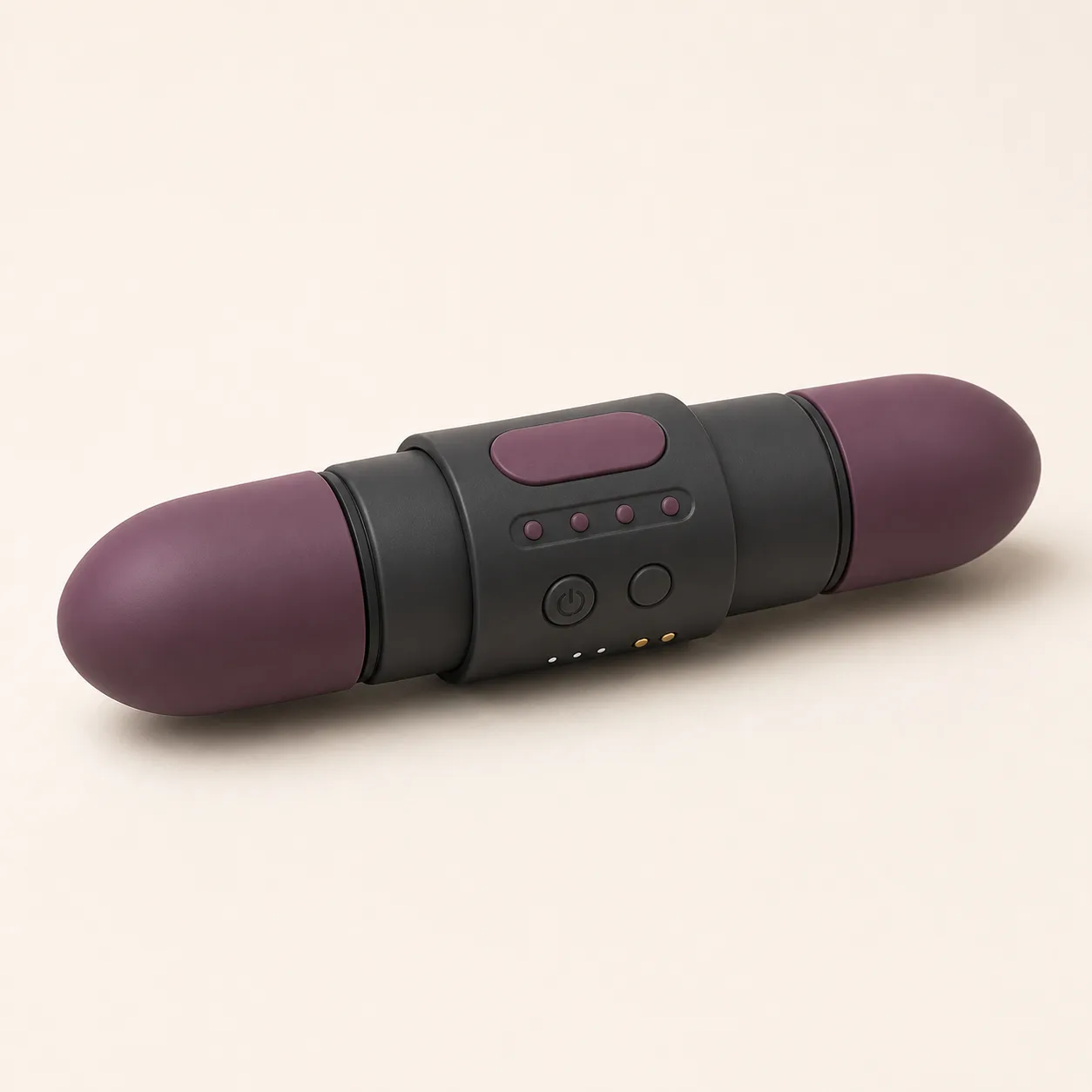
Counter-Pulse Twin-End Bullet Vibrator with Sliding Grip Collar
A slim rechargeable bullet vibrator concept with two opposite rounded tips and one sliding center grip collar for separately testable output, phase timing and handling balance.
27,99 $
200 in stock
Place one rounded contact tip at each end
This twin end bullet vibrator concept combines two plum contact caps on opposite sides of one slim rechargeable body. A broad central grip collar is intended to slide between reference positions while keeping controls near the hand.

The image does not prove usable length, collar travel, motor count, independent tip control, counter-pulse behavior, output, waterproofing, runtime, material or approved contact location.
Inventory left and right architectures
Request an exploded drawing and bill of materials for both contact caps, isolation grooves, tip carriers, actuators, couplings, center tube, collar rails, collar liner, thumb pad, detents, stops, buttons, indicators, controller, battery, charging contacts, pigments, seals, lubricants and adhesives.
Trace the electrical and structural paths to both ends so a mirrored exterior is not mistaken for mirrored internal construction.
Measure dual-end geometry
Record overall length, each tip length, maximum diameter, radius, transition angle, isolation-groove width and depth, center-body length, collar width, control reach, charging-contact offset and mass.
Measure from a central datum and specify acceptable left-right variation in profile, mass and alignment.
Map collar travel and every reference
Measure the collar’s axial range, rotation, detent force, free play, thumb-pad force, stop compression and accidental movement resistance at each visible dot. Approach positions from both directions.
Confirm the collar cannot cover an isolation groove, button, indicator, charging contact or ventilation path.
Assess grip and collar stability
Use instrumented grips to measure pressure, slip, balance, control access and collar creep with the grip near the left end, center and right end. Include dry and lightly damp test gloves.
Check whether vibration from either tip changes the force needed to move or hold the collar.
Characterize the left contact tip
Measure amplitude, frequency, startup, decay, sound and surface temperature at the center and perimeter of the left tip for every confirmed program and charge level.
Repeat with the grip collar at every approved reference to detect structural preload or damping changes.
Characterize the right contact tip
Repeat the complete output map on the right tip with synchronized sensors remaining on both ends and the center body. Compare phase, amplitude, sound and heat.
Document whether differences come from separate actuators, mounting, shell geometry or battery position.
Test any counter-pulse claim
Record both tips simultaneously through every program. Measure phase offset, pulse duration, sequence order, overlap, timing drift, startup and response after mode changes.
Do not use counter-pulse wording as a performance claim until production samples show stable alternating behavior across charge levels and loads.
Apply compliant loads to each end
Load the left tip alone, the right tip alone and both tips against separate compliant sensors within verified limits. Record contact area, pressure, vibration loss, body bending, collar movement, current, sound and temperature.
Stop for sudden tip movement, unstable grip, shell flex, collar creep, output collapse, unusual noise or rising heat.
Measure transfer through the center body
Place synchronized sensors on both isolation grooves, collar rail, thumb pad, controls and center tube. Compare structure-borne vibration with local tip output.
Verify that the isolation grooves do not act as thin failure sections under low bending and torsion.
Resolve controls and program logic
Document short, long, repeated and simultaneous button actions. Verify power, tip selection, program order, pause, lockout, memory, low-battery behavior and a reliable stop command.
Check whether moving the collar can press a control or change program unintentionally.
Audit battery balance and charging
Confirm battery chemistry, capacity, location, charger input, contact polarity, charge time, runtime, standby drain and operation during charging. Measure center of mass through the discharge curve.
Keep the device off and dry while charging unless exact-model instructions explicitly permit another condition.
Log current and heat at both ends
Run the highest verified program in free air and under left-only, right-only and dual compliant loads. Log current and temperature at both tips, grooves, actuators, collar rail, controller, battery, buttons and charging contacts.
Check shutdown and restart behavior after guarded low-force obstruction below confirmed limits.
Cycle collar, tips and cleaning
Run repeated collar slides, detent selections, left-tip output, right-tip output, combined programs, compliant loads, button actions, charging and cleaning cycles. At planned checkpoints measure collar force, rail wear, stop integrity, groove strain, tip bond, output, current and heat.
Obtain the exact cleaning method and ingress rating. Clean both tips, isolation grooves, collar edges, rail recess, thumb pad, buttons and contacts with approved tools, then dry all overlaps.
Price after phase behavior is verified
An Alibaba rechargeable bullet vibrator listing currently shows USD 2.20-2.70 with an MOQ of one. It is a category benchmark only and does not confirm this twin-end architecture, sliding grip collar or approved supplier.
The procurement reference supports an EUR 27.99 planning price after allowing for China-origin freight, complete part inventory, dual-end metrology, collar travel and grip tests, separate tip output, synchronized phase analysis, single and dual compliant loads, center-body transfer, control logic, battery balance, electrical and thermal review, full assembly cycling, materials and battery evidence, cleaning validation, protective packing and discreet fulfillment. Exact quotation, packed dimensions, weight, freight, duty, tax, insurance, payment fees and delivery terms remain pending.
Frequently asked questions
Do the two tips vibrate independently?
Motor count and zone selection remain pending teardown and control mapping.
Does counter-pulse mean the tips alternate?
Only synchronized measurement can confirm sequence, phase and timing stability.
Can the collar slide while powered?
Keep it stopped during adjustment unless exact-model instructions and tests confirm another procedure.
Are both ends the same size?
They appear mirrored, but each profile and tolerance requires direct measurement.
Can the center rail be rinsed?
Only after ingress protection and a method for drying collar overlaps are documented.
Which faults require immediate retirement?
A loose tip, cracked groove, creeping collar, damaged rail, unstable controls, output imbalance, unusual noise, heat, swelling or corrosion.
Reviews
There are no reviews yet.