


Counter-Pulse Twin-End Bullet Vibrator with Sliding Grip Collar
August 14, 2026
Twin-Drum Four-Phase Palm Vibrator
August 14, 2026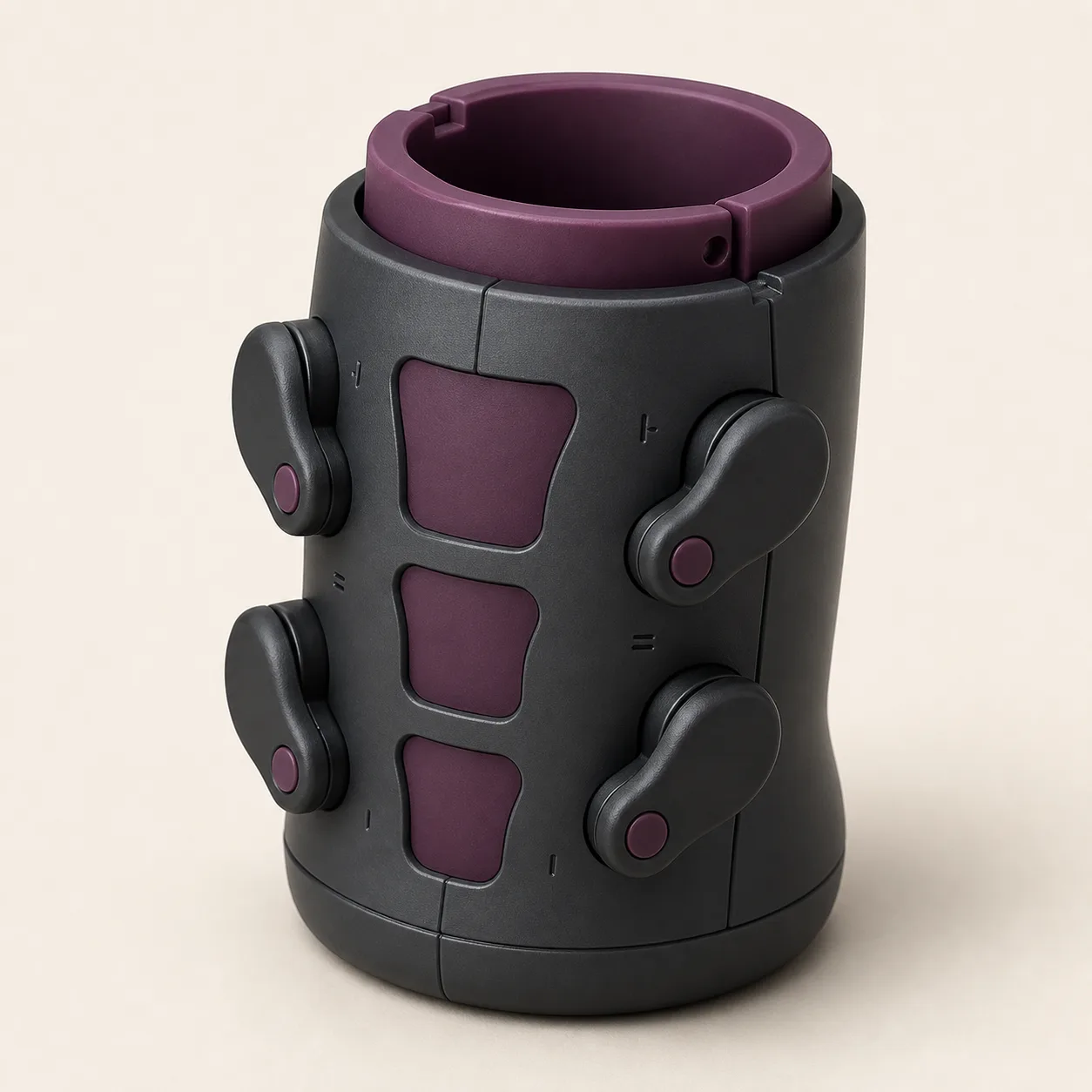
Quad-Cam Three-Zone Compression Stroker with Reversible Open-End Liner
A manual open-end stroker concept with four visible flip cams, three independently testable pressure windows and a keyed reversible liner collar.
29,99 $
200 in stock
Four flip cams make manual pressure visible before use
This quad-cam compression stroker concept surrounds a removable open-end liner with three flexible pressure windows and four external mechanical cams. Each cam has an obvious raised or parked position, so adjustment does not depend on a motor, app or hidden pneumatic sequence.

The illustration defines a purchasing concept, not verified dimensions, materials or pressure limits.
Start with a complete component inventory
Ask the supplier to identify both shell halves, base ring, liner collar, keyed rim, open-ended liner, three pressure windows, four cam levers, pivots, followers, stops, bushings and fasteners. Hidden pads, springs, lubricants and adhesives also belong in the bill of materials.
Every lever should map to a documented zone rather than relying on color or guesswork.
Measure the liner and shell as separate parts
Record overall height and width, empty mass, entrance diameter, exit diameter, internal usable length, shell wall clearances, liner wall thickness and collar engagement depth. Measure the relaxed liner before any fixture expands it.
Also check whether the split shell exposes a ridge when fully closed.
Confirm what reversible means on the exact sample
A reversible liner must seat from either approved end without folding its collar, blocking the exit or exposing a hard rim. Mark both orientations, measure insertion depth, and compare retention under gentle axial and twisting fixture loads.
Do not assume both orientations feel or clean the same; internal texture may be directional.
Map four cams against three pressure windows
Operate one lever at a time on an instrumented compliant cylinder and chart displacement and force at every window. Then test the permitted lever combinations to reveal overlap, shell flex and any zone that tightens when an unrelated cam moves.
The control map must state which upper, middle or lower region each lever influences.
Check every lever for a positive parked state
Measure opening force, closing force, travel angle, tactile engagement and the clearance between a finger and the shell. A lever that floats between positions, rebounds unexpectedly or can be knocked past its stop needs redesign.
All adjustments should be made without body contact and with the liner unloaded.
Set a conservative compression envelope
Use calibrated soft fixtures of several diameters to record pressure across the approved cam combinations. Inspect for concentrated edges, oval distortion, blocked passages and permanent liner set after a timed hold.
Any configuration that creates pain, numbness, color change, coldness, swelling or loss of sensation is a stop condition, not a higher setting.
Keep the open end unobstructed
Verify that the far opening remains visible and accessible with all cams parked and engaged. The liner must not be drawn into a follower, trapped in a shell seam or pushed beyond the base ring.
A cleaning tool, cloth or finger should never be forced past a closed cam.
Inspect the split shell for pinch and shear gaps
Cycle the empty shell and levers while measuring gaps around hinges, seams, windows and cam pivots. Flexible liner material should shield the intended contact path, but it must not act as the only guard against a moving hard edge.
Reject burrs, protruding pins, sharp notches or gaps that close abruptly.
Plan fit by verified geometry rather than labels
Compare relaxed and fixture-expanded entrance size, internal length and zone positions with the intended fit range. Begin with every cam parked, use compatible lubricant, proceed slowly and keep all levers reachable.
Stop immediately if the collar lifts, the shell rotates, the liner bunches or pressure cannot be reduced promptly.
Evaluate grip without squeezing the controls
Map safe hand zones on the shell and confirm that normal holding force does not flip a lever or press a pressure window directly. Test dry and with the exact approved lubricant residue on a fixture, then assess slip, rotation and access to every cam.
A textured grip must not hide seams or cleaning recesses.
Verify every material and colorant claim
Request exact formulations for the liner, pressure windows, collar, shell, cams, pivots, pigments, lubricants and adhesives. Review restricted-substance, skin-contact, odor, oil-bleed, hardness, tear and aging evidence for the ordered production revision.
TPE, silicone, ABS, medical-grade and body-safe descriptions remain unconfirmed until supported by exact-model documentation.
Clean the liner outside the mechanism
Park all cams, release the keyed collar and remove the liner only by the documented method. Wash the liner according to confirmed compatibility, open both ends for rinsing, and dry it completely before seating it in a clean, dry shell.
Wipe the pressure windows and cam recesses without immersing the mechanical housing unless the supplier provides an exact ingress rating and procedure.
Inspect the device before every session
Check collar lock, liner tears, sticky surfaces, permanent dents, window separation, seam closure, cam stops, pivot looseness and contamination inside the shell. Cycle each empty lever and confirm that pressure visibly releases.
Retire the sample if a lever jams, a follower protrudes, the collar will not seat, a window stays deformed or residue cannot be reached.
Build landed cost from a manual-product benchmark
An Alibaba tight-male-masturbator showroom currently lists a manual pressure-control product at USD 5.79-6.42 with an MOQ of 16. That listing is a category reference only; it does not establish this four-cam design, the legal supplier or the production quotation.
The procurement reference supports an EUR 29.99 planning price after allowing for China-origin freight, exact-sample measurements, liner and shell inspection, four-cam force mapping, pinch-gap checks, material review, cleaning validation, protective packing and discreet fulfillment. Packed dimensions, weight, freight, duty, tax, insurance, payment fees and delivery terms remain pending.
Frequently asked questions
Is this an automatic stroker?
No. The concept uses hand-operated mechanical cams and has no motor, battery, app or air pump.
Can all four cams be closed together?
Only if exact-sample testing defines that combination within the documented pressure envelope. Begin with every lever parked.
Why are there four controls for three zones?
The intended design allows paired influence at one region, but the supplier must provide a clear lever-to-window map and force data.
Can the liner be used in either direction?
Only after both collar orientations, retention, internal texture direction and cleaning access are verified on the ordered sample.
May the shell be immersed?
Not without an exact ingress rating and cleaning method. Remove and wash the liner separately by the confirmed procedure.
Which faults mean the product should be retired?
A torn or oily liner, loose collar, jammed lever, raised hard edge, cracked shell, detached window, persistent deformation or inaccessible residue.
Reviews
There are no reviews yet.