


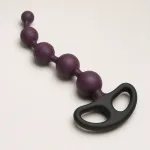
Five-Bead Twin-Ridge Mid-Section Anal Strand with Crescent Safety Handle
August 14, 2026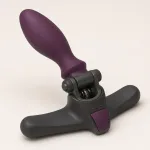
Three-Stop Torsion-Hinge Prostate Trainer with Oversized Cross Yoke
August 14, 2026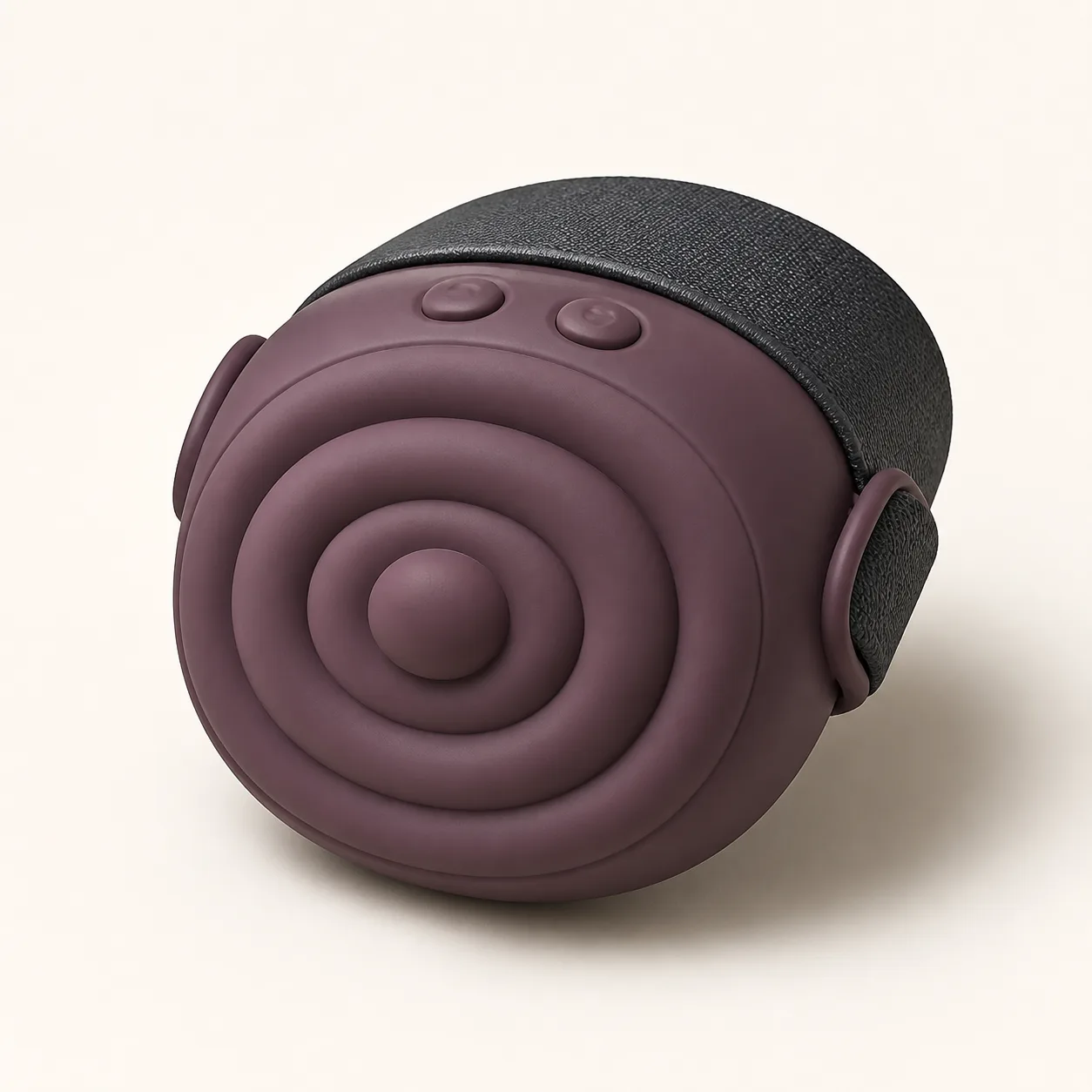
Three-Ring Concentric Palm Vibrator with Adjustable Hand Strap
A compact smoky-plum palm vibrator concept with one centre dome, exactly three raised concentric rings, two controls and a broad adjustable charcoal hand strap.
44,99 $
200 in stock
Read one centre dome inside three raised contact rings
This three-ring concentric palm vibrator concept uses one rounded central dome surrounded by exactly three raised smoky-plum rings. A broad charcoal hand strap spans the back of the flattened oval body, while two unlabelled controls sit on the upper edge for access without covering the contact face.

The image establishes visible form only. It does not confirm dimensions, materials, ring softness, strap range, vibration modes, battery, sound, heat, water resistance or production readiness.
Measure the flattened oval body before judging portability
Record maximum width, height, front-to-back depth, perimeter, mass and the distance from the strap anchors to the control edge. Include a scale diagram because perspective can make a palm device appear smaller than the approved sample.
Pocket-sized, lightweight and discreet-carry wording remains pending physical dimensions, weight and packaging review.
Use the central dome as the geometry datum
Measure dome diameter, projection, crown radius and wall thickness, then inspect the centre for mould seams, sink marks, asymmetry and hard inclusions. Mark the dome centre as the reference for every ring diameter and runout measurement.
Focused, pinpoint and soft-contact claims require hardness, deflection and output evidence from the finished surface.
Label concentric rings R1, R2 and R3
Number the rings from the dome outward. For R1 through R3, record inside and outside diameter, ridge width, height, valley depth, edge radius and radial runout so all three remain visibly separate rather than merging into an uneven spiral.
Inspect the full circumference of each ring for flash, tears, trapped debris and discontinuous texture.
Map pressure across the complete radial face
Use a compliant test pad to compare contact at the dome, three ring crowns and three valleys under several bounded hand loads. Document whether the outer ring stabilizes the face before the centre reaches maximum deflection.
The ring layout does not guarantee even pressure on every body contour. Begin with light contact and avoid forcing the complete face flat.
Grade the broad hand strap by hand circumference
Measure usable strap length, width, thickness, adjustment range, overlap and clearance between the strap and rear shell. Review small, medium and large adult hand fixtures rather than describing the fit as universal.
The strap should stabilize a relaxed grip without compressing the hand, obstructing circulation or requiring fingers to brace against a moving edge.
Proof both strap anchors and edge guards
Inspect the left and right anchor for stitch or mould retention, slot radius, pull strength and abrasion against the strap. The raised side guards shown in the concept should not pinch the strap or create hard corners beside the hand.
Set low-force proof limits and cycle counts before production. The strap is a handling aid, not a tether or suspension point.
Define the two-button control sequence
A signed control map should state power-on, level changes, pattern changes, pause, memory, lockout and low-battery indication for every short and long press. Button shapes or tactile marks should distinguish functions without relying only on printed icons.
The illustration shows two oval controls but no labels or lights. Final mapping and accessibility details remain pending.
Measure vibration radially from centre to edge
Capture frequency and acceleration at the dome, R1, R2, R3 and two rear-shell locations on every approved setting. Compare results with light and moderate contact to show how the concentric surface transmits or isolates output.
Powerful, deep, rumbling and low-numbness language is excluded until the method, sample size and acceptance limits are documented.
Log sound and temperature during the longest cycle
Measure A-weighted sound at a fixed distance in a controlled room, then record temperature at the dome, outer ring, button edge, battery zone and strap-contact area throughout the maximum verified run time.
Stop if the device becomes unusually hot, changes tone, emits odour or operates intermittently. Exact limits remain pending engineering review.
Audit cell, connector and charging protection
Request battery chemistry, rated capacity, charge input, connector type, charging time, measured run time by setting, cycle-life target and protection for overcharge, over-discharge, overcurrent and short circuit.
No cable, adapter, magnetic lead or charging dock appears in the image. Included components and regional requirements must be confirmed from the sealed pack.
Verify ingress before allowing wet cleaning
Inspect button seams, body joints, strap anchors and the charging interface, then test the complete device to the declared ingress method. Cleaning instructions must identify whether the textile strap is removable, washable, wipe-only or permanently attached.
Waterproof and submersible wording remains withheld until traceable finished-product evidence exists. Never charge a wet or damaged unit.
Require material data for both soft and textile zones
Obtain polymer grades, pigments, coatings, adhesives, hardness values and textile fibre declarations for the contact face, shell, buttons, strap and edge guards. Evaluate odour, tack, stain, dye transfer and surface change after the proposed cleaner and storage conditions.
Silicone, body-safe, hypoallergenic, latex-free, phthalate-free and medical-grade claims remain pending finished-product evidence.
Clean every ring valley without saturating the strap
Follow the validated cleaner concentration, water temperature, contact time, rinse and drying method. Pay specific attention to the three valleys, dome base, outer edge, button rims and strap-anchor recesses.
Boiling, bleach, solvents, abrasive brushes, machine washing and high heat are excluded unless the exact assembly is expressly validated for them. Store only when the face and strap are completely dry.
Set a planning price from broad handheld references
An Alibaba personal-handheld-electric-vibrator-massager category page displayed a rechargeable handheld reference at USD 1.66 to 2.21 with MOQ 3 and a compact rechargeable massager at USD 3.50 to 3.95 with MOQ 20. These are broad category examples, not quotations for this three-ring palm design or approved suppliers.
The public procurement benchmark supports an EUR 44.99 planning price after provisional allowance for China-origin freight, concentric-face moulding, three-ring dimensional inspection, strap range and anchor cycling, vibration, pressure, heat, sound, battery, charging, ingress, material and cleaning checks, discreet fulfilment and expected quality loss. Exact supplier, quote, MOQ, dimensions, materials, modes, battery, cable, packed weight, freight, duty, tax, certification, payment terms and lead time remain pending.
Frequently asked questions
How many raised rings surround the centre?
Exactly three concentric rings are proposed around one rounded central dome.
Is the rear strap adjustable?
The concept shows an adjustable broad hand strap, but its final range and fastening method require samples.
How many control buttons are present?
Two unlabelled oval buttons appear on the upper edge; their functions remain pending.
Is this device intended for insertion?
No. The proposed ring face is for external contact only.
Can the textile strap be washed?
That depends on whether the production strap is removable and on verified material care instructions.
Is the device waterproof?
No ingress claim is made until the finished assembly passes a traceable test.
Reviews
There are no reviews yet.