


Shared-Remote Wearable Egg and Open Couples Ring Set
August 14, 2026
Counter-Rotating Twin-Helix Automatic Stroker with Split Drive Collars
August 14, 2026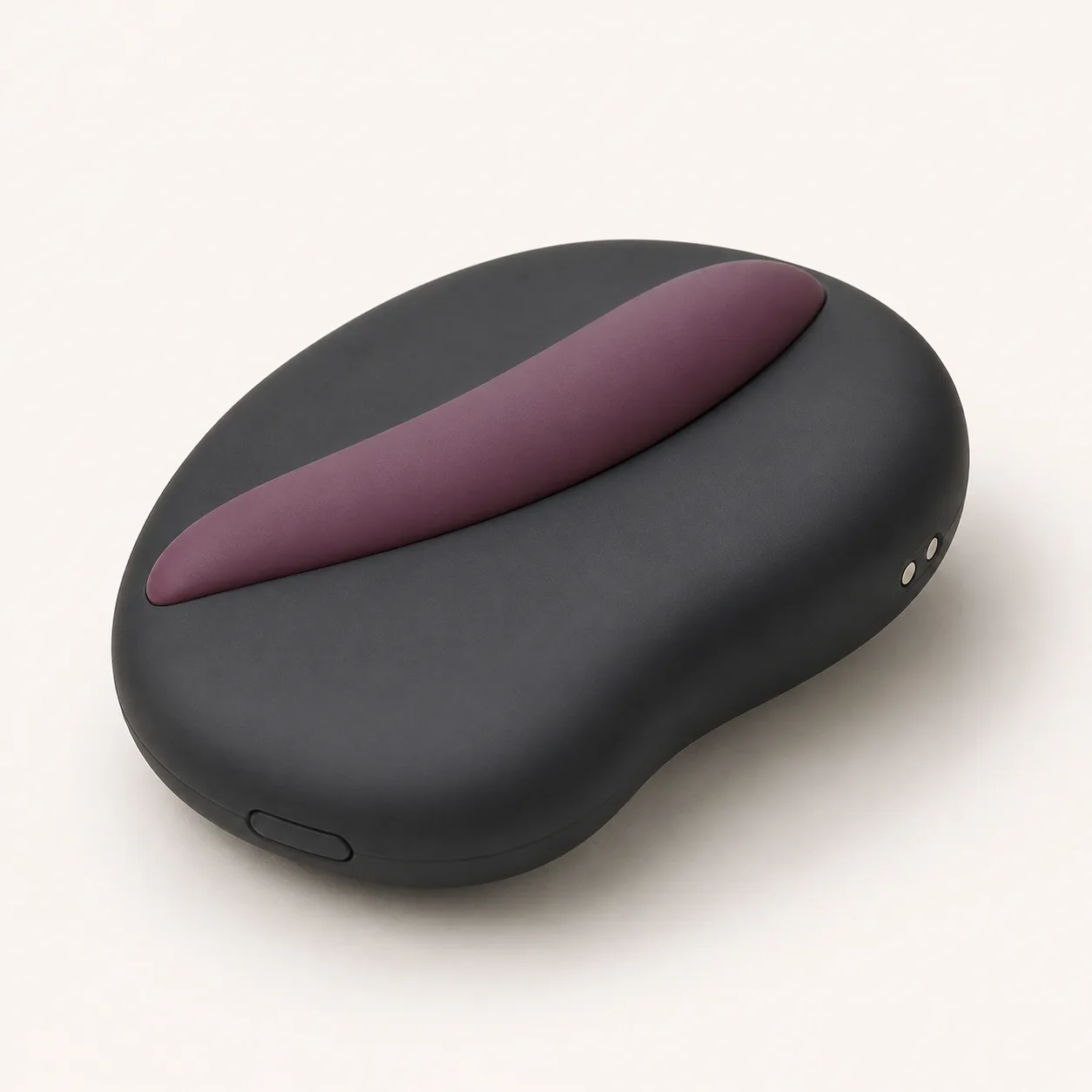
Palm-Squeeze Pebble Vibrator with Offset Contact Ridge
A compact external pebble vibrator concept with side squeeze waists, an offset raised contact ridge and magnetic-charge contacts for documented grip and enclosure testing.
29,99 $
200 in stock
A palm pebble spreads grip across a compact external tool
This palm pebble vibrator concept uses a flattened asymmetrical body, side squeeze waists and one raised offset contact ridge. The shape is planned for external positioning with the hand supported across a broad surface rather than around a narrow handle.

The image does not prove that the shell is compressible, waterproof, quiet or safe to charge through the depicted contacts.
Measure the grip envelope and ridge before choosing it
Confirm maximum length, width, thickness, side-waist depth, ridge height and width, control location, charging-contact spacing and complete mass. Compare those figures with hand span and the intended external contact area.
A palm-size label does not establish fit or how sharply the ridge concentrates pressure.
The squishy-shell claim needs compression data
The source uses a squishy description, but shell material, hardness, internal clearance, compression force, recovery and enclosure life remain unverified. Measure deflection at several hand loads while checking seams and internal contact.
Do not squeeze past the confirmed limit or assume compression changes motor output.
Inspect the ridge bond and enclosure seam
Check the full ridge edge, shell seam, side waists, control recess and charging dots for lifting, cracks, gaps, tack, discoloration, debris or sharp molding. Compress the body only through the approved bench test while listening for creaks or internal movement.
Withdraw the device after ridge peeling, permanent dents, seam opening or any exposed component.
Verify magnetic charging on a dry bench
Use only the confirmed lead and permitted power source, align contacts without forcing polarity and place the clean dry device on a non-combustible surface. Observe for stable attachment, normal indicators and the documented charge time.
Do not charge under bedding, inside a bag, near water or while the motor is running.
Map controls and lockout before body contact
Identify power-on, setting change, immediate power-off and any travel-lock sequence using the exact sample. Test whether a squeeze, bag pressure or contact with the charging dots can activate it unintentionally.
A lock icon, memory function or accidental-start protection is not assumed until verified.
Test the offset ridge on a padded surface first
At the lowest confirmed output, place the pebble on a folded towel and explore how angle and hand pressure change the contact footprint. Mark which edge produces the broadest stable contact without rocking.
The ridge should guide positioning, not justify concentrated force.
Use externally only
The planned shape is an external palm vibrator. Do not insert the body, ridge or charging-contact edge, and do not rely on the widest dimension as an insertion stop.
Keep the charging edge away from mucosal contact unless the final intended-use specification explicitly addresses it.
Begin with a relaxed hand and minimal pressure
Apply the ridge lightly at the lowest setting while keeping fingers in the side waists. Let vibration create the sensation rather than compressing the enclosure or pressing the ridge into tissue.
Lift the device before changing angle and stop after pinching, numbness, pain, redness or swelling.
Grip changes must not become hidden control inputs
If the production model responds to pressure or touch, document the complete response curve and off action. If it does not, squeezing should remain only an ergonomic grip test within the enclosure limit.
Unexpected intensity changes, control lag or a setting that cannot be reduced immediately end the trial.
Partnered use requires local control access
Agree on contact area, pressure, maximum setting, check-in signal and stop word. The receiving partner must be able to stop or remove the pebble immediately.
Do not use while either partner is asleep, impaired or unable to communicate sensation changes.
Monitor shell temperature, sound and recovery
During staged bench and external trials, log ridge, shell and charging-edge temperature at fixed intervals. Listen for new rattling or pitch changes and confirm the side waists recover after each approved compression.
Power off after unusual heat, odor, swelling, noise, output loss or a permanent shape change.
Clean around the raised ridge without flooding seams
Power off and disconnect all charging equipment. Apply the confirmed cleaner and contact time to the ridge top, full ridge edge, shell, side waists, control recess and charging dots while respecting the verified ingress rating.
Do not submerge, boil, bleach or machine-wash the pebble without model-specific evidence.
Dry the charging dots before storage
Air-dry the ridge edge, control recess, enclosure seam and both contacts completely. Inspect for residue, corrosion, tack, trapped moisture, peeling or compression that does not recover.
Engage the verified lockout and store without load, heat, direct sunlight or contact with unverified materials.
Sourcing must test the shell as an electrical enclosure
An Alibaba palm-vibrator results page lists a palm-size squishy vibrator at USD 3.99-6.99 with MOQ 10. Supplier identity, exact model, squeeze construction, modes, charging, waterproofing and every performance statement remain pending.
The procurement reference supports inquiry only. The EUR 29.99 plan allows for China-origin freight, exact-sample measurement, material and ridge-bond review, shell compression and enclosure testing, control and lockout mapping, battery and magnetic-charge inspection, output, heat and sound logging, cleaner trials, protective packing and discreet fulfillment; packed size, mass, freight, duty, tax, insurance, payment fees and destination terms remain pending.
Frequently asked questions
Does squeezing the pebble change vibration?
Not unless the exact model has a verified pressure response; otherwise stay within the enclosure compression limit.
Is the raised ridge intended for insertion?
No. This concept is planned for external use only.
Does it have a travel lock?
Lockout behavior must be verified on the production sample before storage or transport.
Can it be used while charging?
No. Disconnect the charging lead before operation.
Is it submersible?
Not without model-specific water-resistance evidence covering seams, controls and charging contacts.
When should the device be withdrawn from service?
After ridge lifting, cracks, seam gaps, permanent dents, swelling, unusual heat or odor, charging faults, intermittent operation or failed lockout.
Reviews
There are no reviews yet.