


Coral Three-Function Cup Stimulator with Rose-Gold Curved Tail
August 14, 2026
Six-Window Compression-Sleeve Manual Stroker
August 14, 2026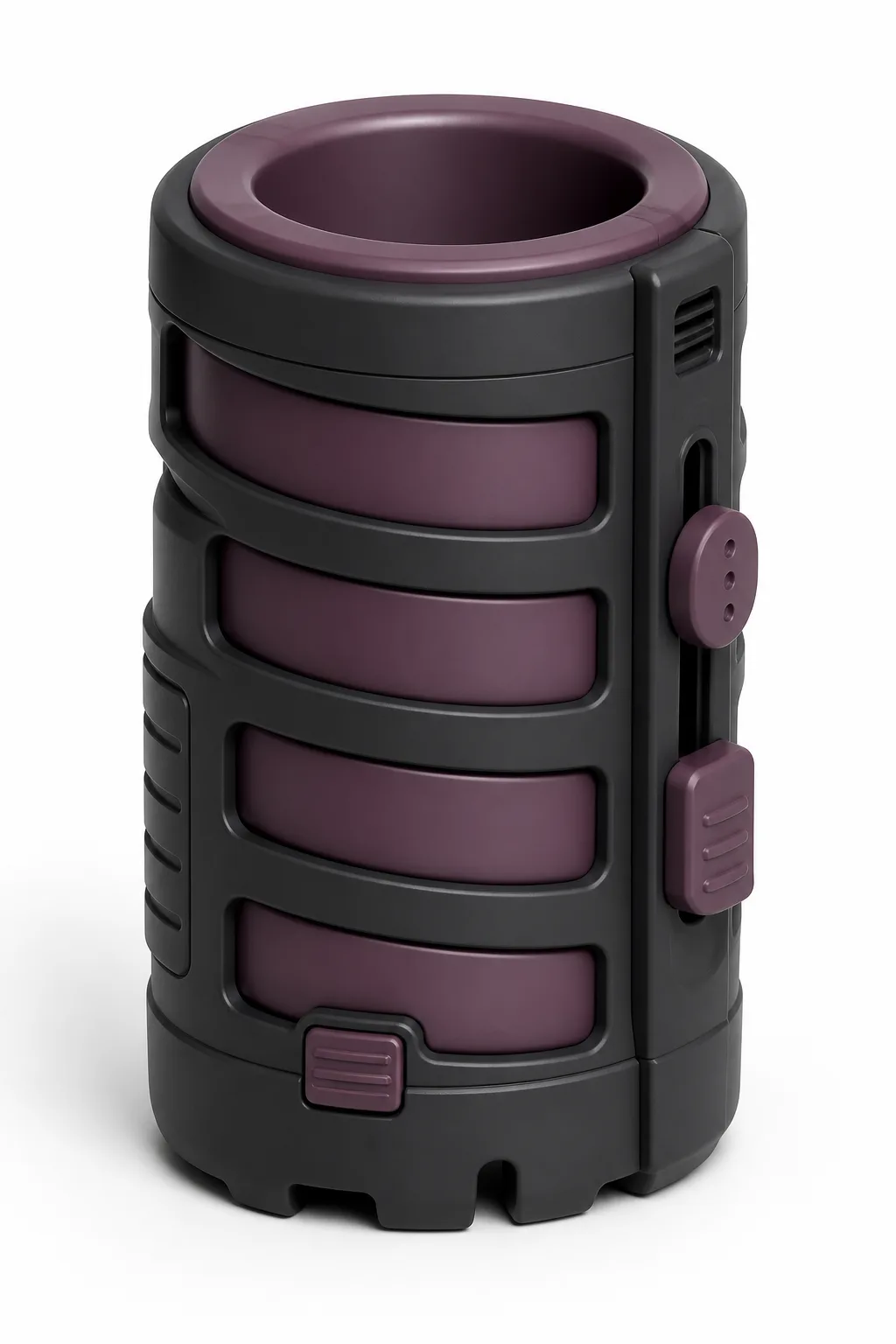
Four-Ring Differential-Tilt Manual Stroker with Three-Stop Side Cam
A manual stroker concept with one open-through liner, four captive tilt-ring stations, a three-stop side cam, local mechanical release and thumb vent.
44,99 $
200 in stock
Read four tilt rings around one open-through liner
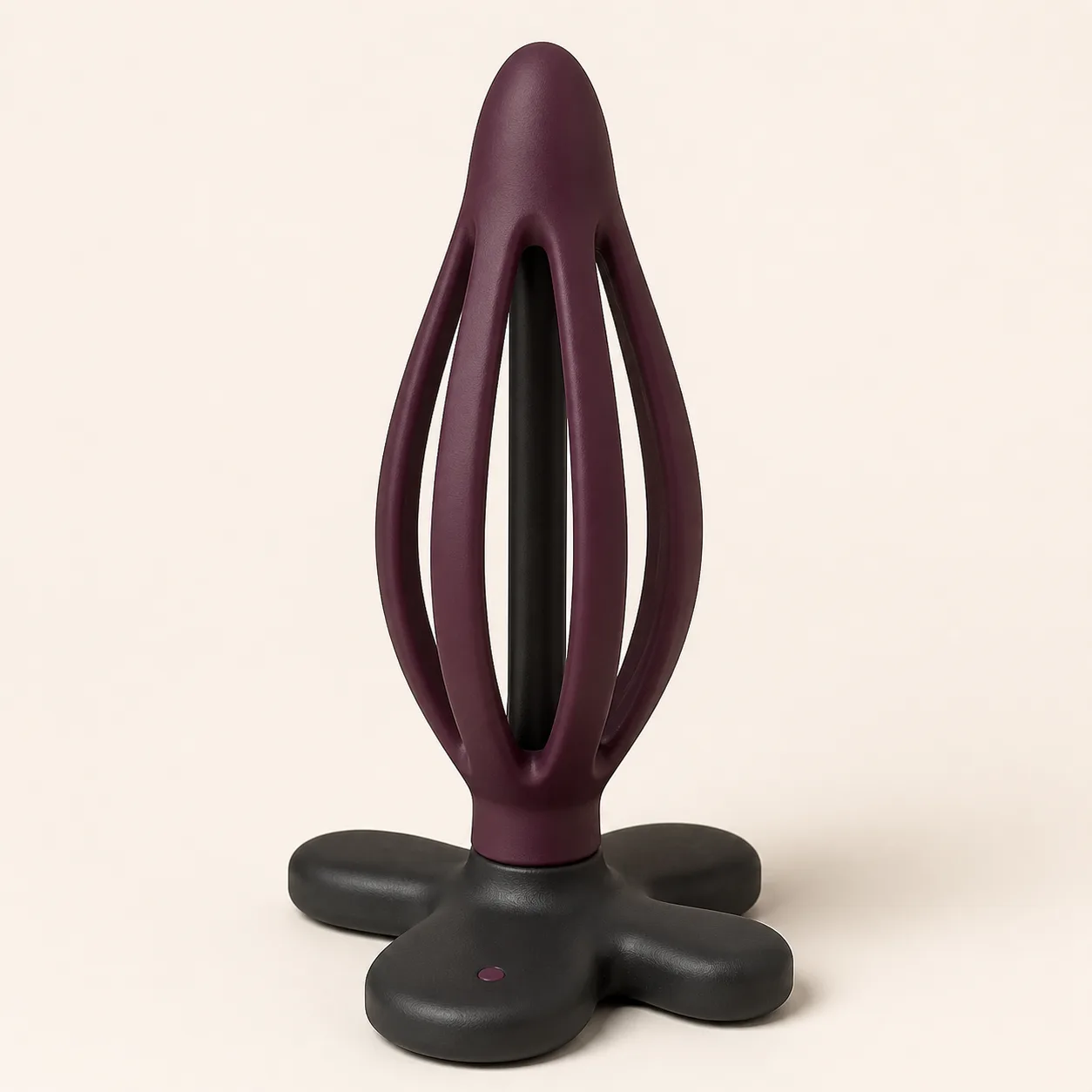
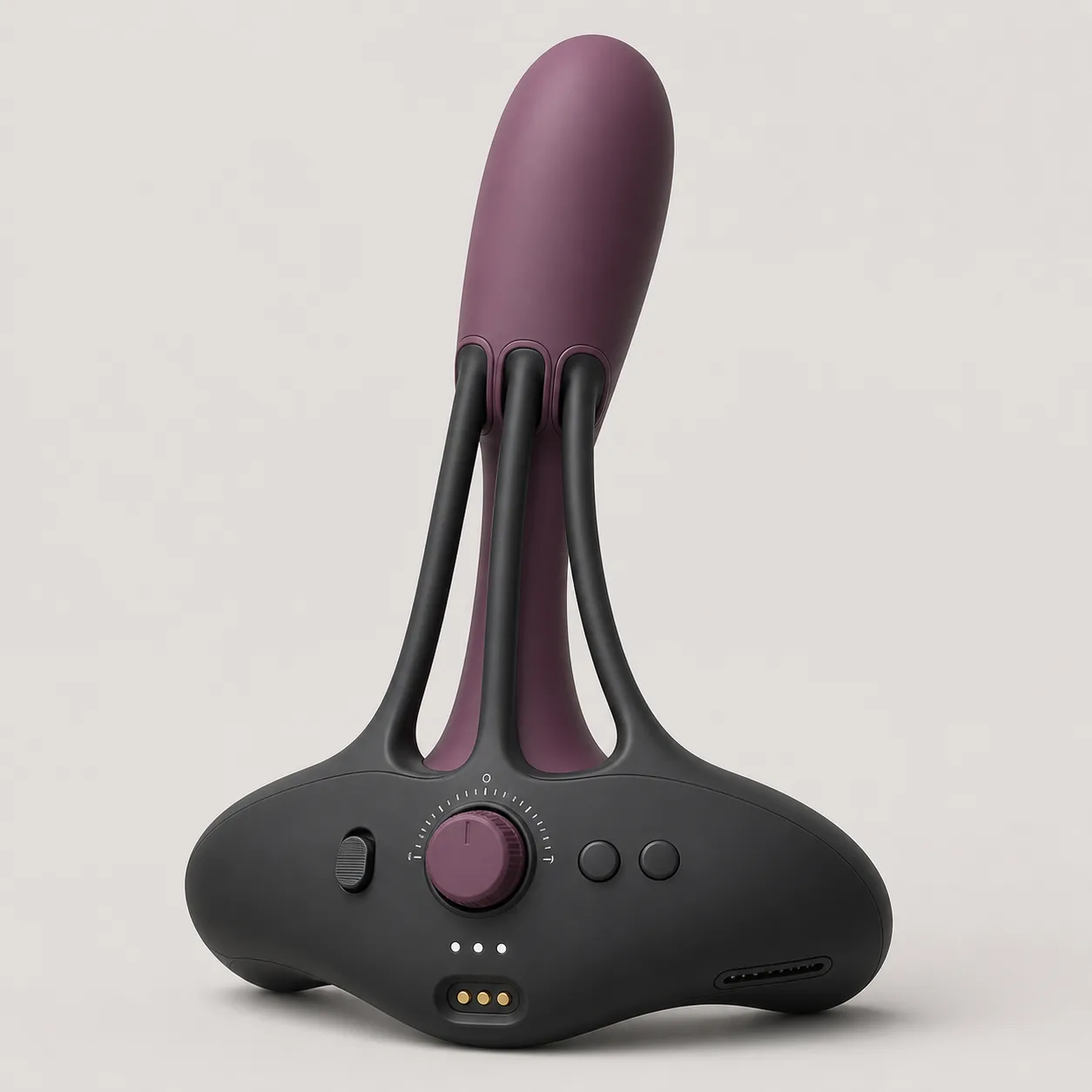
This four-ring differential-tilt manual stroker concept surrounds one smoky-plum open-through liner with exactly four broad external ring stations visible through separate guarded windows. A side spine rail carries a three-stop cam, broad local release and thumb vent.

The render does not prove ring tilt, internal profile change, compression, liner retention, dimensions, materials or manufacturing availability.
Inventory the liner rings frame and linkage
Require a bill of materials for liner, rim, carrier, retention collar, rings R1-R4, ring skins and cores, pivots or flexures, followers, guide windows, crossmembers, spine rail, cam, detents, link rods, travel stops, release slider, bias elements, thumb vent, latch, shell, grips, feet, drainage notch, coatings, pigments, lubricants and adhesives.
Trace how one cam state reaches all four rings before describing differential tilt.
Measure housing ring and control geometry
Record housing height and diameter, base footprint, tunnel axis, rim and liner dimensions, R1-R4 widths, thicknesses, center heights, neutral angles, pivot axes, window openings, crossmember widths, spine position, cam travel, grip areas, mass and balance.
Repeat at all three cam stops and after loading, cleaning, drying and storage cycles.
Seat retain and inspect the removable liner
Measure liner installation, rim capture, axial and torsional retention, tunnel length, wall thickness, opening diameter, minimum internal diameter, carrier support and latch force. Verify orientation marks and a complete seating check.
Reject twist, bunching, creep, thin zones, seam lift, hard carrier exposure, pigment transfer, tearing or incomplete latch engagement.
Characterize rings R1 through R4 separately
Measure each ring profile, compliant-layer thickness, hardness, deformation, rebound, angular travel, pivot friction, play and alignment. Preserve R1-R4 identity in every test.
Reject ring cracking, skin lift, uneven tilt, false centering, follower escape, hard stop contact or drift after the cam is released.
Verify windows crossmembers and ring guidance
Map every window edge, guard overlap, ring clearance, follower slot, crossmember and spine interface through the full tilt path. Measure frame stiffness under symmetric and offset hand loads.
Confirm captive guidance prevents ring exit, collision and direct access to pivots or link rods.
Calibrate the three-stop side cam
Measure cam angle, force, detent depth, backlash, indication and actual R1-R4 angle at each stop approached from both directions. Repeat with the liner empty and on standardized compliant mandrels.
Reject false seating, state drift, excessive force or any stop that creates unintended ring or frame contact.
Test local release and thumb vent separately
Measure release-slider force, travel, cam disengagement, residual ring angle and reset from every state. Measure thumb-vent flow, pressure equalization and accidental occlusion with the liner empty and loaded on fixtures.
The mechanical release must not depend on sealing or uncovering the vent, and the vent must remain locally accessible.
Map the internal profile at every tilt state
Use optical and compliant gauges to record tunnel centerline, minimum diameter, ovality, axial offsets and transition slopes under R1-R4 at all cam stops. Measure static and hand-loaded profiles.
Reject abrupt steps, progressive constriction, hard backing contact, trapped gauges or an internal profile that fails to relax after release.
Measure pressure extraction and movement force
Map circumferential pressure under and between R1-R4 using graduated compliant mandrels. Record insertion and extraction force, standardized movement force, stick-slip, liner migration, ring drift and housing distortion.
State lubricant condition, mandrel compliance, depth, speed and cam stop for every result.
Review grip symmetry and manual control access
Measure grip pressure, slip, shell torque, wrist angle, cam reach, release reach, vent access and accidental latch contact with dry and approved damp hands. Test both grip orientations.
Reject layouts that encourage thumb placement over moving windows or require excessive squeeze to stabilize the housing.
Screen gaps pinch points and cleaning access
Probe rim, carrier, R1-R4 edges, windows, crossmembers, pivots, spine rail, cam, release, vent, latch, shell seams, grip ribs, drainage notch and feet for pinch, abrasion, residue and moisture traps.
Validate liner removal, washing, measured drying, housing cleaning, guide inspection and correct reassembly without losing captive hardware.
Verify materials lubricants and cleaner compatibility
Require exact liner, ring, frame, pivot, follower, shell, coating, pigment, lubricant and adhesive declarations plus restricted-substance and contact evidence. Test colorfastness, swelling, stress cracking, abrasion and odor change.
Confirm any internal lubricant remains isolated from the liner contact path and survives the approved cleaning schedule.
Cycle cam rings release vent liner and latch
Cycle all cam states, R1-R4 tilt, local release, vent covering, grip loads, liner removal, washing, drying, reseating, latch closure and storage. Track angles, play, detent force, release travel, liner retention and frame alignment.
Retire for torn liner, loose rim, ring skin lift, rising pivot play, follower escape, cam drift, delayed release, blocked vent, frame cracks, latch failure, corrosion or persistent residue.
Build landed price after four-ring proof
An Alibaba stroker page showed a manual cup category example at USD 4.29-5.72 with MOQ one. It is a benchmark only and does not confirm this four-ring differential-tilt architecture or an approved supplier.
The procurement reference supports an EUR 44.99 planning price after allowing for China-origin freight, exact-sample sourcing, liner and ring teardown, geometry, pivot and guide metrology, cam and release calibration, internal-profile scanning, pressure and movement-force tests, grip review, gaps, materials, cleaning and cycle durability, protective packing and discreet fulfillment. Exact quotation, MOQ, materials, packed size, weight, freight, duty, tax, insurance, payment fees, certifications and delivery terms remain pending.
Frequently asked questions
Do the four rings really tilt?
Pivot, follower and cam linkage require teardown plus angle measurements.
What changes at the three cam stops?
Actual R1-R4 angles and internal profiles at each state remain pending.
Is the liner removable?
The concept shows a latch, but approved removal, washing, drying and reseating require sample evidence.
Does the thumb vent control suction?
Airflow and pressure equalization must be measured; no suction function is assumed.
Can the ring mechanism be immersed?
No; the exact housing-cleaning method depends on verified guide and material construction.
Which defects require retirement?
Tears, ring lift, pivot play, follower escape, cam drift, blocked vent, frame cracks or residue.
Reviews
There are no reviews yet.