


Four-Ring Differential-Tilt Manual Stroker with Three-Stop Side Cam
August 14, 2026
S-HANDE SHD-S223 Six-Weight Kegel Exercise System
August 14, 2026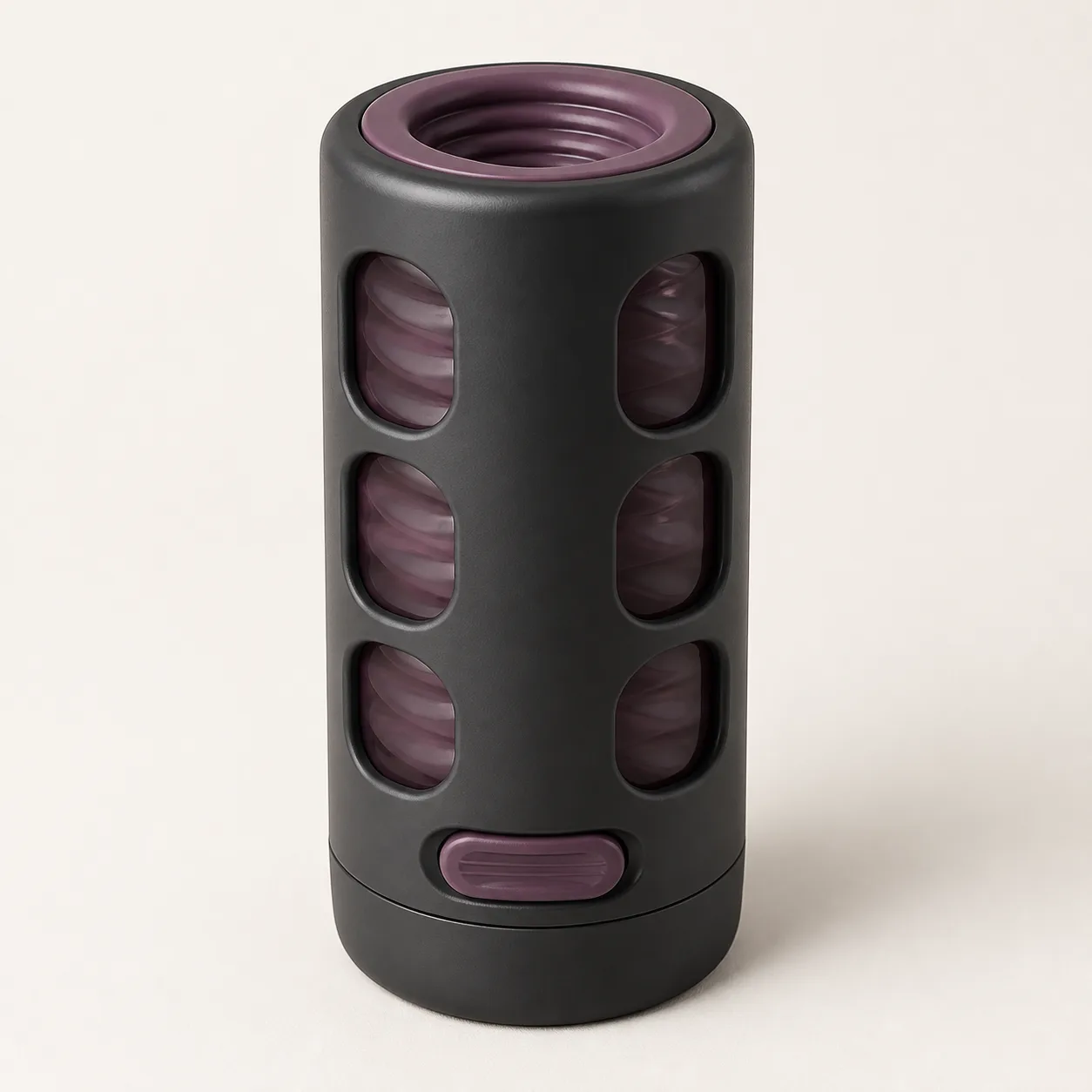
Six-Window Compression-Sleeve Manual Stroker
A manual stroker concept with a six-window compression shell, continuous removable sleeve, abstract concentric opening, airflow slider and closed base.
46,99 $
200 in stock
Use six shell windows as measured grip zones
This six-window compression-sleeve manual stroker concept uses one charcoal cylindrical shell with exactly six rounded side windows arranged as two columns of three, one continuous smoky-plum removable sleeve, one abstract concentric-wave opening, one broad airflow slider and one closed base.

The rendering defines visible design intent only. It does not confirm dimensions, materials, sleeve texture, compression transfer, airflow behaviour, pressure, cleaning limits or production readiness.
Confirm shell, sleeve, slider and base inventory
Request an exploded drawing that identifies the outer cage, continuous liner, opening rim, airflow slider, lower shell, base closure, internal passage, retainers, seals and any adhesive. The image contains no cap, powered module, cable or detached accessory.
Every hidden part must have a traceable drawing position and material declaration before sample approval.
Measure the shell and internal channel separately
Record overall height, maximum diameter, wall thickness, opening width, base height, slider position and mass. Measure relaxed channel length, entrance diameter, minimum internal width and liner-wall thickness using a defined low-force method.
Rendered proportions do not establish a sellable size or safe-use boundary.
Label all six windows from top to bottom
Assign W1-W3 to the left column and W4-W6 to the right. Measure height, width, corner radius, edge blend, frame thickness, opposite-window alignment and distance to the opening, slider and base.
Reject sharp edges, flash, frame cracks, window distortion or unsupported spans that buckle unpredictably under hand pressure.
Map compression through each opposing window pair
Test W1 with W4, W2 with W5 and W3 with W6 using a repeatable broad grip fixture and a compliant internal mandrel. Record applied force, local liner deformation, recovery time, hysteresis and shell strain.
Six visible windows do not prove six independent pressure settings; actual force transfer depends on shell stiffness, liner thickness and grip position.
Verify sleeve retention without trapped folds
Document how the liner seats at the top rim, window edges and lower base. Apply bounded axial and rotational loads while checking for rim lift, bunching, twist, base migration or sleeve exposure beyond the protected window edges.
The sleeve should be removable for complete care only through a supplier-validated method that avoids excessive stretching.
Inspect the abstract concentric-wave opening
Measure every visible wave, the rim thickness and the transition into the internal path. Examine the surface under directional light for pits, tears, tack, seam steps, thin zones and undercuts that hold residue.
The non-anatomical presentation avoids realistic imagery but still requires full surface and hygiene validation.
Trace the airflow slider to its internal passage
Record slider travel, detents, operating force, opening area and whether the control remains accessible during a normal broad grip. Inspect the internal route for obstructions, moisture traps and parts that can detach into the liner path.
No suction or pressure-control claim is accepted until the exact passage and repeatable pressure response are measured.
Confirm shell and liner materials independently
Request traceable evidence for the rigid shell, liner, rim, slider, base, pigments, seals, lubricants and bonding agents. Review hardness, odour, tack, migration, restricted substances, tear strength and batch variation.
TPE, silicone, ABS, body-safe, hypoallergenic and waterproof labels remain pending exact documents and independent review.
Characterize pressure without performance promises
Use an instrumented compliant mandrel to map circumferential pressure at each window pair under several bounded hand loads and slider states. Record peak location, pressure decay, liner displacement and any hard-frame imprint.
Reject pinching, sudden collapse, pressure spikes, sleeve inversion or a force path that cannot be released immediately.
Use broad manual pressure conservatively
Inspect all six windows, the opening, sleeve, slider and base before use. Begin with generous verified-compatible lubricant, minimal broad grip force and slow movement while keeping the airflow control and withdrawal path accessible.
Stop at pain, numbness, bleeding, unexpected resistance, rising pressure, loss of control or visible product change. Persistent symptoms require appropriate medical advice.
Remove and clean the whole liner path
Disassemble only by the approved sequence and follow validated cleaner, water, temperature and contact-time limits. Clean every opening wave, internal channel, outer sleeve surface, shell interior, six window frames, slider passage and base recess.
Boiling, bleach, machine washing, prolonged soaking and abrasive tools are excluded unless exact material evidence supports them.
Dry through windows before closed storage
Dry the liner inside and out separately from the shell. Inspect each window, the airflow passage and the base cavity for remaining moisture before loose reassembly or storage in a clean protective pouch.
Persistent odour, tack, swelling, tear, seam opening, shell crack, slider fault or internal residue removes the unit from service.
Cycle window frames, liner and control together
Define combined tests for repeated pairwise compression, liner removal and installation, slider movement, cleaning, drying and storage. Measure frame deflection, permanent set, sleeve retention, surface wear and airflow consistency at set intervals.
Production approval requires lot sampling and documented failure thresholds rather than a single demonstration sample.
Build landed price from a manual-stroker benchmark
An Alibaba male-masturbator category page displayed one configurable manual-category example at USD 2.86 to 3.73 with MOQ 1 piece. It is a broad benchmark only and does not identify this six-window shell, continuous sleeve or an approved supplier.
The public procurement benchmark supports an EUR 46.99 planning price after provisional allowance for China-origin freight, exact-sample measurement, six-window metrology, compression and pressure mapping, sleeve retention, airflow, material, cleanability and packaging tests, discreet fulfilment and expected intimate-product handling loss. Exact supplier, quote, MOQ, specifications, packed weight, freight, duty, tax, certification, payment terms and lead time remain pending.
Frequently asked questions
How many shell windows are visible?
The concept has exactly six rounded windows arranged as two vertical columns of three.
Is the inner sleeve removable?
The concept proposes a removable continuous sleeve; its final retention and release method require sample verification.
Does each window create a separate setting?
No independent setting is assumed. Compression depends on the shell, liner and applied broad grip.
What does the lower slider control?
It is proposed as an airflow control, but its internal passage and pressure effect remain unconfirmed.
Which lubricant is compatible?
Use only a lubricant validated against the documented production liner through supplier guidance and patch testing.
Can the shell be stored while damp?
No. The sleeve, six window frames, airflow route and base cavity must be completely dry before enclosed storage.
Reviews
There are no reviews yet.