


Concentric Dual-Zone Wand Massager with Independent Center Dome and Outer Ring
August 14, 2026
Slim Pocket Massager – 10 Modes, USB Rechargeable
August 14, 2026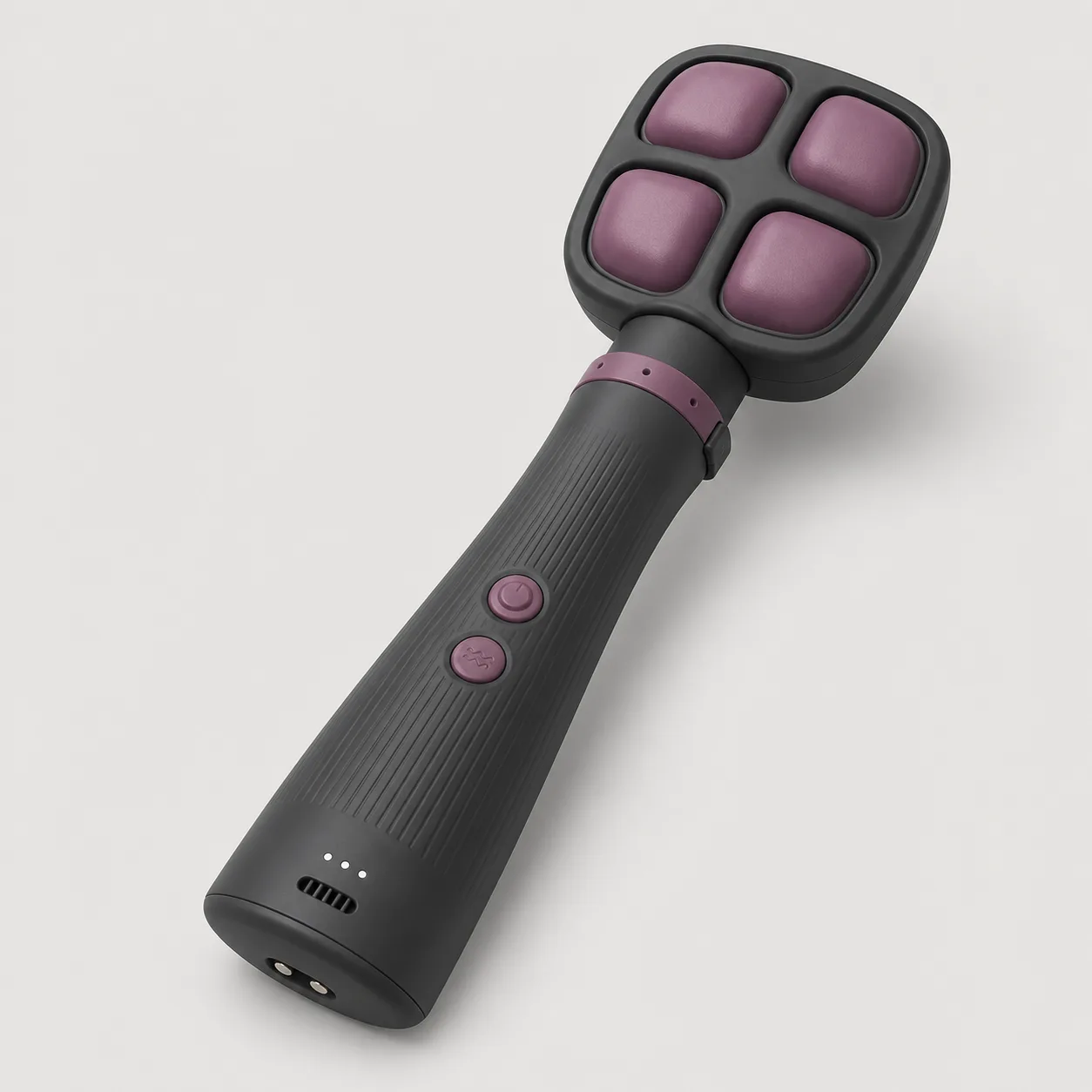
Four-Quadrant Differential-Flex Wand Massager with Cross-Bridge Head
A rechargeable wand concept with four separately measurable contact cushions, a guarded cross-bridge head and a lockable three-stop preload collar.
76,99 $
200 in stock
Divide one wand head into four guarded quadrants
This four-quadrant differential-flex wand massager concept places exactly four rounded plum cushions in a two-by-two head. A thick charcoal cross bridge and continuous blunt outer rim define each quadrant, while a three-stop collar is intended to adjust support preload at the neck.

The image does not prove independent pad motion, actuator count, preload effect, flex range, output, dimensions, materials, sealing, charging safety or production availability.
Inventory pads carriers bridge and drive parts
Request an exploded inventory for cushions Q1 through Q4, skins, carriers, flexures, cross bridge, perimeter rim, hard stops, neck cup, preload collar, cam or compression element, detents, lock tab, actuators, moving masses, bearings, isolators, frame, controls, indicators, vent, cell, charging contacts, conductors, seals, shell, pigments, lubricants and adhesives.
Trace shared components and electrical channels so the four visible pads are not assumed to be four independent drives.
Measure head neck and handle geometry
Record head length, width, thickness, corner radii, rim projection, cross-arm width, pad spacing, neck diameter and length, collar travel, handle taper, base flare, grip area, button recesses, vent and contact positions, mass and balance point.
Measure head plane, neck alignment and handle straightness before and after bounded load, charging, cleaning and storage cycles.
Characterize every contact cushion
For Q1, Q2, Q3 and Q4, measure plan dimensions, crown, edge blend, surface texture, hardness, compression, recovery, friction and thickness at center and corners. Retain quadrant identity in every report.
Inspect skins and bonds for thin edges, voids, hard inclusions, molding flash, tack, pigment transfer, swelling and permanent set.
Inspect the cross bridge and perimeter guard
Map bridge flatness, arm symmetry, intersection thickness, rim height, corner blending and the clearance to each cushion. Use optical inspection, soft film and articulated probes under neutral and loaded positions.
Reject hard bridge or rim contact within the accepted compliant-load envelope, exposed seams, sharp transitions or residue traps that cannot be inspected and dried.
Measure differential flex across four stations
Apply the same bounded displacement to each cushion center and corner, recording force, travel, hysteresis, lateral shift, tilt, neighboring-pad movement and recovery. Repeat with diagonal and adjacent-pad combinations.
Compare stiffness matrices rather than relying on a single center-load number; asymmetry may indicate carrier, flexure or assembly drift.
Resolve drive allocation phase and transfer
Determine whether the head uses one shared eccentric motor, multiple drives or another mechanism. Synchronize accelerometers on all four cushions, the cross bridge, rim, neck and handle to measure amplitude, frequency, phase, harmonics, startup and decay.
Repeat with centered and biased compliant loads to reveal cancellation, amplification, beat patterns or a pad that loses motion when another quadrant is restrained.
Calibrate the three-stop preload collar
Measure collar angle or travel, detent torque, lock-tab force, backlash, hard-stop contact and actual changes in Q1-Q4 stiffness at every confirmed setting. Approach each stop from both directions.
A setting is not valid if the collar can drift, the lock gives a false seat or adjustment creates pad-to-bridge contact.
Verify local controls stop memory and lockout
Document startup, intensity, program change, pause, immediate stop, memory, restart and transport lockout from the two local controls. Check indication and response with every collar position.
Challenge button holds, simultaneous presses, low voltage, controller reset and charging connection; immediate local shutdown must remain predictable.
Map pressure under centered and biased loads
Use a compliant instrumented fixture to map each cushion footprint, peak and average pressure, edge engagement, load sharing, head rocking and cross-bridge clearance. Test center, single-quadrant, adjacent-pair and diagonal-pair cases.
State fixture stiffness, preload and head orientation. Do not convert fixture results into an unverified body-fit or therapeutic claim.
Screen seams gaps and cleaning access
Inspect all cushion borders, bridge junctions, rim corners, neck cup, collar, lock, button, vent, base and charging recesses for capture, shear, capillary retention and inaccessible residue. Repeat while pads deflect and the collar changes state.
Validate the material-specific cleaning and measured drying sequence on used test articles; cleaner compatibility and immersion limits remain pending.
Evaluate handle balance grip and transmitted motion
Record dry and damp grip friction, wrist torque, center of gravity, control reach, accidental collar or lock contact and three-axis handle acceleration at every verified output. Compare centered and quadrant-biased loads.
Investigate grip heating, progressive neck tilt, excessive transmitted vibration or a balance shift that reduces control.
Verify charging current sound heat and ingress
Confirm cell chemistry and capacity, specified input, contact polarity, alignment, retention, protection circuits, charge time, runtime, low-voltage shutdown and charging interlock. Log current, A-weighted sound and temperatures at every cushion, bridge, neck, handle, controller, cell, vent and contact.
Map every enclosure boundary. No ingress or washable claim is accepted without exact-model evidence for pads, bridge, neck, collar, controls, vent, contacts and base.
Challenge faults then cycle and inspect materials
In protected fixtures, restrain one quadrant, bias two pads, block the collar, obstruct the vent and interrupt power. Stop before damage and quarantine units with uncontrolled restart, delayed stop, bridge contact, loose pads, rising current, abnormal heat or cell change.
Cycle collar selection, locking, all confirmed output, biased loading, charging, specified cleaning, measured drying and storage. Recheck geometry, stiffness matrix, phase, pressure, gaps, current, sound, heat and odor. Exact material, restricted-substance, electrical and certification evidence remains pending.
Build landed price after four-quadrant proof
An Alibaba wand-massager page currently shows a 2-in-1 rechargeable category example at USD 7.50-8.61 with MOQ five. It is a benchmark only and does not confirm this four-cushion cross-bridge head, preload collar or an approved supplier.
The procurement reference supports an EUR 76.99 planning price after allowing for China-origin freight, exact-sample sourcing, four-pad and cross-bridge metrology, flex matrices, drive and phase mapping, collar calibration, pressure, gap, grip, charging, current, sound, heat, fault and cycle work, protective packing and discreet fulfillment. Exact quotation, MOQ, materials, battery, packed size, weight, freight, duty, tax, insurance, payment fees, certifications and delivery terms remain pending.
Frequently asked questions
Are all four cushions independently powered?
That is unconfirmed; teardown and synchronized traces must establish the number of drives and shared force paths.
What does the preload collar change?
Its real effect on quadrant stiffness and travel remains pending until all three detents are calibrated under load.
Can the cross bridge touch the contact fixture?
Bridge and rim clearance must be mapped under centered, single-pad, paired and diagonal loads before any use boundary is set.
Is this wand waterproof?
No ingress claim is confirmed; the multi-pad head, neck, collar, controls, vent, charging contacts and base require evidence.
Does the split head make cleaning harder?
It can create extra seams and corners, so inspection, material-compatible cleaning and measured drying need exact-sample validation.
Which defects require retirement?
Loose or torn pads, growing asymmetry, bridge or rim contact, collar drift, failed lock or stop, cracked neck, abnormal sound or heat, damaged contacts, cell swelling or persistent residue.
Reviews
There are no reviews yet.