



Slim Pocket Massager – 10 Modes, USB Rechargeable
August 14, 2026
Five-Segment Variable-Stiffness Neck Wand with Locking Spine Slider
August 14, 2026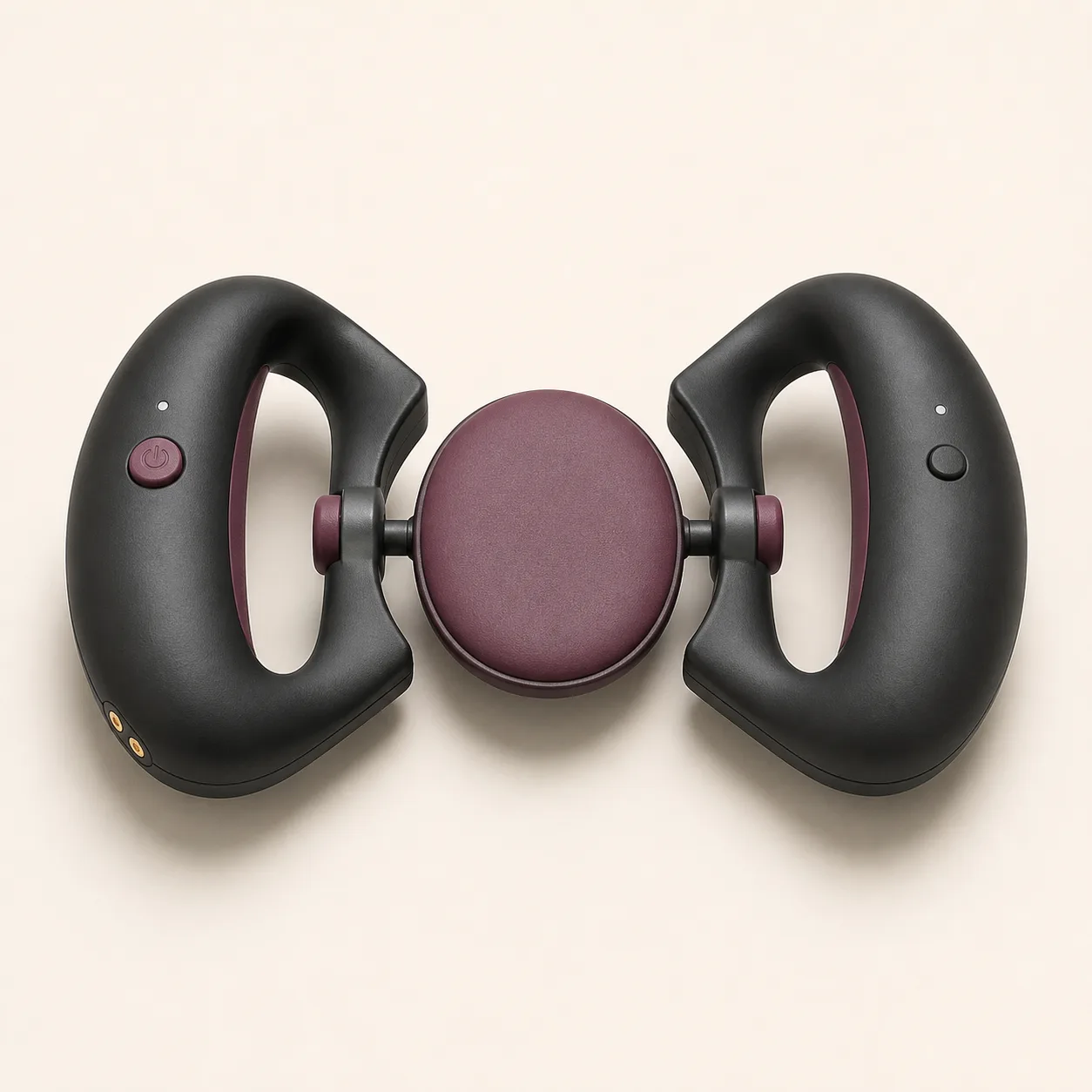
Dual-Handle Floating-Disc Couples Massager with Torque-Limit Bridge
A connected rechargeable couples massager concept with two loop handles and one central floating oval disc for separately testable grip, torsion and shared-control behavior.
49,99 $
200 in stock
Two handles share one central contact disc
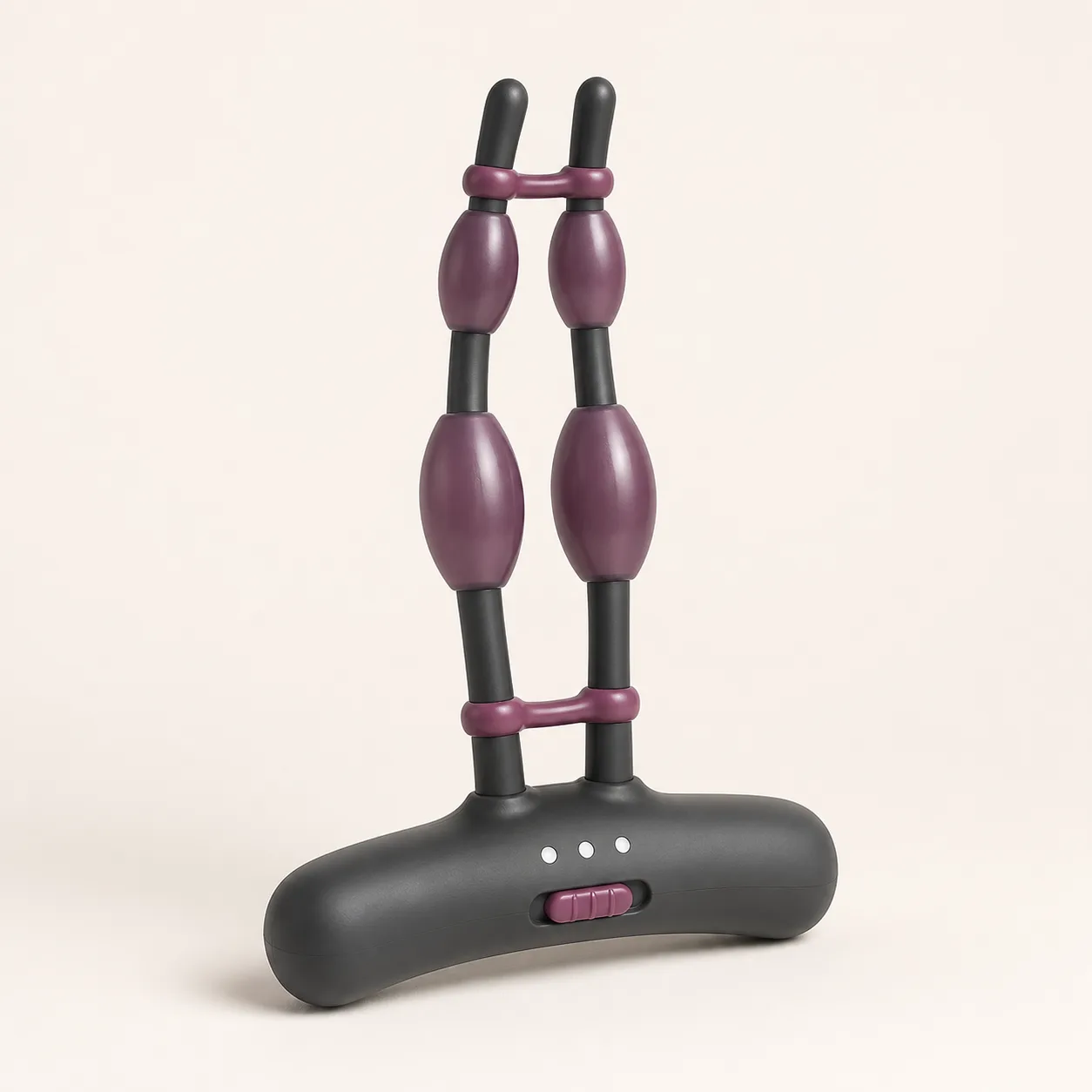
This dual handle couples massager concept connects two loop grips to one broad floating oval disc through opposing pivot axles. The symmetric layout is intended for measurable shared handling, while separate controls invite verification of which person can change power or mode.

The image does not prove disc travel, torque limiting, independent controls, motor count, output, waterproofing, runtime, material or approved contact location.
Inventory the shared bridge and both grip shells
Request drawings and a bill of materials for the central disc, carrier, two axles, bushings, yoke roots, torque collars, mechanical stops, left and right handle shells, grip insets, actuators, controller, battery, buttons, indicators, charging contacts, pigments, seals, lubricants and adhesives.
Trace the wiring and structural load path between handles so twist and conductor strain are not hidden.
Measure symmetry from the disc centerline
Record disc length, width, thickness and curvature, axle diameter, collar spacing, handle length and opening, grip inset area, overall span, neutral angle, control reach, contact location and mass.
Measure each side from the central pivot datum and specify acceptable left-right variation.
Evaluate the left handle as a primary grip
Use instrumented grip fixtures to measure pressure distribution, rotation, slip, shell flex and access to the power button and charging contacts. Repeat at several verified device orientations.
Confirm grip force cannot move the adjacent collar, cover a vent or strain the axle.
Evaluate the right handle without assuming a mirror match
Repeat the grip, slip, flex and control-access measurements on the opposite side. Compare opening dimensions, balance and surface texture with the left handle.
Different control placement can change hand position even when the shells look symmetric.
Map central disc pitch and free play
Move the disc through supplier-approved travel on a guarded fixture. Measure breakaway torque, running torque, angular range, stop contact, rebound, axial play and final alignment in both directions.
Reject rough motion, axle knock, disc-to-yoke collision or a position that cannot be held under a small confirmed load.
Verify both torque collars as protective limits
Measure collar movement, stop angle, latch or detent engagement, release force and resistance to accidental adjustment on each side. Inspect the two collars for synchronized or independent behavior.
Do not describe them as torque limiters until the production mechanism actually caps transmitted torque repeatably.
Characterize output across the floating disc
Map vibration amplitude, frequency, startup, decay, sound and temperature at the disc center, four quadrants and edge for every confirmed program and charge level.
Measure carrier and axle output so disc performance is separated from frame resonance.
Measure vibration transferred into both hands
Place synchronized sensors on the left and right grip insets while the center disc runs in free air and under compliant load. Record amplitude, phase, sound and changes with disc angle.
Excess grip vibration can affect comfort and control even when center output remains stable.
Coordinate two grip loads on an instrumented rig
Apply balanced, left-dominant and right-dominant forces within supplier limits while the disc contacts a separate compliant surface. Record disc angle, yoke strain, axle play, handle rotation, contact pressure, slip, current and temperature.
Stop for sudden twist, loss of grip, unstable disc, hard collision, unusual noise or control failure.
Resolve power and mode control conflicts
Document what happens when the left power button and right mode button are pressed separately, together and in rapid sequence. Verify priority, debounce, lockout, memory and safe recovery after conflicting commands.
Both users should understand who can stop the device immediately before any shared trial.
Audit indicators, charging and battery behavior
Confirm indicator meanings, low-battery response, charging-contact polarity, cable specification, charger input, charge time, runtime, standby drain and operation during charging.
Keep the device off and dry while charging unless exact-model instructions explicitly permit another condition.
Track current and heat under twist
Run the highest verified program under balanced and asymmetric compliant loads. Log battery current and temperature at the disc, axles, collars, yoke roots, both grips, controller, battery and charging contacts.
Verify shutdown and restart behavior if disc travel is gently obstructed on a guarded fixture below confirmed limits.
Cycle the shared mechanism and validate hygiene
Run repeated grip loading, disc rotation, collar engagement, compliant contact, control-conflict and charging cycles. At planned checkpoints inspect disc bond, carrier, axles, bushings, collars, stops, yokes, handles, buttons, seams and contacts; track torque, play, output, current, heat, cracks and residue.
Obtain exact material, restricted-substance, skin-contact, electrical and battery evidence. Clean the disc edge, axle gaps, collar seams, handle openings, grip insets, controls and contacts only by the verified method, then dry fully.
Price the shared mechanism after torsion tests
An Alibaba foldable couples vibrator listing currently shows USD 14.50-16.50 with an MOQ of one piece. It is a category benchmark only and does not confirm this dual-handle floating disc, torque collars or an approved supplier.
The procurement reference supports an EUR 49.99 planning price after allowing for China-origin freight, exact-part inventory, left-right grip mapping, disc travel and torque tests, collar verification, output and grip-transfer maps, balanced and asymmetric load checks, control-conflict logic, current and thermal review, complete mechanism cycling, materials and battery documentation, cleaning validation, protective packing and discreet fulfillment. Exact quotation, packed dimensions, weight, freight, duty, tax, insurance, payment fees and delivery terms remain pending.
Frequently asked questions
Can two people hold the device at once?
The two-handle concept supports that evaluation, but grip fit, coordination, load limits and control rules require sample testing.
Does the center disc rotate freely?
No range is confirmed; production stops, holding torque and obstruction behavior must be measured.
Do the collars truly limit torque?
That remains a hypothesis until calibrated tests show a repeatable maximum transmitted torque.
Which handle controls power?
The concept places power on the left and mode on the right, but final mapping and conflict logic require documentation.
Can it operate while charging?
Only if exact instructions explicitly permit it; otherwise keep it off and dry during charging.
Which faults require retirement?
A loose axle, cracked yoke, failed stop, slipping collar, unstable disc, split handle, failed control, unusual heat, battery swelling, corrosion or residue beyond cleaning access.
Reviews
There are no reviews yet.