


Dual-Handle Floating-Disc Couples Massager with Torque-Limit Bridge
August 14, 2026
Rose Air-Pulse Massager – 10 Modes, USB Rechargeable
August 14, 2026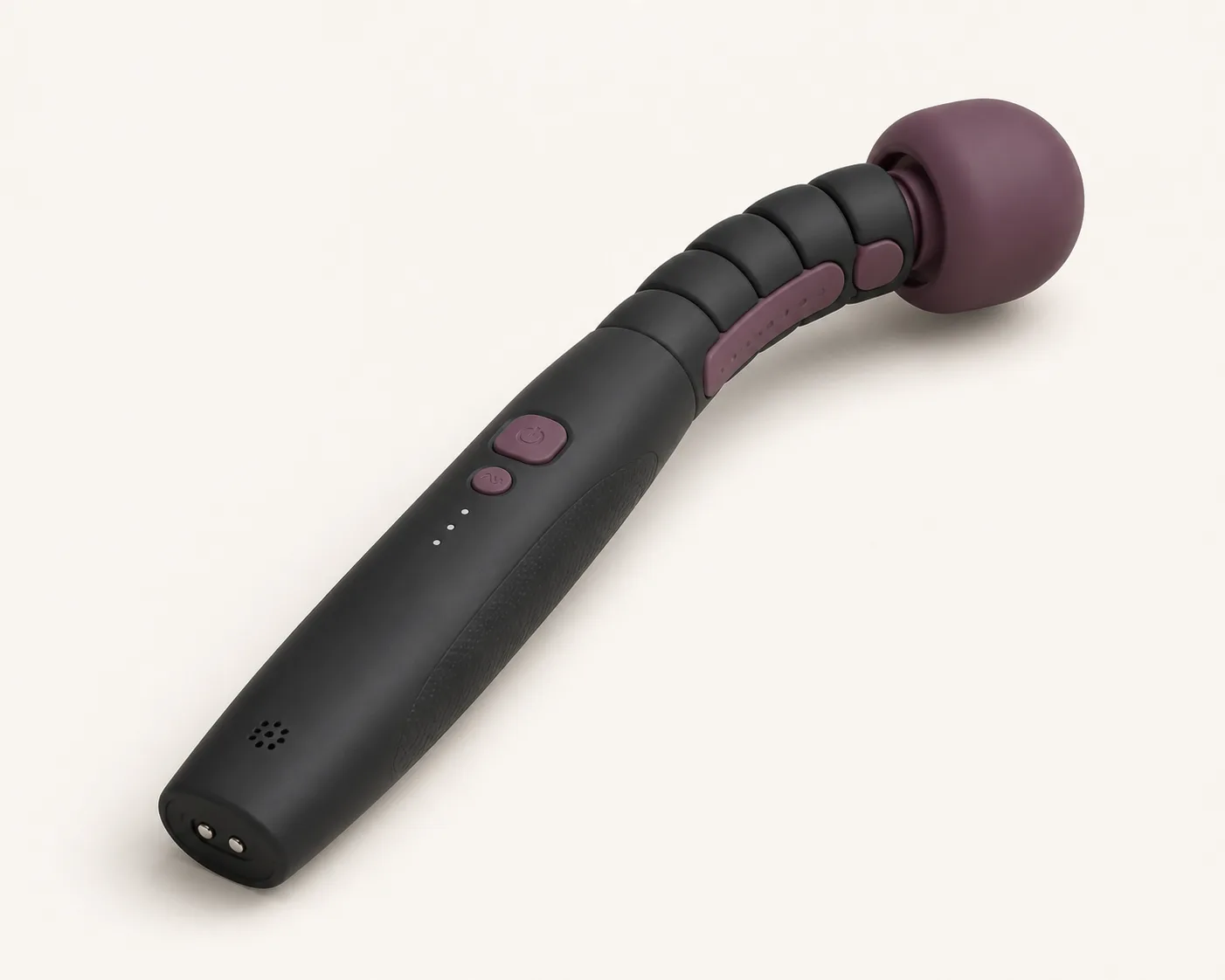
Five-Segment Variable-Stiffness Neck Wand with Locking Spine Slider
A rechargeable wand concept with a fixed broad dome, exactly five articulated neck segments and a three-state locking spine slider.
74,99 $
200 in stock
Place a fixed dome beyond five neck segments
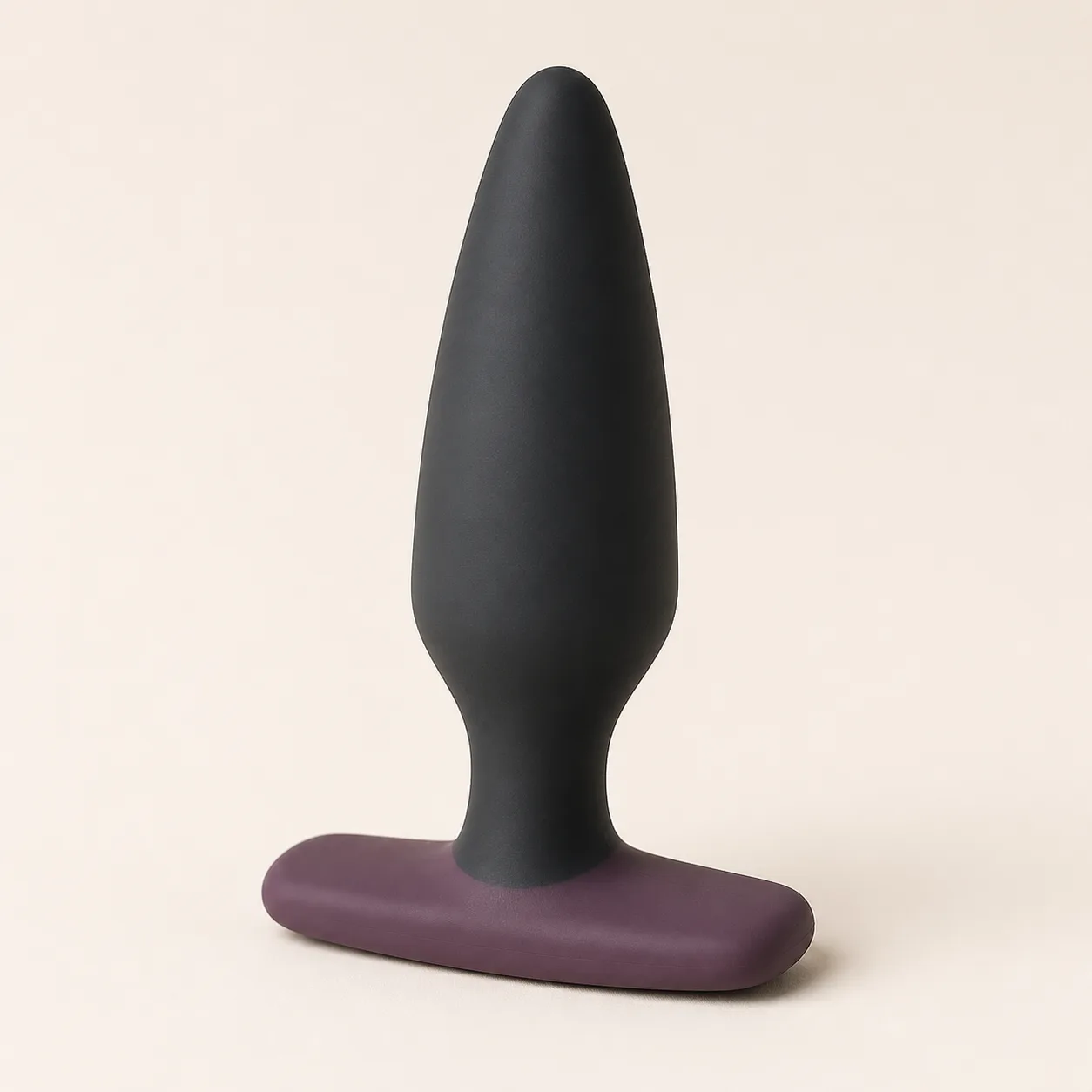
This five-segment variable-stiffness neck wand concept combines one broad smooth plum dome with exactly five rounded charcoal neck sections between head and handle. A low-profile spine slider crosses the middle segments and is intended to select one of three measurable stiffness states.

The image does not prove segment construction, stiffness, minimum radius, locking force, output, materials, ingress or manufacturing availability.
Inventory the head neck and locking spine
Require a bill of materials for dome skin and core, head carrier, segments S1-S5, joint shells, pivots or flexures, bushings, stops, internal spine, slider, detents, release tab, lock element, actuator, moving mass, controller, cell, buttons, indicators, conductors, strain reliefs, vent, contacts, seals, handle, coatings, pigments, lubricants and adhesives.
Trace the electrical and structural paths through every moving joint.
Measure neutral and bent geometry
Record overall length, handle diameter, head diameter and crown, segment lengths and radii, joint spacing, neck centerline, slider travel, release clearance, mass, center of gravity and base-contact position. Use a common datum.
Repeat at each lock state and after bounded bending, output, charging, cleaning and storage cycles.
Characterize the fixed dome surface
Measure crown radius, exposed area, hardness, compression, recovery, friction, edge blend and carrier seating. Inspect the skin and head-to-neck transition for thin zones, voids, hard inclusions, tack, pigment transfer, looseness and seam opening.
The head is treated as fixed until any separate articulation is confirmed by teardown.
Calibrate all five segment joints
For J1-J4 and both terminal transitions, measure rotation axis, range, friction, backlash, restoring force, stop position, lateral play and neutral repeatability. Map joint-gap change through the permitted arc.
Reject pin migration, guard lift, stop impact, progressive looseness, segment twist or a joint that folds into a sharp inner edge.
Calibrate the three-state spine slider
Record slider travel, detent force, release force, backlash, indication and actual neck bending stiffness at all three positions approached from both directions. Test false seating and partial engagement.
Reject lock drift, hidden intermediate states or a setting that concentrates bending into one joint.
Build multidirectional flex matrices
Apply controlled fore-aft, lateral, diagonal and torsional loads at the dome while measuring force, deflection, hysteresis, rebound, residual set and joint contribution. Repeat for every confirmed slider state.
Establish minimum bend radius and accepted load only from exact-sample data; visual curvature is not a safe-use limit.
Inspect conductors seals and fatigue paths
Map conductor length, routing, service loops, strain relief and abrasion contact through S1-S5. Inspect seals and internal spine interfaces during repeated bending and output.
Use continuity and insulation monitoring to detect intermittent opens, pinching, conductor work-hardening or seal displacement before visible failure.
Measure output transfer through the neck
Record three-axis acceleration, displacement, frequency, harmonics, rise, decay, sound and current at the dome, every segment and the grip for each program and slider state. Repeat free and under standardized compliant load.
Quantify damping, resonance, joint rattle and setting-dependent grip transmission rather than assuming a stiffer neck always increases contact output.
Map pressure angle and hard contact
Use a compliant instrumented surface to measure contact area, peak pressure, head angle, neck deflection and handle moment under centered and edge loads. State fixture stiffness and preload.
Reject head-carrier exposure, abrupt dome-edge loading, segment contact or a lock state that causes unstable rebound.
Screen joint gaps and cleaning access
Probe every segment seam, slider edge, release tab, head transition, controls, vent and base throughout the accepted bend range. Map pinch, shear, residue and moisture traps.
Validate a material-specific cleaning method and measured drying without flooding unverified moving joints or electrical seals.
Verify grip wrist torque and controls
Measure static balance, wrist moment, grip force, texture, orientation cues, control reach and accidental slider access. Document startup, levels, patterns, pause, immediate stop, memory and travel lock.
Confirm time to zero output from every mode and after slider movement, low voltage and power interruption.
Verify battery charging and ingress boundaries
Confirm cell chemistry, capacity, specified input, charge time, runtime, polarity, protection circuits, indication and charging interlock. Inspect current peaks while the neck is bent.
Map dome seam, all neck joints, slider, release, buttons, handle seam, vent and contacts. No water-resistance claim is accepted without exact-model evidence.
Log current sound heat faults and cycles
Measure current, A-weighted sound and temperatures at dome, actuator, S1-S5, joints, spine lock, controller, cell, grip, vent and contacts. Challenge excessive bend, restrained head, partial lock, high joint friction, low voltage and power interruption in protected fixtures.
Cycle output, stiffness changes, multidirectional flex, loading, charging, cleaning, drying and storage. Retire for torn skin, loose dome, joint play, pin migration, cracked segments, slider drift, conductor intermittency, delayed stop, exposed contacts, abnormal heat, cell swelling or residue.
Build landed price after neck validation
An Alibaba wand-massager page showed a 2-in-1 rechargeable category example at USD 7.50-8.61 with MOQ five. It is a benchmark only and does not confirm this five-segment stiffness-control architecture or an approved supplier.
The procurement reference supports an EUR 74.99 planning price after allowing for China-origin freight, exact-sample sourcing, head and segment metrology, joint and slider calibration, flex matrices, conductor-fatigue work, output, pressure, grip and wrist-torque mapping, charging, current, sound, heat, faults and cycles, protective packing and discreet fulfillment. Exact quotation, MOQ, materials, battery, packed size, weight, freight, duty, tax, insurance, payment fees, certifications and delivery terms remain pending.
Frequently asked questions
How flexible is each neck setting?
Force-deflection curves, hysteresis and minimum bend radius require exact-sample calibration.
Does the slider lock every joint?
The actual spine mechanism and joint contribution require teardown and distributed flex measurement.
Can neck joints pinch?
Every joint, slider edge, release and head transition needs probe screening through the accepted arc.
Does bending change vibration strength?
Dome output, neck damping, resonance and grip transfer must be measured at every state.
Is the wand waterproof?
No ingress claim is confirmed for the dome seam, moving joints, lock, controls, vent or contacts.
Which defects require retirement?
Torn skin, loose head, rising joint play, pin movement, cracks, slider drift, intermittent power, heat, swelling or residue.
Reviews
There are no reviews yet.