


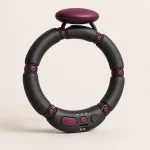
Six-Link Parallel-Motion Couples Ring with Floating External Pod
August 14, 2026
Black Satin-Mesh Longline Corset Bra and Cutout Thong Set
August 14, 2026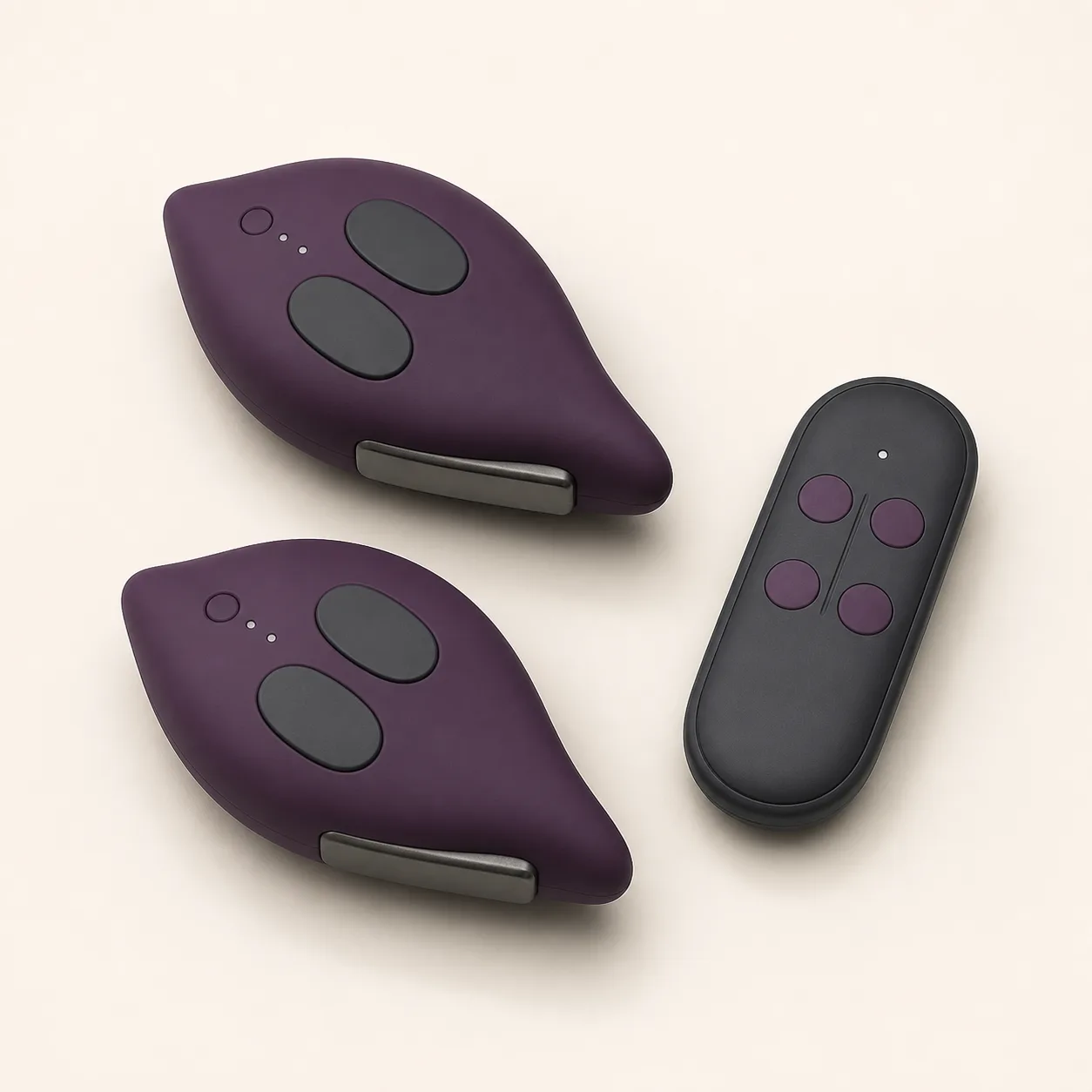
Dual-Module Magnetic-Link Couples Vibrator Set
A paired couples vibrator concept with two matching four-pad modules, local-stop controls, alignment plates and one four-button dual-channel remote.
79,99 $
200 in stock
Treat the paired modules as a matched system
This dual-module magnetic-link couples vibrator set concept includes two matching smoky-plum leaf modules and one four-button remote. Each module shows two raised charcoal contact pads, one gunmetal alignment plate, one recessed local-stop button and two indicator points.

The image defines component layout only. It does not confirm magnetic hardware, coupling strength, materials, motor output, synchronized control, radio range, battery, charging method or water resistance.
Identify module A, module B and the remote
Assign permanent A and B identifiers so dimensions, output, heat, battery condition and fault history can be traced independently. Pair the remote to the same lot and document any re-pairing procedure.
Matched appearance does not prove matched electronics or interchangeable control behavior.
Measure mirrored leaf geometry
Record length, width, thickness, mass, centre of gravity, edge radius, curvature and button position for both modules. Compare tooling deviation and whether each housing sits steadily on a flat inspection fixture.
The rendered proportions are not a size specification and should not guide fit or pressure claims.
Map four contact pads independently
Label pads A1-A2 and B1-B2. Measure profile, area, height, hardness, compression and edge transition, then test how shell curvature changes pad contact under bounded loads.
No anatomical target or universal fit is assumed. Intended positioning must be supported by measured samples and consenting-adult fit review.
Verify the magnetic-link concept cautiously
Determine whether each gunmetal plate contains a magnet, ferromagnetic target or purely mechanical alignment part. Measure attraction, shear resistance, pinch gaps, polarity, debris sensitivity and release force across repeated cycles.
Keep unverified magnetic components away from cards, electronics and medical implants; people with implanted devices must follow device-maker and clinician guidance.
Preserve immediate local stopping
Test each recessed module button from every operating state, including remote loss, low battery, pairing failure and linked configuration. A local stop must not depend on the other module or the remote.
Document short press, long press, lockout and restart behavior in a verified state table.
Map the four-button remote by channel
Label the two button columns for channel A and channel B only after firmware testing confirms their functions. Record power, intensity, pattern, combined commands and emergency stop without relying on button colour alone.
Check that commands cannot cross channels or activate both modules unexpectedly after reconnection.
Measure paired latency and synchronization
Record command delay, start-up skew, setting changes, drift, missed packets and stop timing with modules separate and linked. Repeat under direct line of sight, ordinary obstruction and common household interference.
Synchronized vibration, long-distance control, app support and Bluetooth remain unconfirmed unless the exact product demonstrates them.
Characterize output and sound per module
Measure frequency, acceleration, harmonics, rise, decay, current and sound at pads A1-A2 and B1-B2 for every verified setting. Compare modules at the same battery state and after extended cycling.
Quiet, powerful and balanced language requires test methods and numerical acceptance limits.
Validate batteries and charging as a pair
Confirm cell chemistry, capacity, protection, charge input, connector, charge time, runtime by setting, storage voltage and transport documentation for A and B. Track capacity divergence as the set ages.
No dock or cable appears in the image, so the charging architecture and included accessories remain pending.
Check heat, housing and internal restraint
Map temperature at both contact pads, plate, motor zone, cell zone and button during charging and operation. Inspect fasteners, adhesive, seals, motor retention, wire routing and magnet containment after drop and vibration tests.
Stop using either module after swelling, excess heat, rattling, plate movement, crack, corrosion or a changed odor.
Run a consent-led positioning review
Agree who controls each channel, establish a verbal and nonverbal stop signal and confirm both local-stop buttons remain accessible. Begin at the lowest verified setting and change one variable at a time.
Stop at pain, numbness, skin change, loss of control or unexpected activation. This product concept makes no medical or therapeutic claim.
Clean modules separately before linking
Follow confirmed cleaner, water, temperature and contact-time limits. Clean all pad edges, button recesses, housing seams, indicator points and alignment plates, then dry each module completely before the plates meet.
Keep the remote and unverified charge contacts dry. Immersion and running-water cleaning remain unavailable without ingress evidence.
Store without magnetic load or cross-contact
Power down A and B, separate their alignment plates and store them in divided protective compartments with the remote. Keep the set away from heat, sunlight, dust, keys, cards, electronics and unverified materials.
Repeat pairing, local-stop, plate and surface checks before every reuse.
Build landed price from a two-motor benchmark
An Alibaba wireless-vibrator category page displayed one two-motor remote product at USD 14.20 to 14.50 with MOQ 5. It is a broad category reference only and does not identify this dual-module magnetic-link concept.
The public procurement benchmark supports an EUR 79.99 planning price after provisional allowance for China-origin freight, two-unit teardown, mirrored metrology, four-pad mapping, magnetic-link, local-stop, dual-channel radio, paired-output, battery, heat, ingress, cleaning and packaging tests, discreet fulfilment and expected electronic handling loss. Exact supplier, quote, MOQ, specifications, packed weight, freight, duty, tax, certification, payment terms and lead time remain pending.
Frequently asked questions
How many vibration modules are included?
The concept contains exactly two matching modules plus one separate remote.
How many contact pads are shown?
Each module has two raised pads, making four pads across the set.
Are the alignment plates definitely magnetic?
The magnetic-link design is provisional; hardware type, strength, polarity and containment require sample confirmation.
Can each module stop locally?
Each concept module has one recessed button, but its stop behavior must be verified in every operating state.
Does the set support a phone app?
No app feature is claimed. Wireless protocol, range and supported controllers remain pending.
How is the set charged?
The image shows no charging accessory, and the final connector, cable and charge procedure require supplier evidence.
Reviews
There are no reviews yet.