


Twin-Scale Sliding Hobble Strap with Independent Ankle Cuffs
August 14, 2026
Reusable Writable Hook-and-Loop Charging Cable Labels
August 14, 2026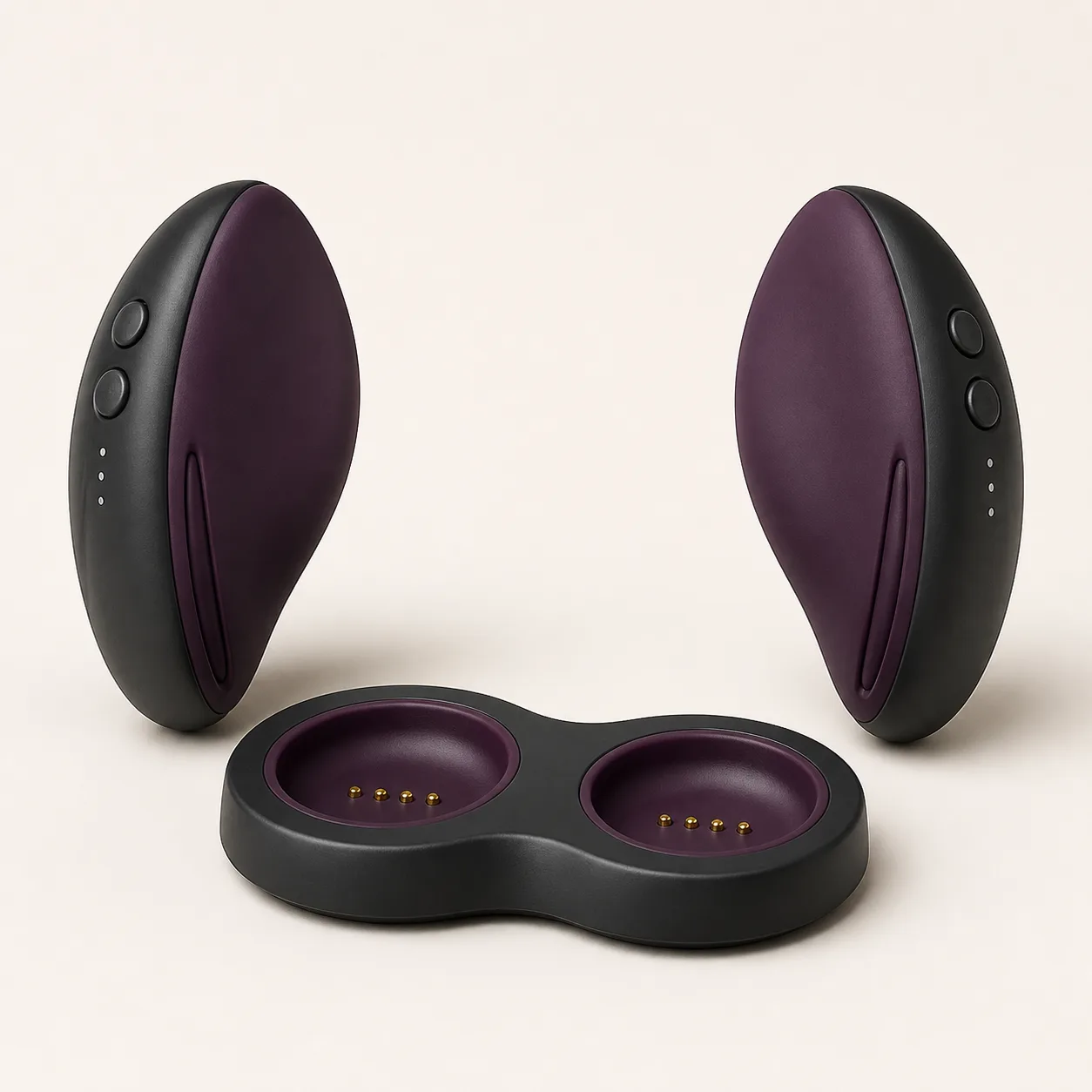
Mirrored Twin-Pod Couples Vibrator Set with Dual-Well Charging Dock
A matched couples vibrator concept with two mirrored palm pods, independent controls and a shared dual-well charging dock.
69,99 $
200 in stock
Compare a true mirrored two-pod system
This twin pod couples vibrator set concept pairs two palm-sized devices with opposite left and right grip geometry. Each pod has a broad contact face, tactile controls and its own indicators, while one figure-eight dock provides two dedicated charging wells.

The illustration does not prove motor count, paired programs, wireless protocol, range, charge sharing, runtime, ingress protection, material composition or supplier approval.
Audit every item in the proposed set
Request a complete bill of materials for pod A, pod B, contact-face skins, shells, grip spines, buttons, indicators, motors, counterweights, sensors, radios, antennas, control boards, cells, contacts, magnets, dock wells, dock board, input connector, seals, pigments, lubricants and adhesives.
Serial or lot identity must distinguish the two pods and the dock so mixed revisions cannot pass unnoticed.
Measure mirrored geometry, not visual symmetry
Record length, width, thickness, contact-face area, edge radius, grip-spine offset, groove depth, button spacing, indicator position, mass and center of gravity for both pods. Overlay scans after reflecting one model.
Quantify differences instead of assuming the left and right housings came from matched tooling.
Map each broad contact face
Measure profile height, surface flatness, edge transition, compression response and force distribution across a standardized compliant pad. Repeat at the tip, center and tail of each face.
Inspect for a hard shell edge beneath the facing, local thinning, trapped air or a seam that becomes prominent under compression.
Test grip and controls without sight
Record dry and damp grip force, one-handed orientation, button identification, hold duration, debounce, lockout, startup level, program order, adjustment direction, pause, immediate stop and memory on each pod.
Confirm a command intended for one unit cannot silently change the other unless paired control is deliberately selected and clearly indicated.
Characterize vibration pod by pod
Mount each device on the same compliant fixture and measure acceleration, dominant frequency, harmonics, rise time, decay, sound, current and shell movement for every verified local program.
Swap fixture positions and charge states to separate product variation from test setup. Publish tolerances only after enough production samples are measured.
Measure paired timing and cross-command behavior
If synchronized or relay modes are supplied, timestamp both outputs against every button event. Record startup skew, phase drift, command latency, dropped events, reconnect time and behavior when one pod changes locally.
Test identical, alternating and call-and-response patterns without describing a program from indicator flashes alone.
Stress wireless range and loss of link
Document protocol, pairing steps, stored identifiers, indoor line-of-sight range, obstructed range, interference response and any connected-service dependency. Repeat near common household radio sources.
Define the safe local state after lost link, depleted partner pod, dock power loss or controller reset. Immediate stop must remain available on each unit.
Validate both charging wells separately
Measure magnet alignment, contact polarity, seating force, false seating, debris tolerance and charge current in the left and right wells with both pod orientations. A pod should not appear docked while its contacts are open.
Test one-pod and two-pod charging, repeated reseating and mismatched states of charge while monitoring dock, contact and cell temperature.
Compare battery aging across the pair
Confirm cell chemistry, rated capacity, protection, input specification, charge time, runtime method, storage guidance and transport paperwork for each pod. Track capacity separately through cycling.
A shared dock can conceal unequal batteries; flag growing runtime spread, premature cutoff, self-discharge or one pod reaching full charge much earlier.
Map heat, sound and housing motion
Log temperature at both contact faces, grip spines, controls, charging contacts, cells and dock wells during long solo, synchronized and charging sessions. Record airborne and structure-borne sound at fixed distances.
Stop for abnormal heat, rattling, motor shift, shell opening, contact discoloration, swelling or an odor change.
Challenge seals, drops and transport loads
Ingress claims require exact evidence for each pod and the dock, including all buttons, seams, indicators and contacts. Perform controlled drop and vibration tests in minimum packaging before cosmetic claims are accepted.
Inspect internal mounts, cell restraint, antenna position, contact alignment and dock-well shape after every event.
Cycle pairing, use and docking together
Run repeated wake, local selection, pairing, synchronized command, link interruption, stop, cleaning, drying, docking, dual charging and storage cycles. At checkpoints repeat geometry, output, latency, sound, heat, grip and contact tests.
Retire any sample with drifting output, delayed stop, unstable pairing, exposed conductor, damaged face, loose motor, swollen cell, unreliable well seating or abnormal heating.
Clean two pods without contaminating the dock
Obtain exact surface and cleaner compatibility data first. Clean contact faces, edge seams, grip grooves, buttons, indicators and pod contacts by the approved method, then wipe the dock wells and contacts separately while unpowered.
Measure drying before docking. Residue or moisture trapped in a well can bridge contacts, hide debris and accelerate corrosion even when the pods appear dry.
Price the complete matched set
An Alibaba remote-control wireless vibrator listing currently shows a two-motor wearable category example at USD 14.20-14.50 with MOQ five. It is a category benchmark only and does not confirm this mirrored two-pod set, paired timing or shared dock.
The procurement reference supports an EUR 69.99 planning price after allowing for China-origin freight, matched-set sourcing, dual teardown, mirrored metrology, two-unit output testing, pairing and latency trials, dock validation, paired battery aging, thermal and acoustic review, cycle life, material evidence, cleaning validation, protective packing and discreet fulfillment. Exact quotation, packed size, weight, freight, duty, tax, insurance, payment fees and delivery terms remain pending.
Frequently asked questions
Are the two pods identical?
They are presented as a mirrored pair; exact geometry, output and firmware matching require sample comparison.
Do they synchronize automatically?
No pairing or synchronized mode is claimed until the protocol, controls, latency and loss-of-link behavior are verified.
Can either pod operate alone?
Independent local control must be confirmed for both units, including immediate stop without the partner pod or dock.
Does the dock charge both at the same rate?
Left-well, right-well and simultaneous current, heat and completion behavior need measured validation.
Can the dock be washed?
No ingress claim is made; clean only by the exact unpowered method documented for the production dock.
Which faults require retirement?
A damaged face, loose shell, delayed stop, unstable pairing, exposed conductor, corroded contact, swollen cell, unreliable docking or abnormal heat.
Reviews
There are no reviews yet.