



Four-Spoke Concentric-Oval Couples Ring with Crescent Twin-Pad Pod and Sliding Lower Clasp
August 14, 2026
P5196 Lace Six-Strap Garter Set: XS-S to 3XL-4XL
August 14, 2026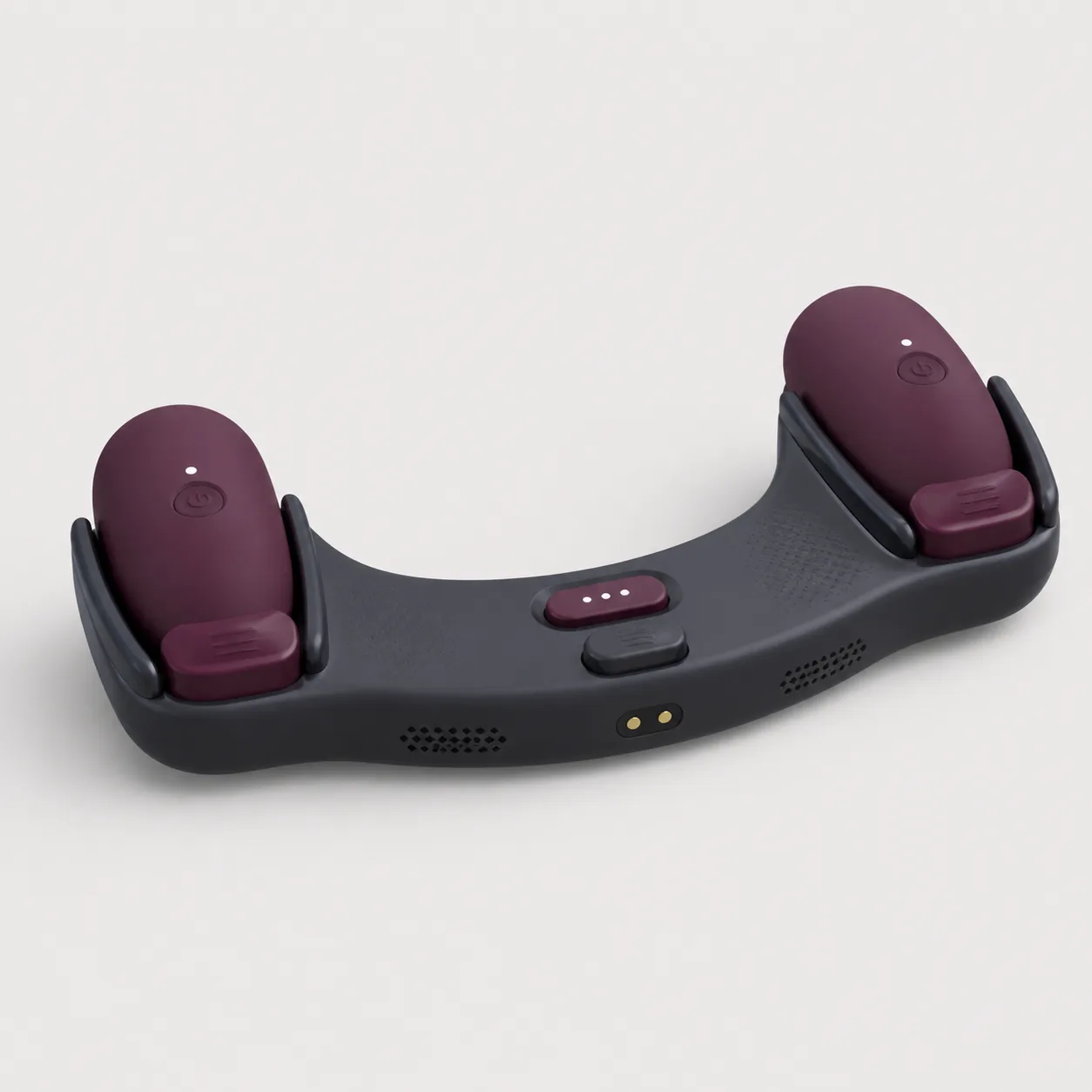
Twin-Pod Dovetail-Rail Couples Vibrator with Three-Stop Spacing Latch
A couples-vibrator concept with two oval contact pods seated in guarded dovetail-rail cradles on one curved bridge and a lockable three-stop spacing latch.
74,99 $
200 in stock
Seat two contact pods on one curved bridge
This twin-pod dovetail-rail couples vibrator concept places exactly two plum oval pods at opposite ends of one shallow charcoal crescent bridge. Each pod sits inside a guarded rail cradle with a broad release tab, while a center three-stop latch is intended to select the spacing state.

The image does not prove pod removal, rail profile, travel, retention, spacing range, motor count, synchronization, fit, materials, electrical safety, sealing or production availability.
Inventory both pods rails and bridge parts
Request an exploded bill of materials for pods A and B, contact skins, pod shells, actuators, moving masses, local controls, indicators, rail shoes, dovetail guides, shoulders, end stops, release tabs, springs, bridge frame, flexible cover, center latch, detents, lock tab, controller, cells, contacts, vents, conductors, seals, pigments, lubricants and adhesives.
Map all shared electronics and structural paths before treating the two ends as independent modules.
Measure bridge rail and spacing geometry
Record bridge length, width, thickness, neutral arc, pod center spacing, rail length, guide angle, shoulder height, end-stop position, center-latch travel, grip area, vent and contact positions, mass and balance. Measure assembled symmetry on a reference plane.
Repeat at every confirmed spacing state and after bounded flex, removal, charging, cleaning and storage cycles.
Characterize pod A and pod B
For each pod, measure major and minor axes, crown, edge blend, shell thickness, contact hardness, compression, recovery, friction, control recess, indicator visibility and mass. Preserve A/B identity in every test.
Inspect skins, rims and rail shoes for thin edges, voids, hard inclusions, tack, pigment transfer, looseness and uneven seating.
Verify dovetail engagement and retention
Measure insertion direction, lead-in geometry, engagement depth, running force, final seating, axial retention, lift-off retention, torsional play and false-seat cues for each cradle. Test dry and damp samples within conservative fixture limits.
Confirm that the rail cannot disengage merely because the bridge flexes or an end load rotates the pod.
Calibrate both release tabs and end stops
Record release force, travel, direction, response time, reset and access for tabs A and B. Check whether a gripping hand can press either tab accidentally and whether a blocked tab leaves an obvious state.
Inspect end-stop compression, rebound, wear and margin to the shoe; a worn stop must not expose a sharp guide or permit rail escape.
Calibrate the three-stop spacing latch
Measure latch travel, detent force, lock-tab action, backlash, indication and actual pod-center spacing at all three stops approached from both directions. Repeat under bounded symmetric and asymmetric bridge loads.
Reject ambiguous intermediate seating, center-lock drift or a setting that reduces rail engagement below the accepted retention margin.
Map bridge flex and spacing stability
Measure opening force, lateral deflection, torsion, springback, hysteresis, residual set and pod-angle change at each latch state. Apply center, end, diagonal and twisting fixtures without claiming a body-fit range.
Inspect rail roots, latch housing, bridge underside and cover for strain concentration, whitening, cracks or delamination.
Measure output at each pod and rail cradle
Record three-axis acceleration, displacement, frequency, harmonics, rise, decay, sound and current at pod A, pod B, both rail shoulders, center bridge and local controls for every confirmed program. Repeat free and under standardized compliant load.
Determine whether rail play or bridge flex changes output transfer, pod tilt or rattling over time.
Resolve synchronization phase and link loss
Synchronize both pod traces to measure command latency, startup skew, phase, beat frequency, drift, dropped transitions and parking behavior across range, charge and temperature. Document physical and electronic pod identity.
Confirm predictable local behavior after link loss, one depleted side, controller reset, pod release or latch adjustment.
Map two-pod pressure and load sharing
Use two independent compliant fixtures to record contact area, peak pressure, load sharing, bridge deflection, pod angle, rail movement and latch stability under equal, one-sided and alternating loads. State fixture stiffness and preload.
Reject hard rail-shoulder contact, unstable rocking, progressive shoe movement or concentrated edges within the accepted test envelope.
Screen rail gaps seams and cleaning access
Use articulated probes and soft film around guide entries, shoes, shoulders, end stops, releases, latch, lock, pod rims, controls, vents, contacts and bridge seams throughout adjustment and flex. Map capture and shear paths.
If pods are removable, validate access to both mating surfaces, a material-specific cleaning method, measured drying and an assembly inspection before reuse.
Verify controls batteries charging and ingress
Document local startup, levels, programs, pause, stop, memory and lockout for both pods. Confirm cell chemistry and capacity, specified input, charge time, runtime, contact polarity, protection circuits, simultaneous-charge rules and charging interlock.
Map every pod, rail, bridge, latch, control, vent and charging boundary. No ingress claim is accepted without exact-model evidence.
Log current sound heat faults and cycle wear
Measure current, A-weighted sound and temperatures at both pods, rail shoes, release springs, bridge roots, latch, controller, cells, contacts and vents under symmetric and one-sided loads. Challenge false seating, high rail drag, one restrained pod, latch mismatch, low voltage and power interruption in protected fixtures.
Cycle insertion, release, spacing, locking, output, load, charging, specified cleaning, measured drying and storage. Recheck geometry, retention, play, flex, phase, pressure, gaps, current, sound, heat and odor. Exact materials, restricted-substance and certification evidence remains pending.
Build landed price after rail and sync proof
An Alibaba wireless couples-vibrator page currently shows a rechargeable category example at USD 2.85-3.56 with MOQ one. It is a benchmark only and does not confirm this two-pod dovetail-rail assembly or an approved supplier.
The procurement reference supports an EUR 74.99 planning price after allowing for China-origin freight, exact-set sourcing, pod, bridge and rail metrology, release and spacing calibration, retention, flex, output, synchronization and pressure tests, charging, current, sound, heat, fault and cycle work, protective packing and discreet fulfillment. Exact quotation, MOQ, materials, batteries, software support, packed size, weight, freight, duty, tax, insurance, payment fees, certifications and delivery terms remain pending.
Frequently asked questions
Are the pods removable?
The concept shows release tabs, but actual removal, service limits and safe reassembly require exact-model confirmation.
What spacing do the three stops provide?
All center distances, latch tolerances and usable fit boundaries remain pending measurement.
Do both pods run independently?
Motor count, channel control and local behavior require teardown and output mapping for each identified pod.
Can the rails pinch?
Guide entries, shoes, shoulders, stops and release paths need soft-film and articulated-probe screening through adjustment and flex.
Is the assembly waterproof?
No ingress claim is confirmed; pods, rails, latch, controls, vents, contacts and bridge seams need evidence.
Which defects require retirement?
Cracked bridge sections, loose pods, worn shoes or stops, delayed releases, latch drift, unstable pairing, exposed contacts, abnormal sound or heat, cell swelling or persistent residue.
Reviews
There are no reviews yet.