



Navy and Silver Seven-Piece Bondage Set with Cross Connectors
August 14, 2026
Four-Spoke Torsion-Isolated Disc Wand with Indexed Output Ring
August 14, 2026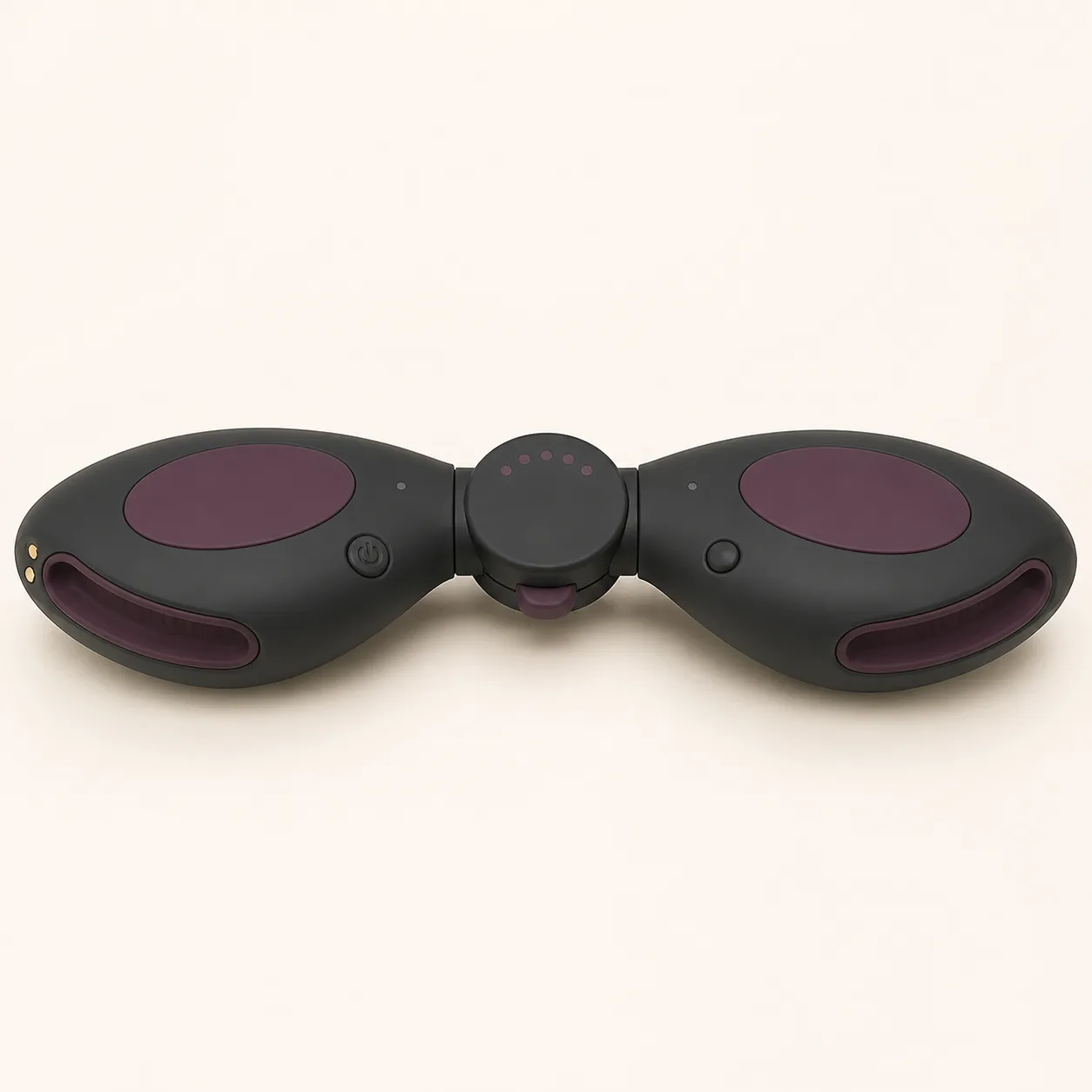
Mirrored Twin-Rocker Couples Vibrator with Five-Stop Center Hinge
A connected rechargeable couples vibrator concept with two mirrored rocker bodies and one indexed central hinge for separately testable pad geometry, angle, shared load and control behavior.
47,99 $
200 in stock
Join mirrored rocker wings at an adjustable center
This hinged couples vibrator concept connects two low crescent rocker bodies through one indexed center joint. Each side carries one broad contact pad and an outer grip inset, while separate button locations invite clear two-person control testing.

The image does not prove five usable positions, hinge range, latch force, motor count, independent controls, output, waterproofing, runtime, material or approved contact location.
Inventory the hinge and both load paths
Request an exploded drawing and bill of materials for both contact pads, rocker shells, grip insets, inner carriers, hinge leaves, center axle, bushings, index plate, detents, release tab, stops, conductor route, actuators, controller, battery, buttons, indicators, charging contacts, pigments, seals, lubricants and adhesives.
Identify which rocker houses the battery and how mass and electrical paths cross the center joint.
Measure mirror symmetry from the axle datum
Record each rocker length, width, depth, curvature, pad area and height, grip opening, control reach, hinge-leaf offset and mass. Measure both sides from the center axle rather than the outer shell edge.
Define acceptable left-right variation for geometry, weight and neutral alignment.
Map every indexed hinge position
Measure the angle, rocker-to-rocker span, pad separation, outer-edge separation and stop clearance at every confirmed position. Approach each index from opening and closing directions.
Check for backlash, overtravel, shell collision and a visual reference that does not match mechanical engagement.
Test the release tab and latch
Measure tab force, travel, detent depth, rebound, accidental activation resistance and latch engagement with the device unloaded and under small balanced or one-sided forces.
Document whether the hinge must be stopped and unloaded before adjustment. Reject any false-seated index that slips after the tab is released.
Measure both contact-pad geometries
Map pad length, width, curvature, edge radius, local height and transition into each rocker shell. Use surface scans to compare the left and right contact envelopes.
Inspect bonds, seams and any hidden hard support beneath the pad across the full hinge matrix.
Characterize output on the left rocker
Measure amplitude, frequency, startup, decay, sound and temperature at the left pad center, four quadrants, shell edge, grip and hinge leaf for every confirmed program and charge level.
Repeat at all approved hinge positions to capture joint preload and shell resonance.
Characterize the right pad and cross-coupling
Repeat the full map on the right side while synchronized sensors remain on both rockers and the axle. Compare phase, amplitude and transferred vibration.
Determine whether the two buttons select separate zones, shared programs or only power and mode. Visual placement is not control proof.
Apply balanced and asymmetric compliant loads
Use two instrumented compliant surfaces to load both pads evenly, then create controlled left-dominant and right-dominant conditions. Record contact area, pressure, hinge angle, latch movement, shell strain, slip, vibration loss, current, sound and temperature.
Stop for unexpected folding, index creep, hard collision, unstable rocker, sudden control change, unusual noise or heat.
Inspect hinge pinch and conductor strain
Screen gaps around the axle, leaves, stops and release tab with calibrated probes through every approved angle. Keep hair, film, jewelry and loose fabric away from the joint.
Use imaging or strain measurement to verify that repeated hinge adjustment does not fold, twist or abrade conductors or seals.
Resolve separate-control conflicts
Document responses to left and right button presses separately, together and in rapid sequence. Verify startup, stop priority, program order, debounce, lockout, memory and recovery after conflicting commands.
Before any shared trial, agree who can stop the device and keep both controls accessible.
Measure grip and handling at every angle
Use instrumented grip fixtures to measure pressure, slip, balance, outer-inset access and accidental button or hinge-tab activation with the rockers narrow, medium and wide.
Confirm a changing center of mass does not rotate the product out of either grip under approved low loads.
Track battery, current and heat by hinge angle
Confirm charger input, contact polarity, charge time, runtime, low-battery behavior and operation during charging. Keep the device off and dry while charging unless exact instructions state otherwise.
At every confirmed hinge setting, run the highest verified program under balanced and one-sided compliant loads while logging current and temperature at both pads, both actuators, hinge leaves, axle, controller, battery, grips and charging contacts.
Cycle the hinge, load and cleaning process
Run repeated index changes, tab releases, balanced and asymmetric loads, button conflicts, output, charging and cleaning cycles. At planned checkpoints inspect pad bonds, rocker alignment, axle play, detent force, stops, conductor strain, output, current and heat.
Obtain the exact cleaning method and ingress rating. Clean both pad edges, grip insets, buttons, hinge gaps, tab recess and charging contacts with approved tools, then dry all joint cavities.
Price after the complete position matrix
An Alibaba foldable couples vibrator listing currently shows USD 14.50-16.50 with an MOQ of one. It is a category benchmark only and does not confirm this mirrored twin-rocker hinge, five-stop index or approved supplier.
The procurement reference supports an EUR 47.99 planning price after allowing for China-origin freight, complete part inventory, symmetry inspection, five-position metrology, tab and latch tests, two-pad output maps, cross-coupling analysis, balanced and asymmetric load checks, pinch and conductor review, control-conflict logic, grip testing, electrical and thermal analysis, full mechanism cycling, materials and battery evidence, cleaning validation, protective packing and discreet fulfillment. Exact quotation, packed dimensions, weight, freight, duty, tax, insurance, payment fees and delivery terms remain pending.
Frequently asked questions
Are there exactly five usable hinge angles?
The visible references suggest five, but production positions and tolerances require measurement.
Can the joint be adjusted while powered?
Keep it stopped and unloaded unless exact-model instructions and tests confirm another procedure.
Does each rocker have independent vibration?
Motor count and control separation remain pending teardown and synchronized output tests.
Which person controls the device?
Control priority must be documented and agreed before shared operation.
Can the hinge be rinsed?
Only after ingress protection, cleaning tools and full joint drying are verified.
Which faults require immediate retirement?
A slipping index, loose axle, cracked leaf, blocked tab, torn pad, exposed conductor, unstable control, unusual noise, heat, swelling or corrosion.
Reviews
There are no reviews yet.