


Mirrored Twin-Rocker Couples Vibrator with Five-Stop Center Hinge
August 14, 2026
Y.Love YAI66W 027 Pink Wireless Remote Vibrating Egg
August 14, 2026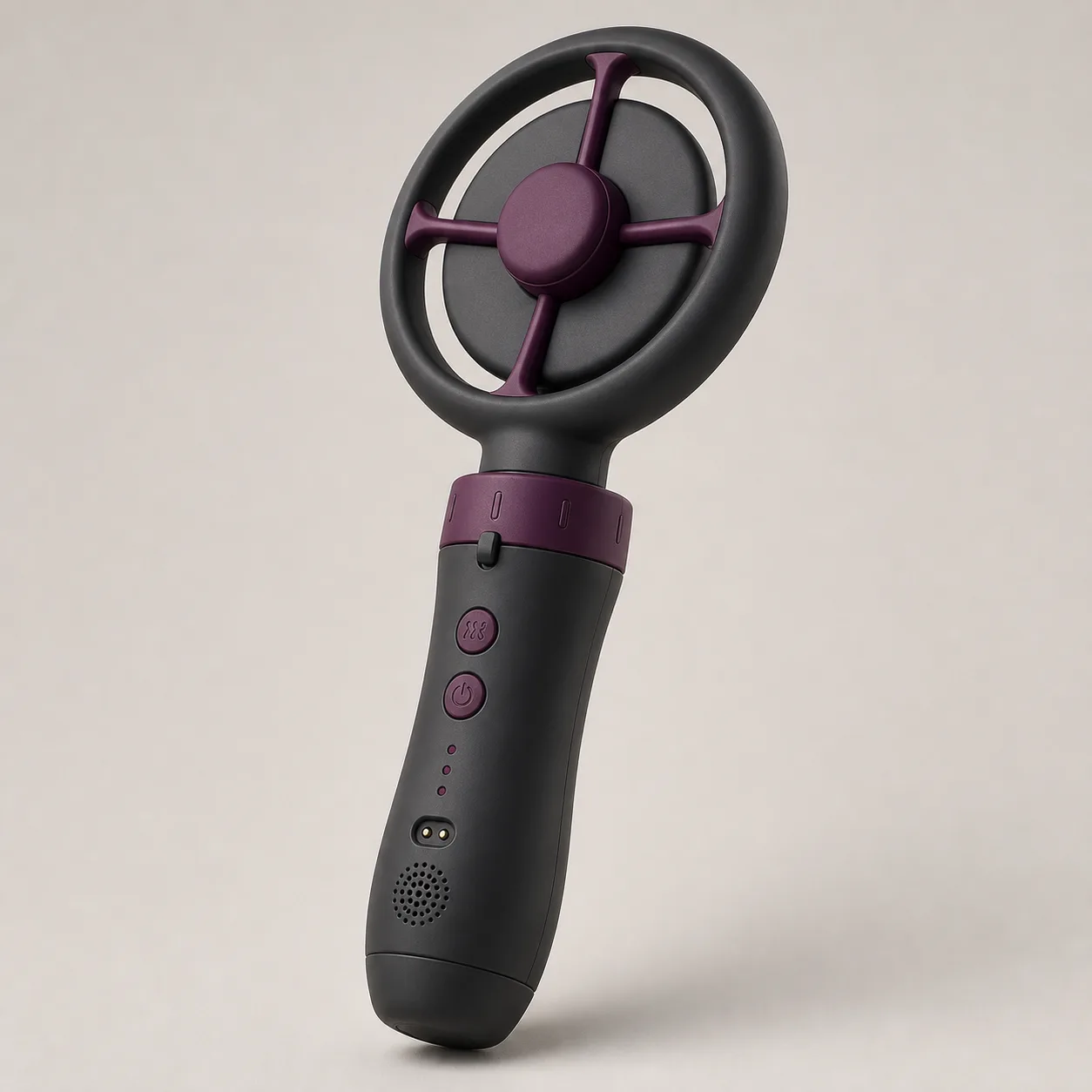
Four-Spoke Torsion-Isolated Disc Wand with Indexed Output Ring
A rechargeable wand concept with a broad disc suspended on four curved torsion-isolation spokes, a central hub and a lockable three-stop output ring.
58,99 $
200 in stock
Suspend a broad disc on four torsion spokes
This four-spoke torsion-isolated disc wand concept places a broad charcoal massage face inside a rounded guard rim. Four curved plum spokes connect the disc to a central motor hub at quarter-turn intervals, while an indexed output ring and lock tab sit between the short neck and tapered handle.

The image does not prove spoke stiffness, isolation, disc travel, output, dimensions, materials, electrical safety, sealing, noise or production availability.
Inventory the isolated head and handle
Request an exploded bill of materials for the soft face, backing disc, guard rim, central hub, spokes S1 through S4, spoke roots, retainers, neck, indexed output ring, three detents, lock tab, two buttons, indicators, motor, eccentric mass, board, cell, contacts, vent membrane, handle shells, end cap, seals, fasteners, pigments, lubricants and adhesives.
Match every component to drawings, tolerances, batch records and the approved sample.
Establish head handle and mass geometry
Measure face diameter, active area, crown, edge radius, rim diameter, rim clearance, disc thickness, hub offset, spoke angles, spoke sections, neck length, ring width, handle axes, overall length, mass and center of gravity. Record head alignment in neutral orientation.
Repeat critical dimensions after conditioning and cycle tests to detect permanent tilt or spoke set.
Map the entire disc face
Use a coordinate fixture to record face flatness, local compliance and edge blending on a grid. Under several controlled preloads, measure contact area, pressure uniformity, hub print-through and any hard transition near the outer rim.
A broad visual surface is not evidence of even contact pressure.
Characterize spokes S1 through S4
For each spoke, measure free shape, cross-section, root radius, bending stiffness, torsional stiffness, damping, surface strain and permanent set. Inspect seams, voids, thin regions, hard inclusions, pigment transfer and root separation.
Compare opposite and adjacent pairs so one stiff spoke cannot hide inside an averaged result.
Quantify torsion isolation and disc travel
Apply a calibrated angular input at the hub and map disc rotation, tilt and translation while the rim remains fixed. Record phase lag, damping ratio, travel limit and restoring torque across operating frequencies.
Verify that isolation does not allow the face to strike the rim or overstrain a root.
Inspect all rim and spoke clearances
Probe full-circumference disc-to-rim, spoke-to-rim, spoke-to-disc, hub and neck gaps while neutral, preloaded, tilted and operating. Use articulated gauges rather than fingers and inspect for residue paths after cleaning.
Accessible moving gaps, rim contact or concealed sharp retainers require redesign.
Calibrate the indexed output ring
Measure ring rotation, three detent angles, torque, hysteresis, repeatability and end-stop margin. Approach every stop from both directions while logging motor command and disc output.
Each tactile mark needs a documented setting; an intermediate position must not create unstable operation.
Verify the ring lock tab
Measure tab travel, force, engagement depth and resistance to accidental contact. Apply conservative torsional disturbance to the ring while locked and repeat after dust, approved cleaner and cycle conditioning.
The lock must not obstruct the neck, controls or a rapid power-off action.
Map vibration from hub to face and handle
Measure tri-axial acceleration at the hub, face center, four face quadrants, rim, neck, output ring and several grip points for each mode and ring stop. Record dominant frequency, harmonics, phase, repeatability and left-right symmetry.
Compare face energy with handle transmission to establish whether the four spokes actually isolate the grip.
Test preload orientation and edge contact
Use instrumented compliant pads at centered, quarter-offset and rim-adjacent positions. Increase preload conservatively while recording contact area, pressure, output, disc tilt, spoke strain, rim approach and motor current.
Stop before hard contact, spoke inversion, persistent tilt or an abrupt pressure peak.
Verify controls charging and shutdown
Identify button functions, indicator patterns, lock sequence, charging-contact polarity, specified lead, charger limits, cell protection and low-voltage response. Interrupt power at every mode and ring stop and confirm a predictable off state without unwanted restart.
Moisture and sealing claims remain pending until the face, hub, neck, ring, buttons, contacts and vent are tested.
Measure current runtime sound and heat
Log input current, runtime, accessible temperatures, hub and spoke-root hot spots and A-weighted sound at a defined distance for every mode and representative preload. Repeat after a conservative blocked-disc simulation and low-cell condition.
Investigate chatter, rising current, asymmetrical heat, ring drift, changing pitch or intermittent control behavior.
Challenge one stiff spoke and cycle the assembly
Add bounded stiffness to one spoke in a protected test mechanism and monitor disc tilt, pressure, output phase, rim clearance, root strain, current, sound and handle transfer. Stop before damage and quarantine any sample with spoke separation, hub shift or rim contact.
Run repeated operation, output-ring indexing, locking, controlled preload, charging, cleaning, measured drying and storage. Recheck geometry, spoke stiffness, gaps, face pressure, vibration mapping, controls, electrical condition and seams at scheduled intervals.
Build landed price after isolation proof
An Alibaba wand-massager page currently shows a two-in-one rechargeable category example at USD 7.50-8.61 with MOQ five. It is a benchmark only and does not confirm this four-spoke isolated disc, indexed output ring or an approved supplier.
The procurement reference supports an EUR 58.99 planning price after allowing for China-origin freight, exact-model sourcing, head metrology, four-spoke characterization, isolation and clearance tests, face-pressure mapping, output-ring calibration, vibration transfer analysis, electrical review, current, sound and heat measurements, fault and cycle testing, protective packing and discreet fulfillment. Exact quotation, MOQ, materials, battery, packed size, weight, freight, duty, tax, insurance, payment fees, certifications and delivery terms remain pending.
Frequently asked questions
Why does the head use four spokes?
The concept uses four torsion elements to support and isolate the disc; measured stiffness and phase data are still required.
Can the disc touch the outer rim?
It should not during approved operation, but full-clearance tests under tilt and preload must confirm this.
What does the indexed ring change?
Its three settings require calibration against motor command, disc acceleration and handle transfer.
Is the broad face evenly compliant?
Grid-based pressure and displacement mapping is needed to reveal hub print-through or edge stiffness.
Is the wand waterproof?
No sealing claim is confirmed; all head, neck, ring, button, contact and vent interfaces need evidence.
Which faults require retirement?
Spoke tears, hub shift, rim contact, permanent disc tilt, ring drift, failed locking, exposed contacts, abnormal heat, swelling or persistent residue.
Reviews
There are no reviews yet.